A cavalcade across the US-Mexico border

 Ángel Estrada Soto
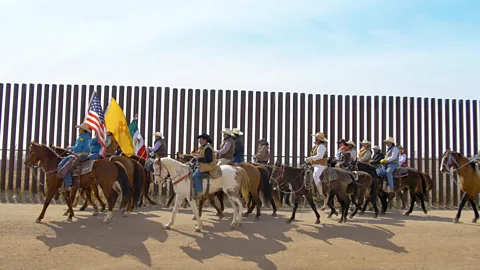
Every year, riders on horseback gallop over the border to honour the nations’ shared past.
 Ángel Estrada Soto
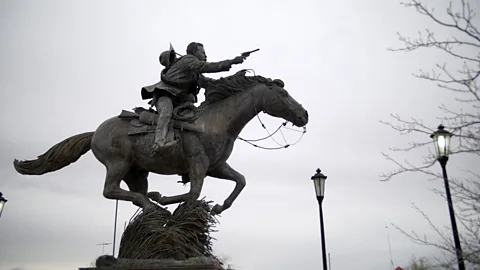
In the hours before dawn on 9 March 1916, Mexican revolutionary Pancho Villa and some 500 soldiers stormed into the US frontier town of Columbus, New Mexico, three miles north of the Mexican border, shouting, “Viva Villa! Viva Mexico!”. What started as a night-time raid thought to be in search of food, horses and weapons quickly escalated into a full-scale battle, with Villa’s troops torching much of the 300-person settlement before being forced back across the border by members of the US Cavalry stationed in the town.
In all, more than 100 of Villa’s troops and at least 14 Americans died in The Battle of Columbus. The foreign invasion prompted then-US president Woodrow Wilson to send thousands of troops to secure the southern border. More than 100 years later, dozens of horse riders continue to gallop across the border at Puerto Palomas, Mexico, every March and sweep into Columbus to commemorate the event – only now, they come in peace.
 Ángel Estrada Soto
For the last 20 years, Mexicans and Americans on both sides of the border have chosen to remember the bloody battle by banding together to host the solemn and celebratory Binational Pancho Villa Cavalcade of Horses. The event, which is held the closest weekend to 9 March when Villa led his surprise attack, began in 1999 to honour the two nations’ enduring friendship and the region’s shared history.
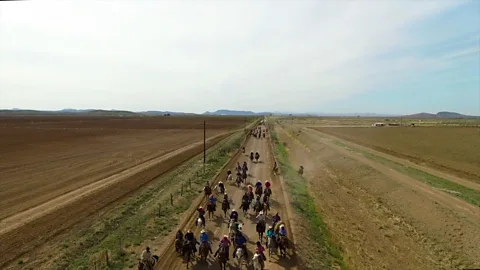
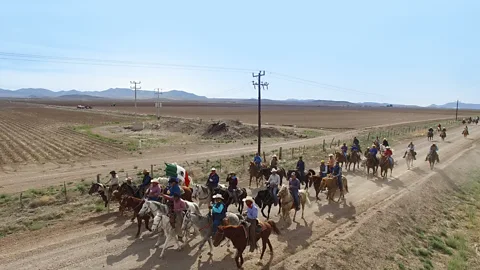
The cavalcade (or 'cabalgata’, as it’s largely known) starts 280 miles south of Columbus in the town of Vicente Guerrero in Mexico’s mountainous Chihuahua region, and slowly winds 350 miles north in a procession that lasts between 15 and 17 days. The first stretch of the journey is slow-going, as the horses slowly climb the Sierra Madre Occidental mountains. After about 10 days, the cabalgata reaches the dusty town of Janos and heads into the desert south of Puerto Palomas before finally crossing the border, where American reenactors on horseback join them for the final gallop into Columbus’ town square.
 Ángel Estrada Soto
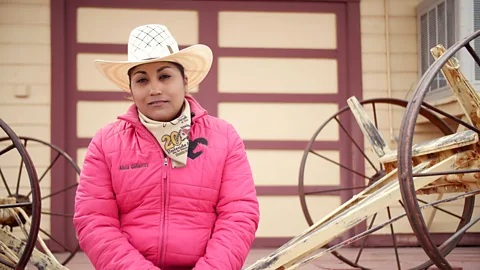
To me, this cavalcade has a sense of friendship and brotherhood. Not just among horsemen, but between two countries,” said Alicia Gutierrez, who has participated in the cavalcade since it began 20 years ago.
 Ángel Estrada Soto
Today, historians on both sides of the border remain unsure of what led Villa to raid the small US town. A revolutionary, military leader and bandit often referred to as Mexico’s Robin Hood, Villa had lost much of his support and troops by 1916. Some experts believe he was driven to the military garrison at Columbus in search of food, horses and weapons. Others argue that Villa thought Mexico’s president, Venustiano Carranza, had agreed to hand over the country to the US, and his raid was an attempt to jeopardise the nations’ pending union.
Villa expected his men would encounter 50 armed soldiers in Columbus, but they were greeted by 350. After driving the Villistas back into Mexico, the US sent 10,000 soldiers 400 miles south to hunt down and capture the revolutionary. After 11 months of searching unsuccessfully in Chihuahua’s mountains, the troops withdrew empty handed.
 Ángel Estrada Soto
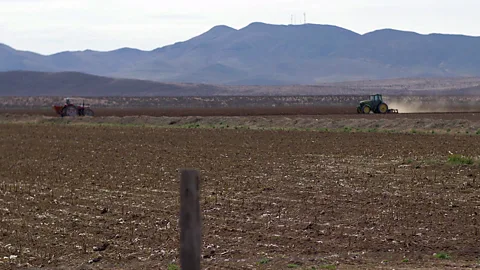
Today, Columbus remains a sleepy 1,000-person farming community where people of predominantly Mexican origin harvest chillies and onions much of the year, migrating to cities each winter in search of work. The town’s torched foundations were rebuilt long ago, and despite opposition from descendants of those killed in the raid, Pancho Villa State Park was inaugurated in 1959 at the site of the old garrison, along with a museum filled with historical photos and artefacts from the battle.
Over time, Columbus’ residents have embraced their tiny town’s major role in US and Mexican history. “People don’t really know Columbus for Columbus,” said Norma Gomez, secretary of the Columbus Chamber of Commerce and a Cavalcade organiser. “People know Columbus for Pancho Villa. He is the main attraction here.”
The idea to heal old wounds and commemorate The Battle of Columbus with a binational cavalcade goes back to 1966, when the state governments of Chihuahua and New Mexico first hosted the Fiesta de la Amistad (Celebration of Friendship). Permit difficulties halted the procession for the next 33 years until Allen Rosenberg, then-chairman of the Columbus Historical Society, resurfaced and relaunched the celebration in 1999 as the Binational Pancho Villa Cavalcade of Horses.
 Ángel Estrada Soto
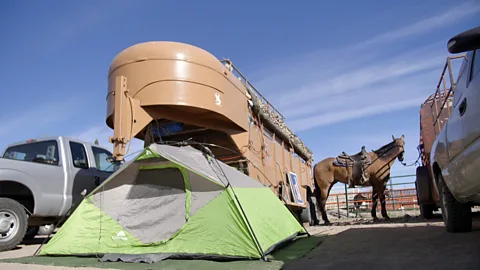
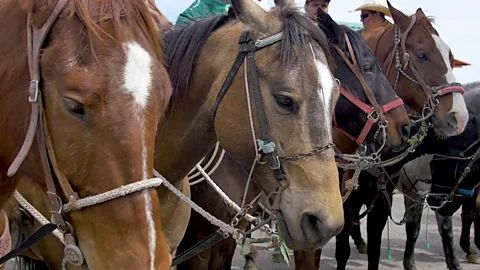
Once riders mount their steeds in Vicente Guerrero, police and government officials slowly escort the cavalcade north through each town, using funds from each town’s treasury to feed both the riders and horses. Of the roughly 80 riders who cross the border into the US at Puerto Palomas, only about 30 complete the full 15- to 17-day journey. Instead, new riders join the caravan at each stop along the way, and villagers often line the roads to cheer them on and throw parties in their honour.
Trotting 350 miles is more than just physical effort. For two weeks, people must leave their jobs, sleep in tents at RV parks and pay to transport their horses back home once the cavalcade ends. Yet, cavalcades are a proud and deep-rooted tradition in Chihuahua. Participating not only gives local riders a sense of community, but also allows men and women to demonstrate their rugged equestrian skills. Furthermore, Pancho Villa is still greatly admired by many Chihuahuans, and to take part in a cavalcade in his name is considered a great honour.
 Ángel Estrada Soto
During the first cavalcade in 1999, US Customs didn’t grant permission for horses to cross the border, so after galloping some 350 miles north, Mexican riders had to leave their steeds at the immigration crossing in Puerto Palomas and walk across the border. Once in the US, members of the Columbus Historical Society and Chamber of Commerce met the riders with 90 horses so that the Mexicans could ride from the border to Columbus’ central square.
Until 2001, Mexican riders didn’t need a visa to enter the US for the festival, but instead applied for a special permit. This all changed after the 9/11 attacks, and now only those with the proper documents can cross the border. The Mexican horses are also examined by US health inspectors to guarantee that they don’t have any disease they could pass along to American horses.
 Ángel Estrada Soto
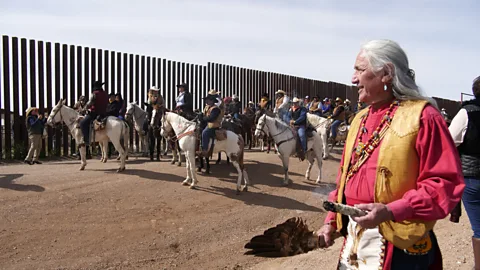
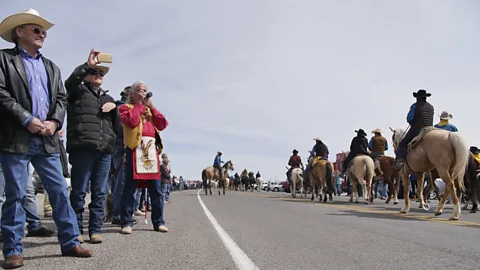
This year, a record 375 Mexican and American horsemen took part in the cavalcade, and an estimated 3,500 visitors from across the south-west US and Mexico filled every hotel and RV park in Columbus for the event – providing a much-needed economic boost to one of the US’ poorest communities.
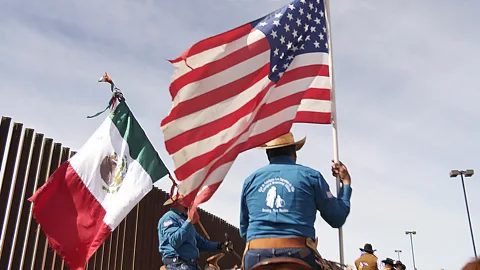
Once the Mexican riders joined their American brethren on US soil, the two sides galloped down Columbus’ Main Street together amid a sea of camera-toting onlookers towards Columbus’ main square. Mexican riders were then offered a meal by Columbus’ Chamber of Commerce, and after a memorial ceremony remembering those who died in the raid, a giant party erupted and people from both countries ate, danced and listened to live music together.
Many riders clad in cartridge belts, cowboy boots and sombreros serve as historical reenactors during the festival each year – and no-one is more popular than the event’s protagonist, Pancho Villa.
 Ángel Estrada Soto
This is strictly for friendship, also one of our goals is promote trade between our countries,” said Allen Rosenberg, founder of the Cavalcade.
 Ángel Estrada Soto
In the last few years, the US-Mexican border has taken centre stage in American politics. According to Gomez, securing permits for Mexican riders to enter Columbus has become increasingly difficult since Donald Trump became president.
But in a highly charged political era, when talks of walls and threats of foreign invasions have divided many American communities, this binational celebration is a reminder that many people along the US-Mexican border share a common history and fondness for their neighbours. If the descendants of those who died on both sides in The Battle of Columbus can look towards the future as friends, perhaps this tiny town can play a big role in US-Mexican history yet again.
Breaking Barriers is a BBC Travel series featuring inspiring tales of unity and humanity in theatres of dispute and division.
