The people who live with tigers

 Arindam Bhattacharya/Alamy
In the dense mangrove forests straddling the India-Bangladesh border, tigers and a mythical goddess unite Hindus and Muslims.
 Kalpana Pradhan
Straddling the border of India and Bangladesh in the Ganges Delta, the Sundarbans are the world’s largest mangrove forest – a vast Unesco-inscribed wonderland of tidal waterways and mudflats. Meaning ‘beautiful forest’ in Bengali, the Sundarbans encompass hundreds of islands and stretch out over 10,000 sq km in an area that’s larger than Cyprus.
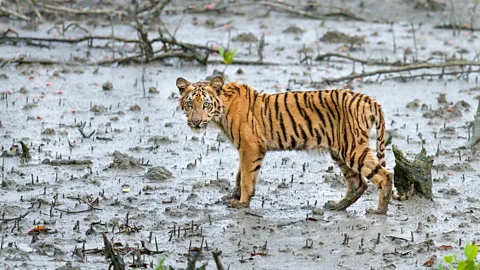
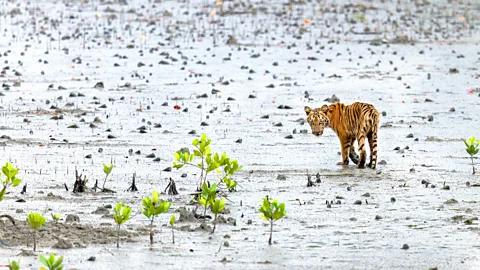
This dense network of swamps and thickly forested islets is home to around 50 species of mammals, 315 types of birds and 59 varieties of reptiles. Yet, it’s perhaps most famously known as one of the last habitats of the Royal Bengal tiger. For hundreds of years, the powerful predator has coexisted with people in a delicate dance: it lurks deep in the forest’s depths, swims from island to island and has been known to attack anything – or anyone – that ventures too close.
 Images & Stories/Alamy
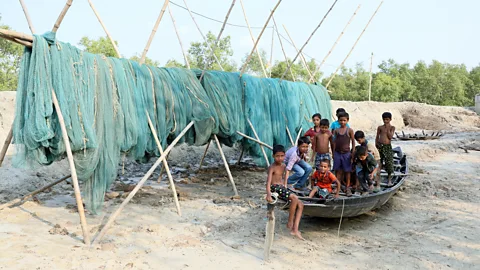
Throughout the Sundarbans, many of the area’s 4.5 million residents survive by fishing in the murky channels or wandering deep into the forest to collect wood or honey. Working in the forest is not only difficult but incredibly dangerous, as crocodiles, snakes and tigers regularly kill villagers. In fact, every year the tigers attack up to 60 people, and many victims don’t survive.
 Kalpana Pradhan
Despite the many dangers looming in the jungle, there’s one thing that unites the villagers of these rural communities: the blessings of Bonbibi, goddess of the forest. For centuries, this venerated deity has been called upon for protection by both Indians and Bangladeshis, Hindus and Muslims, and rich and poor before heading into the forest.
In many ways, Bonbibi’s role as a unifying goddess and guardian makes perfect sense, given the unique physical and cultural landscape of the region: here, three major rivers join the Bay of Bengal; the boundaries between channels and banks blur with each storm; and Hindus and Muslims have peacefully cohabitated in these thick coastal jungles for hundreds of years.
 Kalpana Pradhan
We go to the forest with our Muslim friends and we always stay together. In case of any tiger attack, we would not face difficulty if we are together. The tiger cannot harm us if we remain united,” said Sambhu Nath Mistri, a Hindu fisherman from the village of Mitrabari.
 Arindam Bhattacharya/Alamy
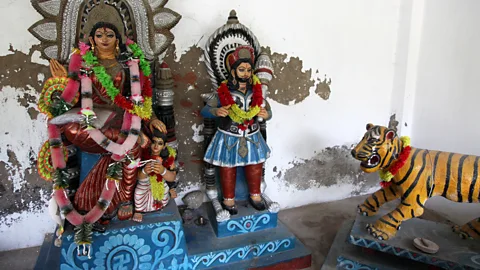
Meaning ‘lady of the forest’, Bonbibi is believed by Hindus and Muslims to have been sent from the heavens to protect them. According to popular legend, she was born a Muslim in Saudi Arabia, and after travelling to Mecca she was bestowed with supernatural powers that carried her 5,000km east to the Sundarbans.
When Bonbibi arrived, she saw that the forest was filled with man-eating tigers and ruled by a demon named Dakshin Rai. Bonbibi overthrew Dakshin Rai and spared his life after he promised to stop letting tigers kill people. Bonbibi became the supreme ruler of the forest and is now worshipped by loyal legions, while Dakshin Rai escaped to the dark reaches of the jungle and is believed to now appear in the guise of an attacking tiger.
 Pallava Bagla/Getty
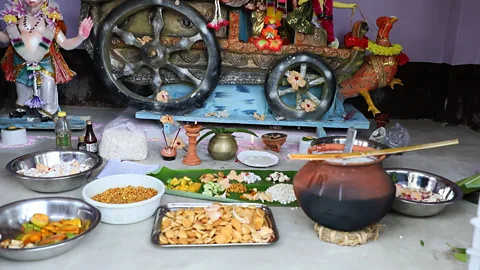
Unlike Hindus, Muslims do not workshop idols – in fact, it’s strictly banned. But nearly every village scattered across the Sundarbans in India and Bangladesh has a Bonbibi shrine placed at the entrance of each village, and Muslims join their Hindu neighbours in donating money to buy milk, fruit, sweets and other offerings for the deity. These offerings, known as bhog, are laid at the feet of a village’s Bonbibi shrine in Hindu tradition, and the suffix ‘bibi’ is often used as part of the surname of sacred Muslim women.
As part of the annual Bonbibi Festival, which takes place between January and February, depending on the village, Hindu and Muslim villagers congregate at each village’s tiny Hindu temple to hear the saga of how Bonbibi conquered Dakshin Rai. Women fast from sunrise until twilight, believing that the abstinence will protect their families from harm. Permanent Bonbibi shrines are usually placed within each village, though many temporary ones are scattered throughout the nearby forests.
“I hear there is communal tension in many places in the country,” said Hazarat Gazi, a villager from Dayapur on Satjelia island. “But we do not have any problem with our Hindu friends. In our Islamic religious festivals, we invite our Hindu neighbours, too. It is local tradition.”
 Kalpana Pradhan
Beyond the annual festival, whenever fishermen or honey collectors need to go into the jungle, they stop at their village’s Bonbibi shrine and make a promise to the goddess not to take more from the forest than they need. Local women are known to offer flowers to Bonbibi on certain auspicious days to bring good fortune to their households.
While villages throughout the Sundarbans worship Bonbibi, those located in the lower islands tend to follow a more traditional form of worship, placing offerings like rice pudding near simple shrines sheltered by hay roofs and bamboo poles. Villages in the upland islands are known for flashier festivals and celebrations, in which the Bonbibi deity stands atop a tiger and wears elaborate garlands.
 Dinodia Photos/Alamy
Despite being a Muslim, we take part in the [offering]. We believe that the goddess Bonbibi can protect us from all dangers while we enter the forest,” Gazi said.
 Kalpana Pradhan
As modernity slowly creeps into the jungle, Bonbibi’s role as a dual-faith deity may be under threat. Reports suggest that some Hindus are unhappy about a Hindu goddess whose name and ‘bibi’ suffix evoke a sacred Muslim woman, and have relegated the shrine to the side of several temples. And certain groups of Muslim Bengalis may be turning their backs against the practice of idol worship.
What’s more, according to Niranian Raftan, a forest guide from the village of Jamespur on Satjelia Island, communities are growing increasingly concerned about foragers breaking their oaths to Bonbibi and taking more than they need from the forest. Raftan claims that a sense that greediness among villagers is rising, the forest’s natural resources are dwindling and this is what has led to a recent increase in tiger attacks.
 Kalpana Pradhan
In the village of Mitrabari, where most residents survive by fishing, farming and honey collecting, many women have lost their husbands and sons in tiger attacks. Among them is Bula Rani Mondol, a woman now in her 50s whose husband went into the forest to collect honey and was mauled to death by a Royal Bengal tiger.
“After I lost my husband, I’ve had problems [providing for] my small daughters and son,” she said. “I am aware of the consequences of going to the forest. But despite knowing the fate, I am forced to go to catch crabs.”
In recent years, a combination of increased deforestation and land erosion and the resulting reduction of Royal Bengal tigers’ habitat has led to the large cats entering coastal villages and attacking people. With the help of villagers, local forest departments have been tasked with capturing tigers using tranquilliser darts and then releasing them back to the forest.
 Kalpana Pradhan
Royal Bengal tigers are known for their intelligence and typically attack their prey from behind. To mislead the animal, many honey collectors and fishermen throughout the Sundarbans wear a mask on the back of their head. “Since the attack comes from the back, wearing the mask in the back often confuses the tiger,” said Subhas Mondol, a young villager from Mitrabari who lost both his father and uncle in tiger attacks while they were collecting honey in the forest.
“I know there is high risk in the forest and there can be tiger, crocodile or snake attacks anytime, but we do not have any other options,” Mondol said. “We are forced to go [into] the forest and we are confident Bonbibi would save us from all dangers.”
Today, the future of these endangered tigers and this sacred deity may be in jeopardy. But as long as people and predators live side by side in the Sundarbans, chances are that Bonbibi will be there, quietly watching over anyone who seeks her protection.
Breaking Barriers is a BBC Travel series featuring inspiring tales of unity and humanity in theatres of dispute and division.
