Why a group of hippos is called a bloat

 Graham Prentice/Alamy
The legacy of a 15th-Century noblewoman lives on in the form of collective nouns used to describe groups of animals across the world.
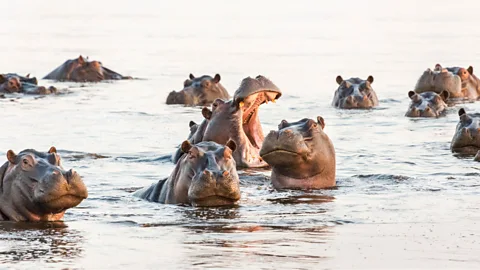
“Do you know what those are called?” the safari guide at Botswana’s Chobe Game Lodge queried while I watched a large group of hippos unabashedly bathing in the waters of the Chobe River. “A bloat of hippos!” he answered rhetorically with the grin of a man who knew this tidbit of information would delight his guests.
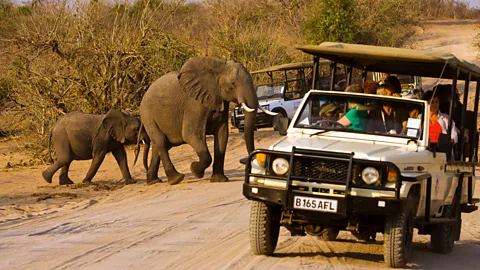
My smile matched his as I laughed at how apropos the word seemed at describing this mass of bulky beasts. ‘A bloat of hippos’ was a witty and whimsical linguistic contrast to the almost Orwellian ‘nest of vipers’ and ‘murder of crows’ that I had always attributed to poetic license. But along came ‘a tower of giraffes’, ‘a confusion of wildebeests’ and, reposed contentedly under the blazing sub-Saharan sun, ‘a bask of crocodiles’.
These collective nouns begged for further wordplay. The opportunity arose when we stopped to observe ‘a business of mongoose’. As I watched their valiant amorous activities, the temptation was ineluctable. “Look, they’re doing the business!” I exclaimed to my travel companions, a couple celebrating their 30th wedding anniversary. Deference be damned. Fits of puerile laughter, comparable only to schoolchildren discussing flatulence, ensued.
 Fernando Quevedo de Oliveira/Alamy
You may also be interested in:
• How falconry changed language
• Australia’s ancient language shaped by sharks
• Are Lithuanians obsessed with bees?
The safari proved a singular travel experience that stayed with me long after I returned home. Of course, the obligatory wildlife photos were shared with friends and family, inclusive of clever captions decrying their relevant animal groupings. But I still wanted to know if these collective nouns were simply a gimmick employed by safari guides to engage their guests, or if they had actual roots in the English language.
As it turns out, these scintillating nouns are neither coincidence nor misnomer, but rather the result of centuries of linguistic evolution.
People have been coming up with terms to describe animal groupings for hundreds of years, but it wasn’t until The Book of St Albans, written by Juliana Berners, a 15th-Century Benedictine prioress from England, that they were recorded extensively. Also known by the title The Book of Hawking, Hunting and Blasing of Arms, Berners' 1486 publication of this gentlemen’s catalogue of wildlife and hunting included 165 collective nouns for animal species, and is said to make her one of the earliest female authors writing in the English language.
Yet, the only documented evidence of this woman’s existence is the attribution ‘Explicit Dam Julyans Barnes in her boke of huntyng’, which appeared in the original edition.
Graham Prentice/AlamyAllison Treese, a masters student at the University of Arkansas and author of the theses A Flourynge Aege: Tracing the Sacred and Secular in The Book of St Albans, believes Berners was likely of noble birth. She explained that because Berners received attribution in a published work – an uncommon feat for most authors during the Middle Ages, let alone a woman – and because of her intimate familiarity with the subject matter, she likely came from a highly influential family.
Treese also posits that Berners was affiliated with Sopwell Priory in Hertfordshire, north of London, where she is thought to have served as a prioress, as it already had a precedent for taking in wealthy widows as nuns or boarders.
The monks of St Albans Abbey, of which Sopwell Priory was a cell, may have also held sway over some of Berners’ writing, as it was common for English monks to fly falcons and hunt after taking their vows, and men of the church were also responsible for much of the era’s hunting literature.
“Hunting at the time was a necessity for food, but the noble sport of the chase was restricted to the upper class. And although women didn’t participate in hunting culture as often as men, hunting knowledge would have been accessible to them,” Treese said.
 University of California Libraries
According to Treese, very little of Berners’ animal glossary is original. She called it, “mostly translations and adaptions of other works, which is an older literary tradition.” In her book What Made the Crocodile Cry?, Susie Dent asks who decides on the right collective noun for something. The answer, she states, is no-one. “English… evolves with its own momentum,” she writes. “Collective nouns are no exception to the rule: many have been with us for centuries, while new versions of the old are emerging all the time, as well as completely new ones when a need arises.”
Treese does, however, concede that if anything can be deduced about Berners from her work, it’s that the woman had a sense of humour. In addition to a number of common animal terms that are still in use, like ‘a swarm of bees’ and ‘a gaggle of geese’, The Book of St Albans also includes groupings for people. ‘A disguising of tailors’, ‘a doctrine of doctors’ and ‘a neverthriving of jugglers’ likely served as the day’s commentary on such professions.
“Since the entire list fell under the heading of ‘Beasts and Fowls’, it had to have been Berners’ tongue-in-cheek means of putting people in the same category,” Treese noted. “Many of the groupings are so satirical that she must have had a playful, humorous attitude about this area of the work.”
 Fernando Quevedo de Oliveira/Alamy
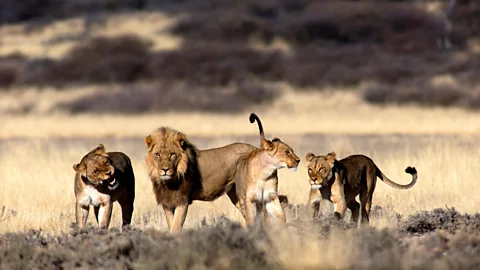
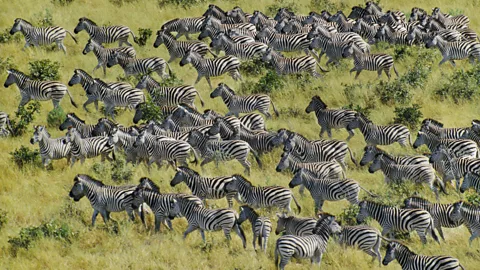
The true origin of many of the collective animal nouns that appear in Berners’ compilation has been lost to time, and since the publication of The Book of St Albans, the terms have continued to evolve. ‘A shrewdness of apes’ and ‘a pride of lions’ – both of which appear in The Book of St Albans – are part of the vernacular in most Anglophone countries. New terms have since developed, too, still with the intent to illustrate a characteristic of the animal. Michael Nagel, head guide at the Gondwana Game Reserve in South Africa, explained “a zeal of zebra is a term from back in the day, but today we’re more likely to use ‘a dazzle of zebra’ in order to paint a picture of the group.”
While The Book of St Albans was a gentleman’s reference guide, Berners penned parts of it as motherly advice to ‘my dear sons’ and ‘my dear child’ from ‘your dame’. And today, the playful terms resonate with children. Florance Kavios, a guide at Chobe Game Lodge, has found that teaching collective animal nouns to her 12-year-old son has had a ripple effect on youths in their local community. “He’ll think they’re funny and teach them to his friends at school who then come home with him and try to test me to see if I know them all,” she explained.
Nearly all traces of Berners have been lost to history, but her glossary of collective animal nouns remains a charming part of the English language.
 Mint Images Limited/Alamy
After returning from a morning safari, while I was finishing lunch on the veranda of Chobe Game Lodge, I watched a troop of baboons flee from the kitchen with stolen containers of freshly made shortbread. Despite their armfuls of sweet loot, the animals moved with the synchrony of a dance troupe, their long limbs quickly and gracefully scaling the rafters of the veranda. Their young followed suit like skilled understudies.
Atop the roof, the lesson in biscuit theft was rewarded. The baboons sat nonchalantly, taking in the views of the Chobe and greedily shovelling the not-so-hard-won booty into their mouths. They didn’t so much as pause to show deference to the chorus of kitchen staff angrily shaking pots and pans at them from the ground below.
It seems a hastiness of cooks is no match for a troop of baboons.
Join more than three million BBC Travel fans by liking us on Facebook, or follow us on Twitter and Instagram.
If you liked this story, sign up for the weekly bbc.com features newsletter called "If You Only Read 6 Things This Week". A handpicked selection of stories from BBC Future, Earth, Culture, Capital and Travel, delivered to your inbox every Friday.
{"image":{"pid":""}}
