What's the most painful sting in the world?

 Getty Images
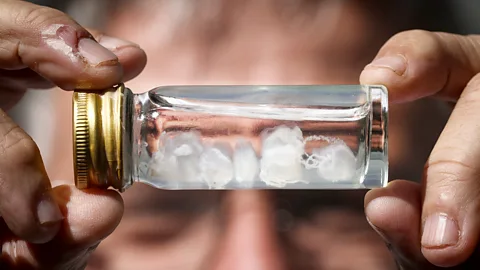
Top contenders for the nastiest sting range from bullet ants to warrior wasps and tiny jellyfish. To find out which is most painful, some adventurous experts have spent their lives getting stung.
Would you rather be walloped by boxer Mike Tyson or take a jackhammer to the kidneys? That's what it feels like to receive two of the world's most painful stings. When it comes to which is the worst, it's all a matter of taste.
Stinging animals – from familiar backyard buzzers to curious sea creatures – use a cocktail of chemical defences including neurotoxins and inflammatory agents to defend themselves or subdue prey. While biters (such as spiders and snakes) use their fanged mouths to administer venom, for stingers it's the other end you should steer clear of.
We asked experts about the most painful stings in the animal kingdom, setting aside lethality. Here's their ranking.
Stinging insects: Wasps, ants and bees (oh my)
The father of the modern getting-stung-on-purpose field was Justin Schmidt, an entomologist from Arizona who developed an eponymous sting pain index by subjecting himself to jabs from at least 96 species of insects, including bees, hornets, wasps and ants. He sorted stings into four tiers of pain, adding evocative, almost lyrical descriptions of each unique sensation (thankfully for us, Schmidt was an entomologist with the soul of a poet!).
The first level is home to the trivial. The sting of an anthophorid bee, for instance is "almost pleasant, a lover just bit your earlobe a little too hard". Level 2 sees some heavy hitters, like the honey wasp: "Spicy, blistering. A cotton swab dipped in habanero sauce has been pushed up your nose." And the fierce black polybia wasp: "A ritual gone wrong, satanic. The gas lamp in the old church explodes in your face when you light it."
The seven species in level 3 carry Schmidt into real torture: Dasymutilla klugii: "Explosive and long lasting, you sound insane as your scream. Hot oil from the deep fryer spilling over your entire hand."
Only three species ever earned a level 4 designation from Schmidt.
Schmidt's first level 4 was the bullet ant, an inch-long arthropod from the rainforests of Central and South America often called the "24-hour ant" for how long the torment from its sting lingers: "Pure, intense, brilliant pain. Like walking through charcoal with a three-inch nail embedded in your heel."
Next came the tarantula hawk, a spider-hunting wasp the size of a golf tee with a near worldwide distribution. "Blinding, fierce, shockingly electric. A running hair dryer has been dropped into your bubble bath," Schmidt wrote, noting the effect lasted only a few minutes.
Finally, the warrior wasp (Synoeca septentrionalis), a colony-dwelling wasp native to Central and South America. "Torture. You are chained in the flow of an active volcano. Why did I start this list?"
 Getty Images
Schmidt died due to complications from Parkinson's in 2023, but his heir apparent is Coyote Peterson, a YouTube personality who has subjected himself to stinging species that Schmidt never ranked. What Peterson lacks in formal science training, he makes up for in willingness to sacrifice his left forearm for the education and entertainment of millions of people who watch him writhe and sweat and scream on his channel, Brave Wilderness.
Peterson used Schmidt's pain index as a roadmap, aiming to "create the movie version" of Schmidt's 2016 book Sting of the Wild, he says. "Let's honour the 1 to 4 scale, but let's find out what other number fours are out there."
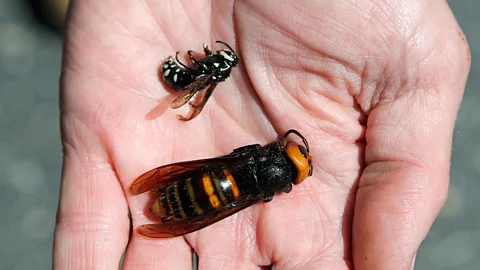
After travelling the globe to experience 30 species' stings, Peterson nominates two more species for level 4 status: the Japanese giant hornet, popularised in 2020 as the "murder hornet", and the executioner wasp.
"The Japanese giant hornet was unquestionably the worst on impact, like getting hit in the face by Mike Tyson," says Petersen. "I whited out. It was instantaneous and explosive." Native to Asia, this hornet had a brief but splashy tenure in the Pacific Northwest of the United States between 2019 and 2024.
The executioner wasp (Polistes carnifex), though, is Peterson's all-time winner. "The pain lasted maybe 12 hours," he says, but it was the after effects of the venom that stayed with Peterson – literally.
"There were some necrotic properties that rotted out like a pockmark, like a divot on my forearm. That is the only sting that physically ate flesh away, and I still have a scar… like a cigarette burn," says Peterson. Scientists have yet to pin down the composition of the executioner's venom, but some of its relatives use enzymes that damage tissues by activating the immune response.
Jellies, more sting than squish
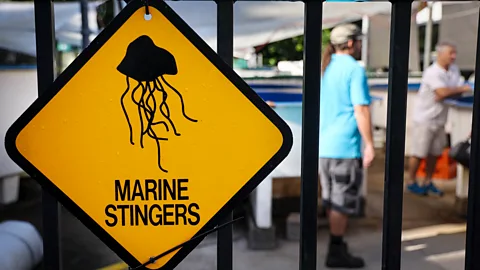
But insects don't hold a monopoly on the stinging game. Jellyfish have tiny harpoon-like cells called nematocysts that deliver punishing payloads of venom. Brushes with the Irukandji jellyfish – tiny jellies whose squishy bell can be as small as a thimble but whose tentacles can stretch up to a meter long – can lead to a syndrome that sounds like medieval torture.
The sting itself is a non-event. Most people don't even notice, says Lisa-ann Gershwin, a jellyfish researcher who classified and named 14 of the 16 Irukandji species during her PhD work on the cryptic jellies at James Cook University in Queensland, Australia. In fact, this delayed onset of symptoms meant that doctors struggled to identify what was causing summertime beachgoers such agony for decades. The mystery was only solved after a local physician named Jack Barnes spent four years hunting the culprit, finally closing the case in 1961 by purposefully stinging himself, his ten-year-old son, and a lifeguard.
 Getty Images
Gershwin has interviewed more than 50 people diagnosed with Irukandji syndrome and read at least a hundred historical case reports, she says. While few stings result in the excruciating syndrome – and the experience can vary dramatically, Gershwin says – a typical case goes something like this:
After about 20 minutes, the first symptom is a sense of overexertion or malaise, followed quickly by a sensation like a jackhammer to the kidneys that lasts for up to 12 hours. Then, victims endure a parade of symptoms, including profuse sweating that drenches the bedsheets several times an hour and unrelenting vomiting every few minutes for up to 24 hours.
All of that is "just the warmup" to the full Irukandji syndrome, Gershwin says. The person will then suffer "wave after wave after wave of true agony", full body cramps and spasms that each "redefine pain" as it keeps building, she explains.
But Irukandji jellyfish also open another dimension of pain – the existential. Their calling card is an overwhelming sense of doom, described as a perfect conviction that death is near. This is separate from the severity of the other symptoms, underscores Gershwin. "Patients have actually begged their doctors to kill them because they're so certain they're going to die, they just want to get it over with," she says.
 Getty Images
Gershwin says we don't have a complete understanding of the venom's content or how it causes Irukandji syndrome, but we do have some clues. Jellyfish venom contains toxins called porins that punch holes in cell membranes, leading to cell death and biochemical chaos as lots of molecules that are used to activate different bodily functions are unceremoniously dumped out at once.
Researchers studying Irukandji syndrome suspect the jellies' venom may also affect sodium channels in neurons, leading adrenaline, norepinephrine, and dopamine to flood the system – a process that likely contributes to both the psychological and the heart-related symptoms.
Contrary to their sense of impending doom, most people make a full recovery. Treatment largely consists of heavy-duty painkillers such as morphine to help weather the waves of pain.
More like this:
There are several more strong contenders in the stinging sea creature department, starting with the Australian box jellyfish, considered the most lethal jellyfish in the world. Its tentacles, which stretch up to 3 metres (9.8ft), leave long stripes on its victims. "You get these whip marks all over the skin that look like you've been attacked by a cat'o'nine tails," Gerswhin says. "It feels like boiling oil."
The fireworm, a bristly marine worm that looks like a centipede, defends itself using urticating hairs – tiny spines that detach and stay behind in the skin of anyone foolish enough to touch it. (Some divers call it the "fibreglass worm".) Scientists believe both the structure of the spines and the venom they carry contribute to the excruciating, burning pain, which reportedly can last hours.
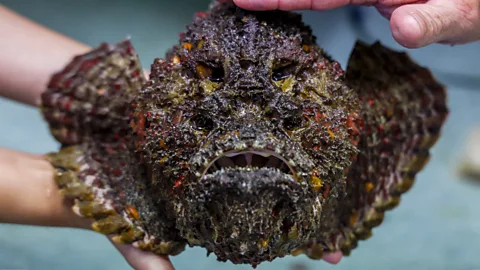
The stonefish masquerades as a rock in sandy shallows, coral reefs, and rock pools – unsuspecting beachgoers sometimes step on the fishes' sharp back spines, which deliver a tremendous payload of frost-blue venom. A burning pain that can last up to 48 hours is accompanied by dramatic swelling. According to the University of Florida, numbness and tingling can linger for weeks.
Which is 'worst'?
To be able to crown a definitive king of sting for land, air and sea, some foolish soul would have to volunteer to cross categories – experience both the worst insect and marine stingers – and Peterson says it won't be him. The jellies are simply too dangerous and carry a real risk of death, Peterson says, adding some species are "horrifically not worth dealing with".
Gershwin and Peterson agree it would be reckless to purposefully seek out a sting from an Irukandji jelly since some species can cause potentially lethal reactions, including brain haemorrhage and heart failure.
So how will we ever know which is the worst?
Perhaps the only way to find out is to invite a survivor of Irukandji syndrome on a world tour of pain to experience Schmidt's level 4 insect stings. Sounds like a BBC Earth show in the making.
--
If you liked this story, sign up for The Essential List newsletter – a handpicked selection of features, videos and can't-miss news, delivered to your inbox twice a week.
