'We’re constantly surprised': The strange deep-sea creatures that eat whales

 A Glover and T Dahlgren
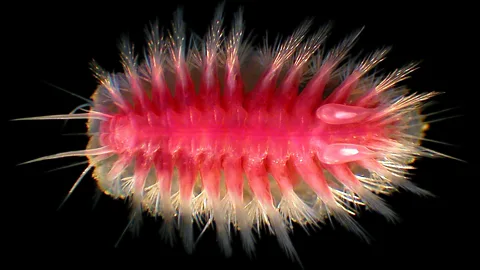
From bone-eating snot-flowers to snowboarding scale worms, when a whale dies it becomes a colossal island of nutrients – attracting weird and wonderful creatures to feast.
Whales are the big rigs of the ocean. They can transport up to 150 tonnes (300,000 lbs) of food stuffs – meat, blubber and bone–far across oceans, and from the surface to the depths. Their bodies are a veritable feast in the making.
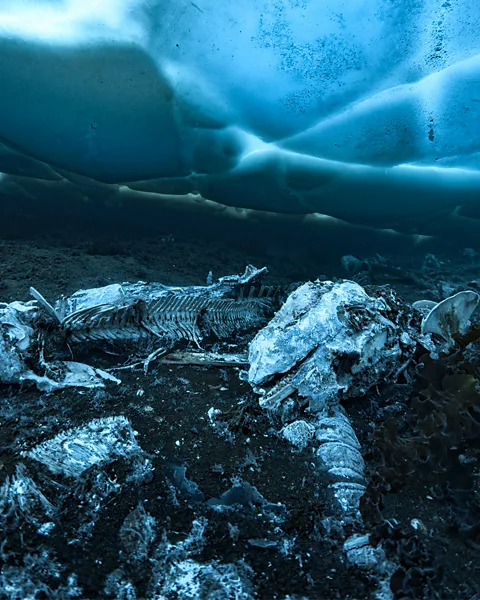
Whales usually die far out to sea, scattered along their often vast migration paths, says Greg Rouse, curator of benthic invertebrates at Scripps Institution of Oceanography in San Diego, California. At first, the carcass may float as the gases inside make it swell up like a balloon. Then the whale sinks – through the sunlight, twilight and midnight zones – eventually reaching the darkness of the abyss, its final resting place.
 Alex Dawson
In death, the whale gives life, becoming an immense island of food. Nutrients usually arrive in the deep sea as tiny particles of organic matter, known as marine snow. But when a whale sinks to the seabed, it is said to be the "largest organic input" to reach the deep ocean floor at any one time. A single whale can be equivalent to several thousand years' worth of marine snow – and its bounty can feed a whole ecosystem for decades. (Read more about the importance of whale fall to deep-sea biodiversity.)
First come the scavengers
The "deep water scavenging community" are the first to arrive, says Adrian Glover, deep-sea ecologist at the Natural History Museum in London, UK. "Which includes vertebrates like hagfish and sleeper sharks, and lots of scavenging amphipods – crustaceans like shrimps. They eat the flesh, exposing the bone." This "mobile scavenger phase", he says, can last years.
 Alamy
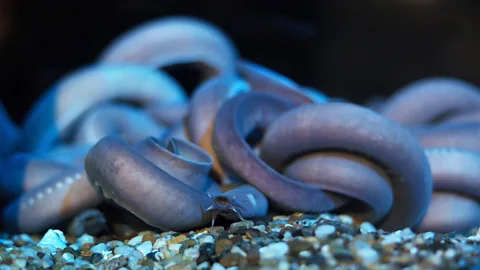
AlamyHagfish are the only known living animals that have a skull but no vertebrae. These fish burrow face-first into their food, eating it from the inside out. Hagfish have an extraordinarily slimy self-defence tactic. When attacked, a hagfish will exude mucous which forces a predator to retreat or suffocate.
 Alamy
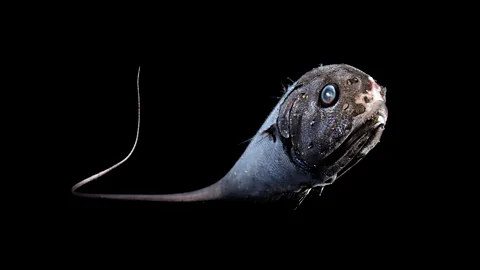
AlamyRattail fish can grow up to a metre in length (3.2ft) and live at depths of up to 4,000m (13,100ft). Down there, far beyond the reach of the sun, the only light is made by living organisms – and the rattail's big blue eyes can glimpse even the tiniest flickers of bioluminescence that give its prey away. Whisker-like barbels on its chin, too, sense any movement by tasty morsels – crustaceans or wriggling worms – that might be hiding just under the surface of the muddy ocean floor. A keen sense of smell, meanwhile, helps the rattail find its way to rotting carrion such as a whale carcass.
The opportunistic diners
After the large scavengers have had their fill and the bones are stripped, smaller diners arrive. "Osedax – the 'bone-eating worms' – arrive in large numbers," says Rouse. Osedax are a type of polychaete worm. Commonly known as bristle worms, these are a diverse and abundant group of segmented worms thatpopulate a whale fall in their thousands. Some of the species at this "enrichment-opportunist" stage have only ever been found at the site of a whale fall.
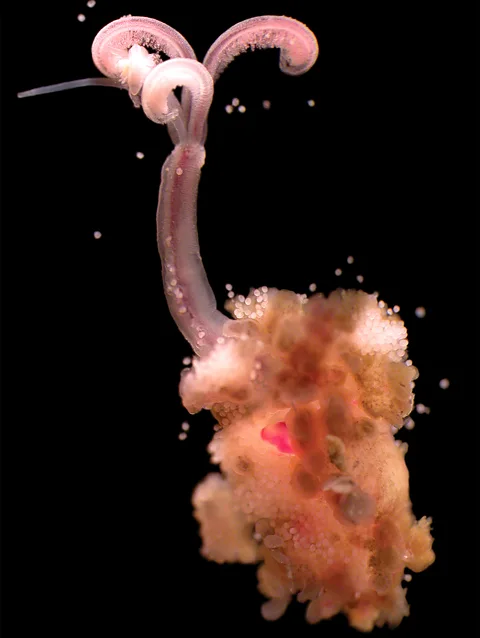 Adrian Glover
The "bone-eating snot-flower" – Osedax mucofloris – in a polychaete worm that was first discovered in 2005 on the carcass of a whale. These bone-eating worms inject acid into the bone. "It's like they're putting their gut inside the bone and absorbing it directly – quite strange," says Glover.
Over the course of a decade, an entire population grows, lives and dies on a single whale fall. When all the skeleton has been consumed, just before they die, the Osedax release larvae that will travel on ocean currents in the hope of happening upon another whale carcass to settle on, and start the whole cycle again.
"They decalcify the bone, getting to the collagen," says Rouse. "The bone then becomes very spongy and can be torn apart by crabs and other scavengers."
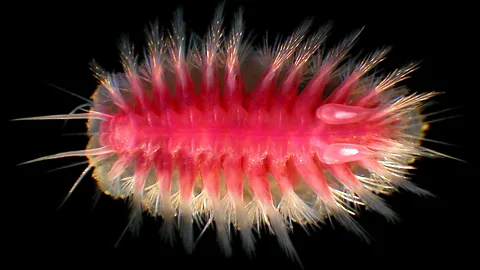 A Glover and T Dahlgren
Organic matter spills out from the carcass, enriching the surrounding seabed with nutrients. Now, tens of thousands of opportunistic worms, molluscs and crustaceans arrive to hoover up any remaining scraps of blubber or flesh, and to sift through the seafloor sediment.
 Alamy
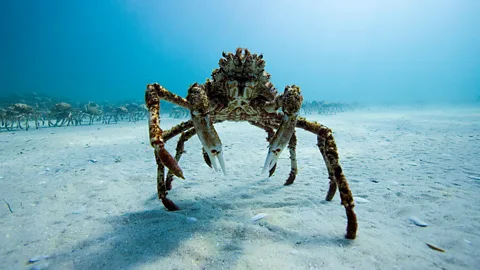
AlamyThe Japanese spider crab is thought to live up to 100 years and is the biggest crab in the world. Its main body can grow up to 30cm (12in) wide, but its legs keep growing and can span up to 3.8m (12ft) from claw to claw – almost the length of a small car.
Travelling the whale fall corridor
At the same time that the scavengers are digesting the bones, a more specialised set of feeders joins the banquet – and feasts for up to 50 years. This is the sulphophilic – or sulphur-loving – stage. As bacteria continue to break the bones down, hydrogensulphide is released. These gases are consumed by chemosynthetic organisms.
 Phillipe Crassous/ Science Photo Library
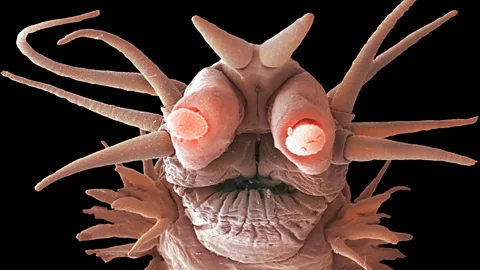
Chemoautotrophs are organisms that can create energy from chemical reactions, a process known as chemosynthesis, as opposed to plants which need sunlight and carbon dioxide to perform photosynthesis. These chemical-consuming microbes often form close symbiotic relationships with invertebrate hosts, providing them with nearly all of the nutrition they need.
"The ability of organisms to evolve to exploit these remarkable, weird, amazing adaptations to these unusual environments… we're constantly surprised," says Glover.
More like this:
Chemoautotrophs are found at just four distinct deep-sea habitats – hydrothermal vents, cold seeps, wood falls and whale falls. Now, experts say whale falls act as stepping stones for specialised animals, allowing them to disperse across the usually desolate ocean floor.
In life, a whale fertilises the oceans and carries carbon to the depths, helping to keep the ocean full of life and the climate cool. In death, a single whale can provide tens of thousands of individual marine animals with food, a habitat, and a chance to thrive in the harshest of environments. Its final gift to the Earth, a whole new ecosystem.
--
For essential climate news and hopeful developments to your inbox, sign up to the Future Earth newsletter, while The Essential List delivers a handpicked selection of features and insights twice a week.
