'There are so many bones everywhere': The whale graveyards that transform the deep sea

 Alex Dawson
A photographer captured this extraordinary site where whales' bodies lie in the shallows. Had they died naturally, their bodies would usually be scattered across the ocean. These images tell the story of a deep-sea denied of vital sustenance, and entire ecosystems that will never come to be.
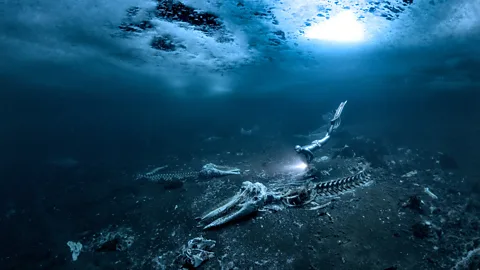
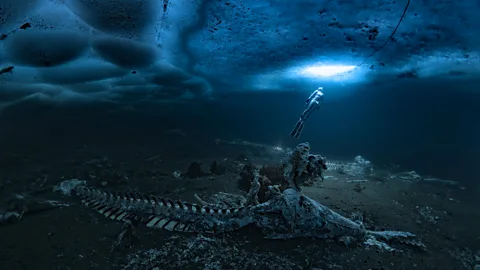
In eastern Greenland, Alex Dawson slipped into the ocean through a hole cut into the pack ice. He sank into the darkness below and – just a few metres down – he found a mass grave of butchered minke whales.
It took an hour of travelling to get to the dive site, by foot and by snowmobile. The air was -20C (-4F), and the team battered by strong winds. "We had a lot of gear," says Dawson, an acclaimed underwater photographer. "We were six scuba divers, with six divers' gear. There were cameras, there was food and all kinds of supplies for the day – safety equipment, ice drills…" The equipment was piled on a sledge and pulled by a snowmobile while the team walked on foot. "When you walked, if you didn't have snowshoes on you stepped through the thin layer of ice, and you got into water almost to your knees – every step," says Dawson.
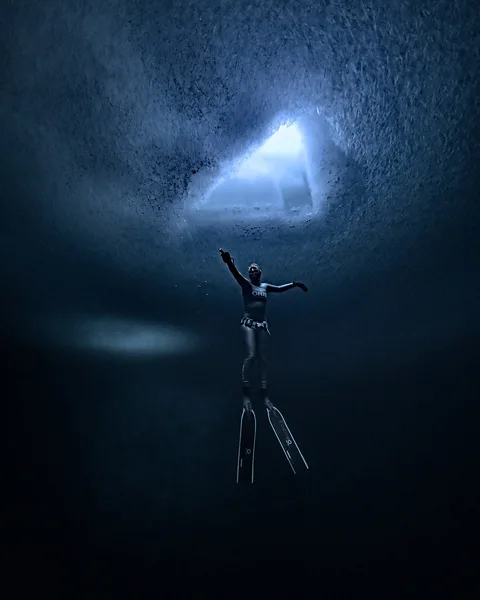
"Once we got there it took hours to make the hole," he continues. Their way into the ocean beneath the ice was a small triangle-shaped hole cut by hand through about a metre (3ft) of ice. "We tried to clear out as much of the slush from the hole as possible," he says. Then, Dawson – in his thick drysuit, hood and gloves – was first to enter the water.
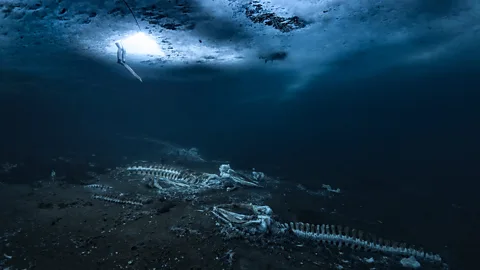
The site Dawson eventually found below the waves was not only striking, but troubling. In life whales transform their environment, and in death too they play an outsized role on their ecosystems. And here in eastern Greenland, bones that would naturally have fallen to the deep ocean floor instead lie trapped in the shallows.
Despite the protection of his drysuit, "I felt like my face was falling off", he says. "It was so extremely cold."
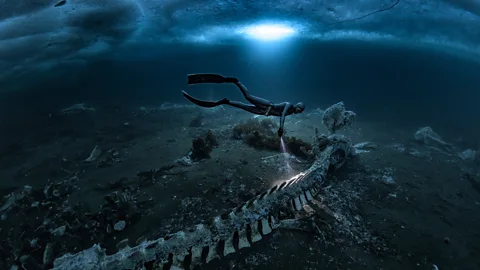
Anna Von Boetticher, who Dawson was to photograph swimming amongst the whale bones, followed him into the ocean. The competitive freediver wore just a 5mm wetsuit to protect her for from the -2C (28F) water. At this temperature she could only last up to 45 seconds before needing to surface for air.
Dawson, attached to a safety rope, dove straight down away from the daylight. This is when the fear began to creep in, he says. When you first enter the water through the hole, "you see nothing. It's just the black abyss below you. You feel like all these creatures are lying there [in the deep] looking up at you."
 Alex Dawson
When he reached the seafloor, "I just lay there breathing," he says, as he waited for his eyes adjust to the darkness.
After a short while, his vision became clearer. "I started looking around, and I was like, 'This is so crazy. There are so many bones everywhere.'"
There, at around just 5m (16ft) depth – bathed in the blue light of their icy tomb – lay the remains of around 20 minke whales.
Dawson was just beginning to relax when he heard a loud "boom". "It sounded like somebody was blowing dynamite underwater. Then I heard a second boom. That's when I realised that this was the tide starting to move, and the ice cracking."
Diving under pack ice is one of the most hazardous kinds of diving. The currents could carry you away under the "endless pack ice", says Dawson, "and you'd be gone forever". Pack ice is made up of fragments of frozen seawater that are squeezed together, becoming a large mass of floating ice that covers the sea surface and drifts with the winds and ocean currents.
"The tide was going out, which meant the ice was sinking. If our hole were to compress, I thought, 'I'm screwed' – because there was only one hole. It would take [the team above the ice], well over an hour to make a second hole if they were trying to save me."
He decided to risk it, however. "Focus on the photography," Dawson told himself. "Everything will be fine". This mindset paid off. The Swedish photographer was named winner of the Under Water Photographer of the Year 2024 for the image he called "Whales Bones".
 Alex Dawson
Whales, some of which are the largest animals to have ever existed, usually die out in the open ocean, most likely scattered along their migration paths, says Greg Rouse, curator of benthic invertebrates at Scripps Institution of Oceanography in San Diego, California. Their bodies – a colossal bounty of nutrients – sink to the ocean floor to become oases of life.
After a whale dies, its insides begin to decay first. The body expands with gas and may float to the surface like a balloon. The first scavengers to profit are therefore surface-dwelling creatures like seabirds and sharks.
Eventually, the carcass begins to sink, falling through the ocean's sunlight, twilight and midnight zones, perhaps to the abyss – maybe even making it to the deepest trenches. "You can find them thousands and thousands of metres [down]," says Rouse.
The deepest whale carcass ever found belonged to an Antarctic Minke whale. It lay in the darkness of the abyssal zone, at 4,204m (13,793ft) depth on Southwest Atlantic Ocean. And what was left of skeleton – just nine vertebrae of the animal's tail – suggested the whale had been lying on the seabed for as long as a decade.
The species found living there made up a thriving ecosystem. Among them were deepwater crabs, sea snails and bristle worms. In fact, most of the 41 species living on the carcass were new to science. The species did, though, share qualities with those living on other whale carcasses found thousands of miles away in other ocean basins – suggesting the existence of a "worldwide whale-fall corridor".
Once on the ocean floor, the usually nutrient-limited ocean floor suddenly has an immense island of food. Deep-sea creatures amass. Large scavengers and microscopic bacteria alike come to inhabit the whale fall.
"There is an initial phase of scavenging by deep-water scavengers," says Adrian Glover, deep-sea ecologist at the Natural History Museum in London, UK. "These include vertebrates like hagfish and sleeper sharks, as well as scavenging amphipods – little crustaceans like shrimps. They eat the flesh, exposing the bone." Hagfish burrow face-first into their enormous meal, while sleeper sharks, crabs and lobsters strip the blubber and muscles from the bone.
It can take several months to strip off all the flesh – then just the skeleton is left "sitting in the mud" says Glover. Now, the oily bones become home to another community of organisms, like the Osedax – or "bone-eating worm". "They are related to hydrothermal vent tube worms," says Glover, "but have evolved the ability to degrade the bone directly, and consume the fats and the collagen inside the bone".
 Alex Dawson
The benefits of whale fall spread beyond the carcass itself. Lipids and oils leak out into the seabed and a "massive bacterial mat forms around the whale", says Rouse. "Invertebrates explode in numbers."
As the bones decompose, sulphur is released. "There's a halo of organic enrichment," adds Glover, with sulphur-rich habitats found in the sediments surrounding whale carcasses. The sulphur is consumed by chemosynthetic organisms – bacteria which live in environments devoid of light and derive their energy directly from chemicals in their environment, rather than the products of Sun-driven photosynthesis.
Chemosynthetic bacteria live symbiotically with deep-sea creatures like clams, mussels, snails and worms. "This is where you get organisms, which exist on hydrothermal vents and cold seeps, hopping onto whale bones as a sort of similar habitat," says Glover. The diversity of species found in this last stage is larger than any other deep seafloor community that we know of – and this "sulphophilic" – or sulphur-loving – stage can last for decades.
Whale carcasses are thought to be the largest organic inputs to reach the deep ocean floor in a single event. The extended whale fall biome can support as many as 407 species, "fundamentally" contributing to deep-sea biodiversity, say experts. This is slightly less than a hydrothermal vent – where geothermally-heated water escapes from fissures in the ocean floor – which can sustain up to 469 species. But it is far more than a cold seep – where energy-rich chemicals like hydrogen sulphide and methane escape from cracks in the ocean floor – which host to up to 230 species.
Specialised organisms have evolved over millions of years in the bodies of whales, ever since the appearance of these large ocean-going beasts. Now, say experts, whale fall should be considered a source of "evolutionary novelty and biodiversity in the deep-sea".
But in some cases, this natural progression of decay from the surface to the ocean depths is interrupted.
 Alex Dawson
Over the past century, industrial whaling has decimated whale populations. In a single century, the world witnessed likely the "largest cull of any animal – in terms of biomass – in human history," according to a report in Nature. Almost three million whales were killed, devastating global whale populations.
The carcasses were stripped of blubber and flesh, baleen plates and teeth removed, and the head split into precious parts. Any remains were then abandoned to decay in the shallows or left to litter the shores. Often, there was nothing left at all.
Dawson took these photographs off the coast of Tasiilaq, a town of around 2,000 people that sits roughly 66 miles (106km) south of the Arctic Circle. Here Greenlanders live in a "wild and harsh environment where agriculture is severely limited", states the International Whaling Commission (IWC), the intergovernmental organisation that regulates whale hunting. This means that indigenous Greenlanders continue to depend upon on marine resources – including permittedsubsistence hunting of whales.
The hunters drag their catch ashore at the flenseplassen – or "skinning grounds", says Dawson. Families gather to cut away the skin, blubber and meat, stripping the carcasses down to the bare bones. Then the tide carries the skeletons back into the water.
More like this:
• How whales help cool the Earth
Minke whales are the smallest of the baleen whales. They are considered abundant and found all over the world, from the tropics to polar regions. Of this stable population, an average of nine minke whales are killed each year in East Greenland.
Even catches as small as this can impact deep ocean ecosystems, though, with shallow graves depriving the deeper ocean floor of vital nutrients.
As whale populations continue to struggle, a decline in whale falls is reported to have reduced the biodiversity of deep sea ecosystems – and has likely contributed to the extinction of species before we ever knew of their existence.
"We're still in an era of very low whale numbers," says Rouse, "So, there's probably a lot less whale skeletons on the seafloor than there used to be. What was striking to me is that we still see thriving whale fall ecosystems today. But did we lose some things when we had such a catastrophic decline in whales? We don't know."
--
For essential climate news and hopeful developments to your inbox, sign up to the Future Earth newsletter, while The Essential List delivers a handpicked selection of features and insights twice a week.
For more science, technology, environment and health stories from the BBC, follow us on Facebook and Instagram.
