How photographer captured six planets in 'parade'

 Josh Dury Photo-Media
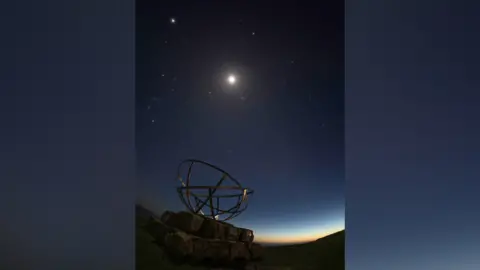
A photographer has captured six planets in one picture as part of a celestial planetary parade.
Josh Dury, from Bristol, photographed the phenomenon from a radar memorial in Worth Matravers, Dorset, on Tuesday just after 18:30 GMT.
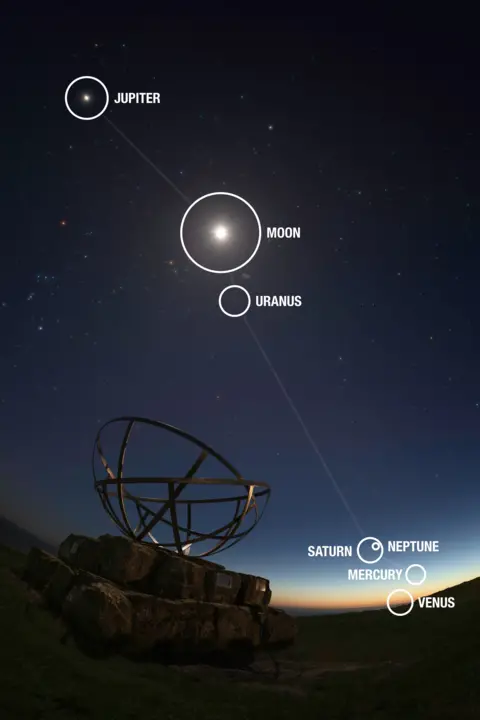
His picture includes Earth, Mercury, Venus, Jupiter, Saturn, Uranus and Neptune, as well as the Moon.
A planetary parade, which occurs when several planets appear to align on one side of the Sun from Earth's perspective, will be visible in the UK again from sunset on Saturday.
 Josh Dury Photo-Media
Dury arrived at the location following a gruelling four-hour journey, which should have been two hours, but was made longer by road closures.
"It was a matter of arriving on location and seeing the sun go down to get into position to wait for the sky to darken."
Dury said it was a "battle against time" to get the picture, which he captured using a wide lens.
"It meant it was possible to capture a nearly 180 degree field of view, so you could almost capture them like a string of pearls in the sky."
 Josh Dury Photo-Media
The photographer said he was "positively overwhelmed" when he captured the shot.
"It was wonderful to see the developmental stages of the parade happen," he said.
"It's quite a rare photograph purely because it's that line-up of how they appear in the night sky.
"It just really puts into perspective our place among the solar system."
What is a planetary parade?
A planetary parade describes a moment when several planets appear to line up in the sky from the Earth's perspective.
Just after sunset on Saturday, Mercury, Venus, Saturn, and Neptune will appear low in the western sky, close to the horizon.
If you don't have access to binoculars or a telescope you might be able to attend a local astronomy society event to get a better look.
A viewing spot with the clearest view of the horizon is best, particularly to see Mercury and Venus, which will appear very low in the sky.
Higher in the sky, Uranus will be sitting in the constellation Taurus and won't set until around midnight, giving skywatchers with the right equipment a better chance of tracking it down.
Jupiter will be the easiest of the six to find, shining brightly in the constellation Gemini and high enough to stay in view for much of the night, even from light-polluted towns and cities.
You can follow BBC Hampshire & Isle of Wight on Facebook, X (Twitter), or Instagram.
