The rare 'dinosaur egg' returning from extinction

 National Commission for Culture and the Arts
Asin tibuok is one of the world's rarest salts, and it's only produced on one small island. But thanks to chefs and TikTokers, this prehistoric-looking orb is now being revived.
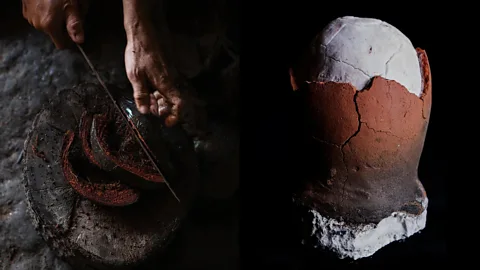
In a thatched-roof workshop on the Filipino island of Bohol, 68-year-old Romano Apatay uses a scoop made from an empty shell to pour brine into a series of brown, orb-shaped clay pots suspended over a wood fire. When the pots begin to crack, he removes them from the flames. Once cooled, he turns them over and carefully breaks open their brittle outer shell with his fingertips, revealing a white sphere that's one of the rarest salts on Earth.
This is asin tibuok, which means "unbroken salt", but around the world, it's popularly known as "dinosaur egg" salt, thanks to its ovoid appearance. Once ubiquitous throughout the island, asin tibuok production has declined drastically in recent years. Apatay is one of the few people on Bohol still making it – and is part of a new generation helping to save it from extinction.
A centuries-old tradition
Asin tibuok has been made on Bohol since at least the 1600s. It was first recorded in the 17th Century by a Spanish missionary who described the local practice of filtering seawater through the ashes of charred coconut husks and baking brine inside clay orbs.
 Lokalpedia
Yet, ethnoarchaeologist Andrea Yankowski says this indigenous Filipino craft existed long before the arrival of the Spanish. Yankowski first came across asin tibuok 20 years ago when she was carrying out research on the island. In 2019 she realised there were only a few manganisays (salt makers) left and she started to record their work.
"Many communities along the southern coast of the island participated in salt making," she says. "This salt was regularly traded to the island's interior, where there are farmlands, for rice and other agricultural products. [It] was also traded to other islands."
For generations, asin tibuok was produced by families living along the coastline who would tie a piece of string to the egg-shaped salt and dip the orb into savoury rice porridge. But in recent years, as mangasinays have aged and successors were unwilling to carry on the labour-intensive craft, the practice has nearly disappeared. Until a few decades ago, an estimated 100 families produced it.
"It is very important for me to save a craft that could die out," says Apatay. "I am proud of the legacy of my forefathers."
 Lokalpedia
A return from extinction
In recent years, this centuries-old tradition has experienced something of a revival, thanks to TikTokers and Gen Z chefs who have started falling for the smoky-tasting mineral. In 2021, Filipino YouTube star Erwan Heussaff shared a video of the salt being made to his millions of followers. Then in 2023, dinosaur eggs starred in an episode of Filipino Netflix drama Replacing Chef Chico. And in December 2025, asin tibuok was recognised by Unesco as an Intangible Cultural Heritage in Need of Urgent Safeguarding.
In 1995, the Philippine government passed a law stipulating that salt must be iodised. As a result, fewer families continued producing it and asin tibuok production began its steep decline. But as awareness of dinosaur eggs' cultural importance grew, the ruling was lifted in March 2024.
More like this:
Father Cris Manongas was born into a family of salt makers. While he helped on the salt farm as a child, by the 1980s the family business had closed and both he and his siblings chose other occupations. Each time Manongas returned to Bohol, he noticed there were fewer producers. In 2010, he encouraged his siblings and a nephew to relaunch their salt-making business. "I missed [it], I missed aroma of the salt," Manongas says. "I [didn't] want it to get lost. Once it's lost, it will be forgotten."
At first, his family were reluctant to toil in the heat and revive the salt's painstaking production. But they eventually relaunched the salt company, which they named after Cris's grandfather: Tan Inong Manufacturing Corporation.
 Gerald Marcfred Dillera / Unesco
A lengthy process
Manongas explained that it takes more than four and a half months to make dinosaur egg salt and the process has remained relatively unchanged for generations. Workers start by gathering more than 1,000 coconut husks, which they place in a pit in the mangroves so that water soaks them at high tide. The husks are left for four months before they are dried in the sun, then chopped into pieces and burnt in a fire for up to four days. The coconut ashes are then placed in a filter of palm leaves and seawater is poured through the ashes to create a brine, which is then poured into the pots.
At one time, salt makers would transport coconut husks to the workshop by bamboo raft or on carts pulled by carabaos, says Manongas. But when he relaunched the company, he invested in a truck. He also installed a pumping station so they no longer had to carry the seawater using hollow bamboo tubes.
Manongas' grandfather, like many salt makers of his generation, believed the practice was sacred and asin tibuok must never be sold; only bartered for rice. But since Manongas had taken out a loan to restart the trade, he had no choice. "We had to charge at least $150 (€112) [to] break even," says Manongas, who admits that he went to his grandfather's grave to seek his approval the day before they launched.
Commerce aside, other rituals have remained intact. During the salt-cooking process, all workers must remove their jewellery, and no one can carry coins or eat oily food. Seashells are also used to add the water to the pots as they can withstand the heat of the furnace and don't taint the flavour.
 Gerald Marcfred Dillera / Unesco
Veronica Salupan, Manongas' sister, who works alongside her brothers, says the final day when they cook the unbroken salt is one of the most intense. "We start cooking at 08:00 and eventually finish at 15:00," she says.
Yet, preparing the salt seemed easy compared to the commercial challenges the family faced. "There was no market," Manongas says. "Filipinos thought it was too expensive."
Then in 2015, tourists and visiting students started to blog about the salt, and it caught the attention of a Filipino-American businesswoman in California who placed an order for 1,000 pieces. It took the family a year to fulfil it. In 2020, the pandemic hit and the orders stopped. Then in 2021, the business was levelled during a typhoon. Locals rallied and helped the family rebuild with the fallen coconut palms.
Five years later, Manongas says the business is flourishing, and the asin tibuok industry in Bohol has continued to grow. In 2022, 26 former salt makers joined together to create a salt-making cooperative. With the help of the National Museum of the Philippines in Bohol and the British Museum, they received a grant to help them build a traditional kamalig (salt workshop). Now, renowned Filipino chefs are clamouring for their wares.
 Toyo Eatery
Where to taste asin tibuok
Chef Jordy Navarra, whose Michelin-starred restaurant Toyo Eatery in Manila was crowned the nation's best by Asia's 50 Best Restaurants, has incorporated asin tibuok into his eight-course tasting menu. Navarra's wife's family is from Bohol, and so he had heard about the salt, but it wasn't until 2018, when one of his friends who knew he had a love of lesser-known ingredients, brought it to him to try.
Not only did he find that the asin tibuok had a more subtle taste than iodised salt, he says that it actually had two distinct flavours. "The interesting part is the top part and the bottom part of the salt tastes different," Navarra says. "One side takes more of the characteristics of the smoke, maybe because of its exposure to the fire" while the other is free of the smokier flavour.
Traditionally the salt was largely used to season soups or savoury rice porridge, but Navarra chooses to serve it with dessert. "We wanted to highlight the actual salt taste profile and really serve it as unadulterated as possible. So, we ended up serving it on ice cream," he says.
Instead of tying a piece of string to the egg-shaped salt, as people did in times gone by, the team choose to grate it for guests tableside. "We present the whole block of salt so people can see [it]," Navarro says. "[They taste] the salt and ice cream [separately] and then taste it together so they can see how it adds [to the dish]."
 The Chocolate Chamber
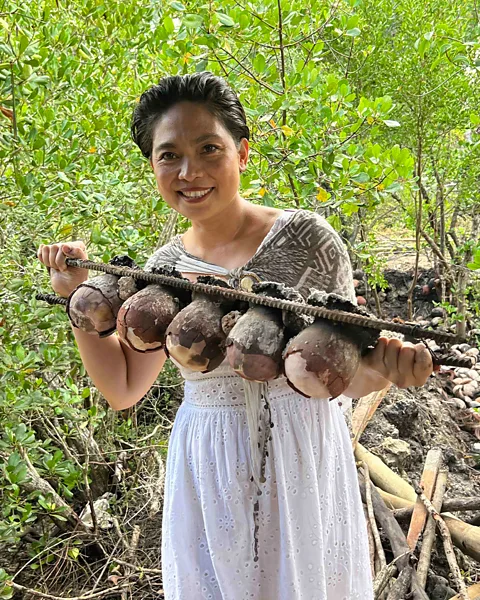
Gourmet chocolatier Raquel Toquero-Choa, co-founder of The Chocolate Chamber in Bohol, also showcases the smoky artisanal ingredient in her salted chocolates and salted caramel chocolate powder. "Rich cacao is made more vibrant with a touch of this rare salt. Its natural mineral saltiness makes chocolate more alive," she says.
"Just as cacao was once a hidden treasure, I see asin tibuok in the same way: rare, fragile and deeply rooted in our heritage," says Toquero-Choa.
Back in Apatay's thatched-roof workshop, once the salt-filled pots have cooled, these rare dinosaur eggs are finally ready to be sold. He drives the prehistoric-looking orbs to a shop in front of his home where he sells roughly 240 of them each month to passing tourists.
He says that salt making has its challenges. When he's burning the coconut husks, he needs to constantly tend the fire and can't sleep for up to 96 hours. "No sleep, because our shed may burn also," he laughs.
But it's the new interest in asin tibuok that keeps him going. "I feel so proud," he says.
--
If you liked this story, sign up for The Essential List newsletter – a handpicked selection of features, videos and can't-miss news, delivered to your inbox twice a week.
