Leeds peregrine falcons: Bird net removed from uni building

 Paul Wheatley
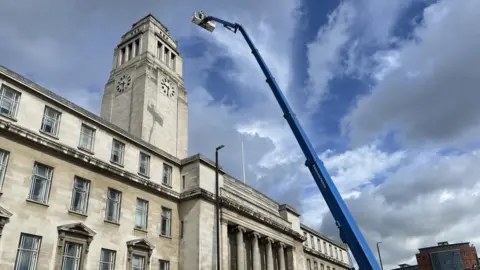
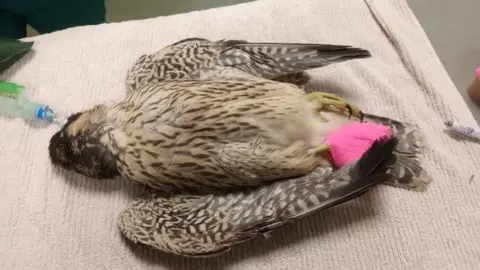
Netting which trapped several peregrine falcons on a university building, leaving three dead and two having to be rescued, has been taken down.
The first dead bird was found on the University of Leeds' Parkinson Building on 11 June after fire crews were called to save a stuck fledgling.
Two more carcasses were found during an operation to remove the nets on Sunday.
A university spokesman said it took steps to ensure the peregrines living on the tower were not disturbed.
The netting was installed about 10 years ago to deter pigeons for health and safety reasons and to help conserve the Grade II listed building.
Peregrines only began nesting there in 2018, the university said.
'Precious birds'
"Netting and other bird deterrent measures were removed on Sunday morning from the Parkinson Tower, in line with updated advice from the RSPB and other wildlife experts and having obtained the required licence from Natural England," the university added.
"An ecologist was on hand throughout to help ensure that disturbance of the peregrines was kept to a minimum.
"We are extremely grateful to everyone involved in this work, and in the rescues of these precious birds - as well as those who have kept a watchful eye on them in the meantime."
 Paul Wheatley
The university thanked birdwatcher Paul Wheatley, who was the first to raise the alarm on 11 June.
He said: "Thanks go to all those at the University of Leeds who have made this happen at short notice.
"Of course, it's a real shame it took a bad news story for the uni to take action. This should have been sorted a long time ago."
Wildlife TV presenter and conservationist Chris Packham tweeted his support, and said: "Forget Top Gun, this was Top Work. Thank you".
Allow X content?
Mr Wheatley said the first dead bird to be found was thought to have died about a month ago, but it was not clear when the others became trapped.
"We hope DNA testing will help ID them all," he said.

Follow BBC Yorkshire on Facebook, Twitter and Instagram. Send your story ideas to yorkslincs.news@bbc.co.uk.
