Kilns used to make bricks for Colchester's Roman wall found

 Colchester Archaeological Trust
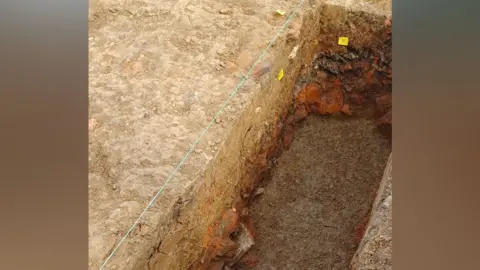
Roman kilns which created the bricks used to build Britain's oldest town wall have been found during a dig.
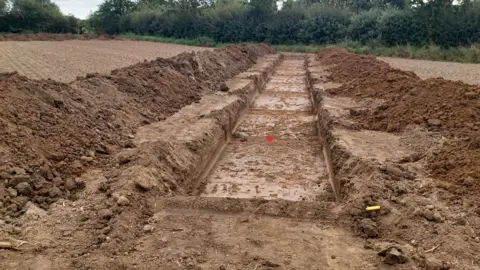
The excavation took place at Cymbeline Meadows, Colchester, Essex, ahead of the city council's plans to transform the site into a nature reserve.
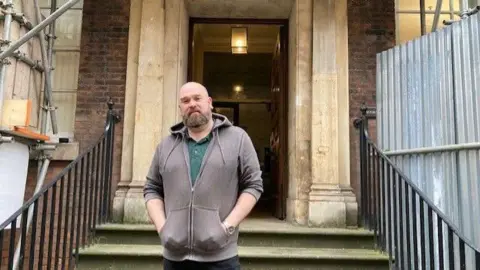
Archaeologist Philip Crummy said it is "unusual" to find a collection of Romano-British kilns in one area.
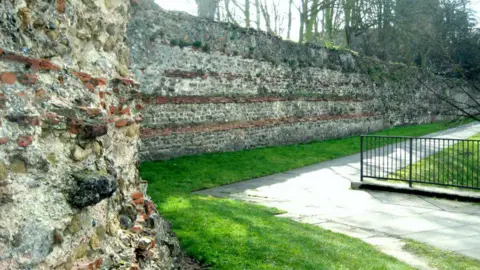
The town wall was built following Boudicca's revolt and dates to about 60 to 80 AD.
 Colchester City Council
A Roman kiln was originally discovered at the site, which is to the south of the city's mainline railway station, in the 1960s, the director of the Colchester Archaeological Trust said.
"The tenant farmer regularly ploughs up bits of red dust and broken tile and brick, so it was obvious the site was probably a tilery," he said.
More than 60 trenches were dug during this summer's excavation, and Mr Crummy now believes "there might be up a dozen kilns" in the area.
There would have been huge demand for clay bricks and tiles, especially during the Roman town's peak building era in the late 2nd and early 3rd centuries.
Mr Crummy added: "It would have been amazing if they hadn't used locally-made bricks and tiles, some of which must have come from this area."
 Colchester City Council
This would have included the 1.73-mile (2.8km) town wall, which had a core of calcareous mudstone called septaria, supplemented by four courses of bricks.
"We know all the bricks were broken before they were laid, to make them bind better," he said.
Bricks and tiles were not extensively manufactured again in Britain until about 1,000 years after the end of the Roman era, he added.
 Colchester Archaeological Trust
Plans for the 74-hectare (182 acre) site, which has riverside grazing meadows and woodland, include a wetland, the planting of 8,000 trees, 580m (1902ft) of hedgerows and a wildflower-rich grassland.
No trees will be planted on the kiln site, to preserve the archaeology.
Andrea Luxford Vaughan, Colchester City Council's portfolio holder for planning, environment and sustainability, said it would become "a nature haven" that would preserve and enhance the city's biodiversity.

Follow East of England news on Facebook, Instagram and X. Got a story? Email eastofenglandnews@bbc.co.uk or WhatsApp 0800 169 1830