A428 dig: Possible Bronze Age finds unearthed in roadworks

 MOLA
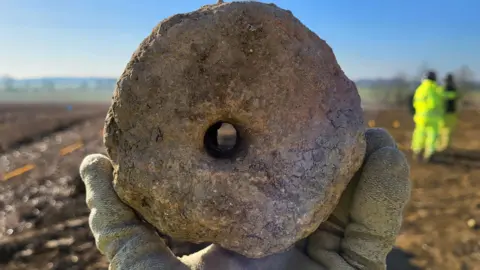
MOLAArchaeologists have unearthed a loom weight believed to date to the Bronze Age during an excavation.
The find was made at a dig at the Highways England work on the A428 Black Cat to Caxton Gibbet on the Cambridgeshire-Bedfordshire border.
The only pre-Iron Age objects previously discovered in the area have been stone arrowheads, experts said.
Museum of London Archaeology (MOLA) project manager Simon Markus said: "We make new discoveries every day."
 MOLA
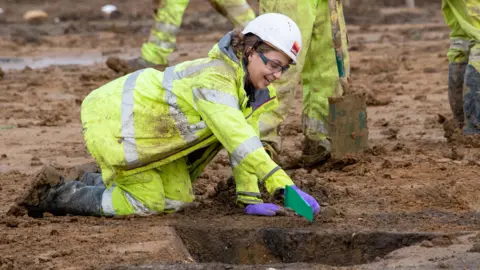
MOLAThe finds help "build an incredibly detailed picture of what life was like" in this part of Britain thousands of years ago, the MOLA team said.
These include the "unusual loom weight" which would have been used in cloth making.
If it is proved to be Bronze Age (2500 to 800BC), it suggests that people were living in the area for far longer than originally believed.
Archaeologists believe that luxuries such as wine might have been enjoyed in the area during the Roman period (AD43 to 410) after lab analysis of grape pollen found in waterlogged soils suggested the area had vineyards.
The dig has previously revealed evidence of Roman-era beer making and of a communal area for Iron Age feasts.
 MOLA
MOLAThe Romans also seem to have imported amphora - possibly holing olive oil from Spain - and an expensive dinnerware called Samian ware from France, the team said.
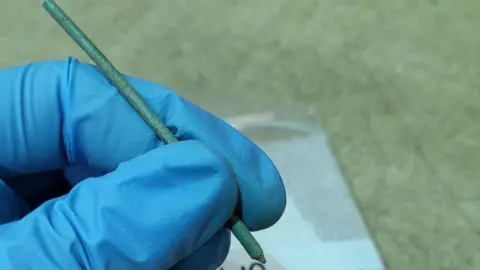
Another surprising find was a Roman stylus, which would have been used to write on waxed tablets.
Mr Markus said: "These excavations are super exciting, and give us the unusual opportunity to understand an entire ancient landscape."
Work on the £950m A428 Black Cat roundabout to Caxton Gibbet road upgrade near St Neots is expected to start by the end of the year.
 MOLA
MOLA
Follow East of England news on Facebook, Instagram and Twitter. Got a story? Email eastofenglandnews@bbc.co.uk or WhatsApp us on 0800 169 1830
