Call for urgent action to reduce autism and ADHD waiting lists

 BBC
BBCA Scottish Parliament committee is calling for urgent action to improve assessments for autism and ADHD.
The health, social care and sport committee wants a national plan to ensure people with autism and ADHD (Attention Deficit and Hyperactivity Disorder) can access clear and consistent support across every health board in Scotland.
It is concerned that people are waiting years for neurodevelopmental assessments and that some health board areas have closed waiting lists.
On Sunday the Scottish government announced an extra £3.4m to improve access to neurodevelopmental support for children, young people and their families.
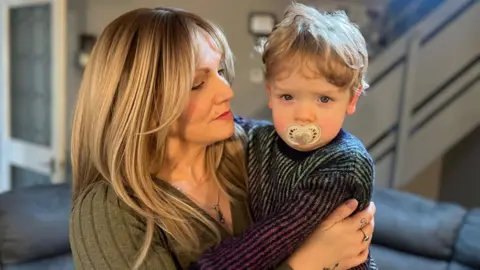
Abbie McNeill, from Dumfries and Galloway, is facing a wait of up to three years to have her two youngest children assessed for autism and ADHD.
Two-year-old Dalton and his brother Grayson, 3, are among thousands of youngsters on the waiting list for the assessment.
The mother-of-four told BBC Scotland News the wait was so stressful her hair has been falling out.
A diagnosis is often required before a family can get tailored support from social work or at school.
 Abbie McNeill
Abbie's youngest son has a rare genetic condition and he is currently unable to talk or walk unaided. He has hypermobility and suffers from vacant episodes.
There is a 50% chance that Grayson may also have the hereditary condition, 16p13.11 microdeletion syndrome.
''They are presenting two completely different challenges," Abbie, from Lochmaben, said. "Dalton is presenting with the more autistic traits, whereas Grayson is very much behavioural challenges.
''Having an NDAS (Neurodevelopmental Assessment Service) diagnosis for both of my boys would very much give clarity for everybody involved.
"From staff at school so that they're given the right support, to things like whether we need a blue badge for transport for Dalton and financial support too."
With no answers on when her children may be assessed, Abbie said her own mental and physical health was suffering.
Her relationship with her partner has also broken down, which she said was "very difficult" and was caused by the relentless stress.
''Every night I lose sleep with worry," she said.
"My hair is starting to fall out to the point I now have to wear hair pieces, which has impacted my confidence massively. It's like living in emotional hell."
There are currently 2,235 children waiting for NDAS assessments in Dumfries and Galloway, according to statistics obtained by BBC Scotland News.
Most children in the region are waiting between two and three years for the tests, with almost 150 cases waiting for more than three years.
Data shared with the health, social care and sport committee last year showed 42,000 children across Scotland were waiting for the assessments.
The longest waiting times for each health board varied - from one year in the Western Isles to six-and-a-half years in Ayrshire and Arran.
Rob Holland, director of the National Autistic Society Scotland, told the BBC's Radio Scotland Breakfast programme: "It is absolutely a postcode lottery.
"There are some areas where the wait can be a matter of months and there are some areas where it can be a matter of years.
"It very much is inconsistent."
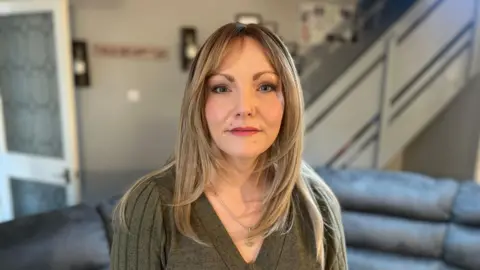
Abbie has started a petition calling for urgent action from local and national government to reform the NDAS system.
''The families who have reached out and told me their stories have been quite harrowing and I've been in tears," she said.
"For those children who are neurodivergent, there are challenges. This system that is in place, NDAS, is failing them all massively."
NHS Dumfries and Galloway said its waiting list reflected a wider picture of high demand and limited capacity across Scotland, with significant pressures on services.
A spokesperson said: ''Families in Dumfries and Galloway are given clear information about expected waiting times at referral, and we work to keep them updated throughout the process.
''We are actively working to improve the situation through a new, co-designed neurodevelopmental assessment pathway.''
The parliament's health and social care committee said it recognised the unprecedented demand for neurodevelopmental assessment and the need to put certain thresholds in place before a referral was made.
But it warned this approach could be seen as "gatekeeping" and could cause delays to accessing assessments and support.
Its report also highlighted evidence that long waiting times can push people into crisis, which can increase complexity of the support needed and put additional pressure on services.
It said this could also result in people paying for a private diagnosis, risking a two-tier system.
The committee also called for:
- A comprehensive review of assessment processes, leading to a national standard that guarantees consistency, responsiveness and support
- Consistent, high-quality communication with people on waiting lists
- Mandatory training for everyone involved in making referrals
- Consistent national data on referrals and waiting times
Committee convener Clare Haughey said: "Our inquiry has shone a light on the myriad issues those with neurodevelopmental conditions face in accessing and receiving support from Scotland's NHS.
"We acknowledge the huge rise in demand for assessment and diagnosis and the huge pressure this places on services.
"But we are concerned that inconsistent care pathways and a lack of support can leave some feeling isolated and unable to access the support they need."
She added: "It's clear things need to improve."
The Scottish charity, Stand Together for Autism and Neuro Divergence, said a formal diagnosis was not a luxury or a label.
Claire Stock, a volunteer with the charity, said: "While it is the case that support for all children should be needs-led rather than diagnosis-led, the reality on the ground is that many essential supports still rely heavily on diagnosis, whether officially or unofficially.
"ADHD medication cannot be prescribed without a diagnosis, some social work support requires a diagnosis, and in education many children and their families experience their concerns being dismissed or deprioritised if they don't have a formal diagnosis.
''A diagnosis helps families understand their child, advocate effectively, and plan for the future with clarity rather than constant uncertainty.''
The Scottish government said demand for neurodevelopmental diagnosis had increased significantly in recent years.
Tom Arthur, minister for mental wellbeing, said: "I am determined to use every lever at my disposal to drive real, meaningful improvements and deliver the best possible outcomes for neurodivergent people.
"We are working to make changes to our system to ensure that people can access timely support based on their needs, without requiring a diagnosis – as set out in the National Neurodevelopmental Specification.''
He said more than £1m of the extra £3.4m announced on Sunday was intended to directly support families, through measures such as providing access to digital support on neurodevelopmental conditions.
"A diagnosis is just one part of someone's experience," he said. "What matters most is that people get the right support at the right time, and this funding will help make that happen."
