Power from peelings at new food waste plant

 BBC
BBCA company that processes food waste is opening a second site next month to meet rising demand from councils across the south coast.
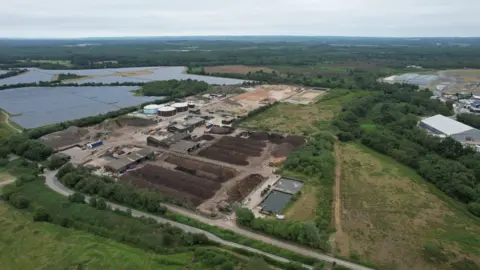
Eco Sustainable Solutions already handles 80–100 tonnes of food waste a day – about 42,000 tonnes a year – at its anaerobic digestion plant near Piddlehinton in west Dorset.
The new £16m facility at West Parley, north of Christchurch, will take a further 70,000 tonnes a year collected from kerbsides and will cut the distance waste has to travel for processing.
Bryony Hammond, from Eco, said: "What's really exciting is the new plant will produce gas which can go direct into the homes of people who've had their food collected and sent here."
Councils from across Dorset and as far away as the Isle of Wight and Portsmouth have been sending their food waste to the Piddlehinton site for years.
Demand is rising as councils face a government deadline to introduce kerbside food‑waste collections by the end of March.
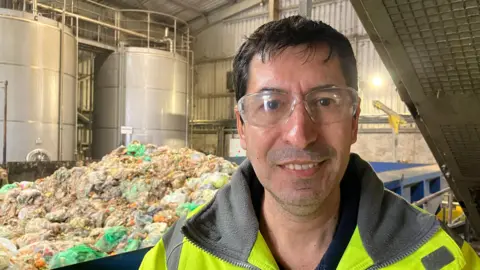
Antonio Rodrigues, plant manager at Eco solutions in Piddlehinton, has worked there for 20 years and admitted the smell could be overwhelming and that he had to get used to it.
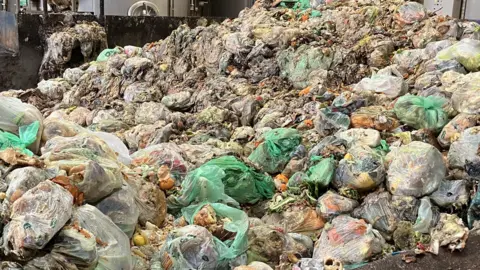
He oversees the arrival of thousands of bags of food waste every day that are tipped into a gigantic skip, called a hopper.
It is left for 24 hours to decay, although much of it arrives mouldy and already decomposing.
It is then mixed up with a blender and goes through a shredder machine, which removes plastic.
This can be present if people have used the wrong sort of bag for their food waste, or have thrown away a microwave meal container into their food bin.
 Eco Sustainable Solutions
Rodrigues said: "This is a really hard part of the process, as some plastic is really elastic and stringy and it's difficult to get it out. We have to squish the food waste through a screener".
The brown gunky soup of squashed food waste is pumped into anaerobic digestion tanks where bacteria breaks it down over 45 days.
Two products are created.
At Piddlehinton, the biogas is burnt to fuel two large engines, producing enough electricity to power 4,000 homes a year.
In West Parley, the new plant is gas to grid, meaning the biomethane created can be fed straight back into the gas network or be used to fuel the HGVs that bring the food waste.
The digestate, or gunk left at the bottom of the tanks, is used as a soil fertiliser.
The separated plastic is sent to landfill.
Rodrigues urged people to make use of their food waste collections.
"I love my job, it's incredibly clever, the technology behind it and to be able to give back to the environment and community is fascinating," he said.
