'I didn't know I was at high prostate cancer risk'

 BBC
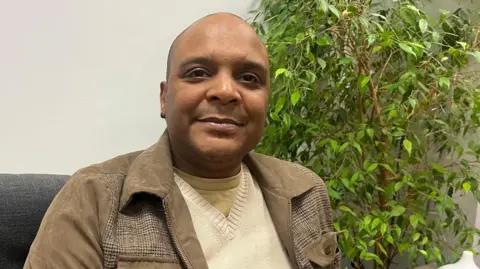
BBCThree years ago, Maurice Blake was diagnosed with prostate cancer.
"I didn't have any of the traditional symptoms, apart from the random signs of blood every so often," said the 52-year-old building services engineer from Manchester.
The diagnosis came as a huge shock to Maurice and also led to him discovering an alarming statistic. According to Prostate Cancer UK, black men are twice as likely to suffer from it than the population as a whole.
Maurice said he was determined to raise awareness about this disparity and campaign for more effective research and treatment options.
"To actually find out that I was in a higher risk group was quite alarming," he said.
"I then found out that when [black men] are diagnosed with cancer that our cancers tend to be more aggressive and that the treatment options available to us are reduced because we've not been involved actively in clinical trials.
"So when medications and treatments are being put forward to try and tackle prostate cancer, because we weren't part of the system or our information wasn't part of the data, it meant it was less likely to have any effect on us."
'Push for change'
Following his diagnosis, Maurice was closely monitored for the first year before being told that his cancer had grown in size and become more aggressive.
He began radiotherapy as well as being accepted on a clinical trial for further treatment.
Eighteen months on, Maurice is now in remission.
He is determined to raise awareness of the health inequalities faced by black men.
"We need to actively be involved, actually stand up and have your voice counted and actively push for change and instigate a national screening process," he said.
According to Prostate Cancer UK, more than 63,000 men are diagnosed with the disease each year in the UK, and it claims more than 12,000 lives.
It is now the most common form of cancer for men in the UK.
Men aged 50 or over can ask their GP for a prostate specific antigen (PSA) test but there is currently no national screening programme - in which men without any symptoms are invited for a test to look for signs of prostate cancer.
Despite a huge increase in prostate cancer cases, men often face a postcode lottery when it comes to diagnosis.
In November, the UK's National Screening Committee recommended that only a very small group of men at high risk of prostate cancer - with a confirmed BRCA gene variant - should be screened.
This means no screening was recommended for other high-risk groups, such as black men and men with a family history of prostate cancer.
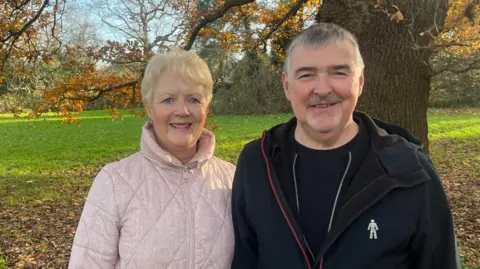
Tony Collier, who was diagnosed with incurable prostate cancer in 2017, said: "If I'd had that simple blood test I could be in a totally different position now, instead of being given a worst case prognosis of two to three years."
He said he was only diagnosed when he went to a doctor with a groin strain while training for a marathon.
"Being told you have cancer is devastating; being told it's incurable is indescribable and you immediately go to a very dark place," he said.
"[The doctor] said 'you may be lucky and get longer'.
"But you only hear the 'two to three years', you don't hear the 'longer'.
"I started living as if I was going to die in two years' time. I got that so wrong.
"I spent the 18 months after my diagnosis thinking so much of dying that I forgot the joy of living.
"I soon realised I needed to sort myself out."
Tony's wife Tracey said they kept each other strong by focusing on living in the present.
"I did say to him at the time 'If you're still here then you've wasted 12 months.'
"Don't waste a day, don't just sit in a chair and wait for it to end."
Tony said he was now determined to make sure "as few men as possible end up like me".
"It's really important that we save as many men's lives as possible. And 12,000 men are dying every year. That's one every 45 minutes.
"The quicker we stop that, the better. And the only way we can stop that is with a screening programme.
"In the meantime, we've just got awareness. That's all we've got left."
The screening committee will make its final recommendations to the governments of the four UK nations later this month after a consultation process closed in February.
Listen to the best of BBC Radio Manchester on Sounds and follow BBC Manchester on Facebook, X, and Instagram. You can also send story ideas via Whatsapp to 0808 100 2230.
