Could graphene come of age in Atom Valley?

 Getty Images
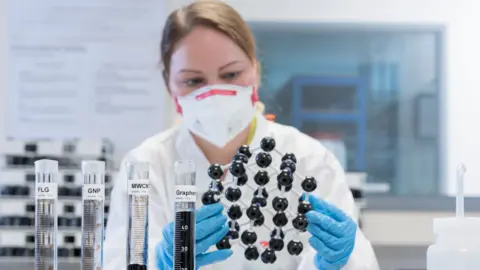
It is now 21 years since graphene - the "miracle" material made in Manchester - was first shown to the world by two academics who discovered it when they were playing with sticky tape one night.
The thinnest and strongest substance ever recorded led to acclaim and Nobel prizes - but scientists who have studied it acknowledge it has not yet changed the world in the way it was thought it could.
Greater Manchester mayor Andy Burnham said graphene's journey to world domination would begin in some fields next to the M62.
They have been earmarked as Atom Valley, and the first part is due to open this year.
"This is the place where graphene and other materials will go into mass production," Burnham said.
"It will be a global cluster of leading work in advanced materials and manufacturing," he said.
The patchwork of public bodies behind the plans say 20,000 people could eventually be working across the three sites that will comprise Atom Valley in the boroughs of Rochdale, Bury and Oldham.
'Tipping point'
The intention is that Atom Valley will be unlike other business parks or industrial estates because the development of the three sites will be guided around advanced manufacturing companies - those companies that rely on cutting-edge science and research.
Start-up companies working in advanced manufacturing with materials like grapehene often have to begin by experimenting to develop their products before they can scale-up to mass production.
If Atom Valley were an actual atom then its nucleus - the most important part ofthe site would be the Sustainable Materials and Manufacturing Centre (SMMC), which is due to open in the summer.
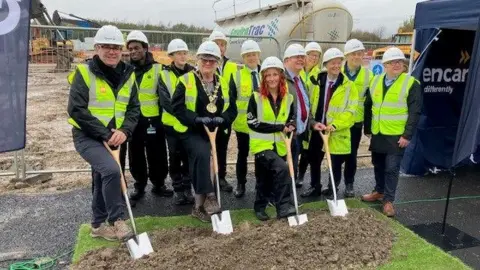
The SMMC will be a hub where small start-up advanced manufacturers can base themselves to conduct the research and experiments they need to be able to scale-up.
Professor James Baker from the University of Manchester, who has been attempting to spearhead the effort to realise graphene's potential, told the BBC last year that research since its discovery in 2004 had brought researchers to a "tipping point" where they "know how to make it work and we know how to make it work affordably".
"It's no good making graphene by the gram or the milligram. We need to make it by the kilo, by the tonne, by the 100 ton."
"And the good news is now you can," he said.
Burnham has been granted special devolved government powers to drive investment across the three sites, which he said will eventually transform the area in the same way the Media City UK development has transformed part of Salford.
"Think Media City - that's a cluster for creative and digital.
"This is the same thing at the other end of the city region for materials and how you put modern materials into manufacturing processes," Burnham said.
'Grow the local economy'
Chromition is a small start-up company that is looking at the possibility of relocating to one of the Atom Valley sites from its two premises in Stockport and Alderley Park in Cheshire.
The firm needs specialised lab space because it is developing nanoparticles for a luminous substance that is aimed at making cancer diagnoses more effective and less invasive.
CEO and co-founder Mark McCairn said he was attracted to Atom Valley because it would bring together companies like his "with industry, with universities, with research institutions across the region".
"I'm hoping on a personal level for Chromition that it propels us to the next level on a global stage to actually grow the local economy but also capitalise on a growing market in advanced materials," he said.
 Rochdale Council
Being close to other companies in the advanced manufacturing sector and research support from universities would, he said, lead to a transfer of knowledge and skills between them, as well as providing "the resources and capabilities that are actually required to create jobs, to innovate and grow the local economy".
But unlike Media City, which was built on derelict dockyards, Atom Valley will be developed across green countryside - albeit countryside which is on the edge of a huge city region and close to a motorway.
The Atom Valley proposals are tied-in to plans for 7,000 new homes, which together have inspired resistance from some of the surrounding areas, including the village of Simister.
'Beautiful views'
Joe Leahy, from Simister Village Community Association, said residents were not just upset about the loss of "beautiful views". He said: "The wildlife that all this supports is just going to be gone."
"It doesn't make any sense," he added.
"What's the point of living in a nice quaint village if it's just going to be turned into a city?" he said, adding the local roads would not be able to cope with the anticipated extra traffic.
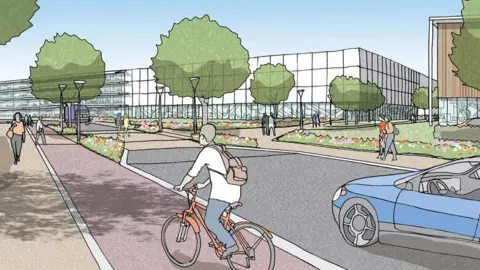
Council leaders point to the fact new roads - many named after some of Britain's most famous engineers - have already been built on the Rochdale site where the SMMC is being developed, along with a Metrolink tram stop.
Burnham also acknowledged that Atom Valley will need to "learn from" one of the criticisms that Media City has sometimes been hit with by those who live nearby in Salford - that the site has employed a lot of people who have moved in but not enough of those who already live in the area.
He said the organisations driving Atom Valley would need to "make sure there are really clear paths for young people growing up in Rochdale, Oldham and other surrounding areas into the really good jobs", including as an alternative to attending university.
But for Burnham, the three sites are not just about graphene and advanced materials changing the world.
They are also about changing parts of Greater Manchester which have long complained of being left behind.
"The whole strategy is to bring high level employment that in some ways are still struggling with the de-industrialisation we saw in the 20th century," he said.
Listen to the best of BBC Radio Manchester on Sounds and follow BBC Manchester on Facebook, X, and Instagram. You can also send story ideas via Whatsapp to 0808 100 2230.
