Why are people in such a flap about pigeons?

 Peck Savers
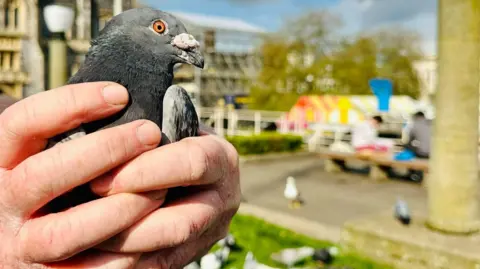
They are the bird that some of us love to hate - the nuisance "rats with wings" who scavenge food and pepper our pavements with poo.
To others, flocks of feral pigeons in our towns and cities are a thing of beauty and deserve as much care and respect as any other creature.
Since Norwich City Council began its (so far unsuccessful) attempts to deter the birds, it has come up against defiant pigeon-feeders, some of whom have been filmed by the BBC emptying large bags of seed.
Why has the scruffier cousin of the sleek domestic pigeon - and any suggestion of a deterrent - become such a divisive subject?
What's the issue?
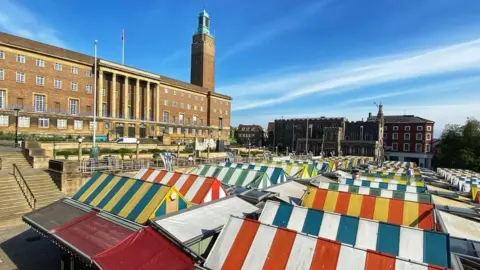
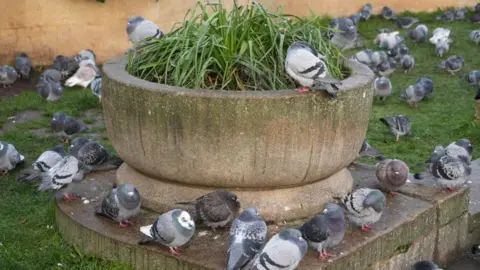
Pigeons have flocked to Norwich Market for many years, tempted by the food stalls and anyone carrying their lunch up to the adjoining memorial gardens to eat.
As well as grabbing the odd stray chip, market pigeons have the bonus of bird seed being deliberately scattered around the gardens on a daily basis.
And with pigeons, comes poop, which is jet-washed away by street cleaners. In 2015, the city council put up signs asking people not to feed them, to no avail.
The issue raised its head again recently when the council unveiled £740,000 plans to revamp the market, which has become more street food-focused in the past few years.
Carli Harper, a Labour councillor and cabinet member for finance and major projects on the authority, said thousands of people wanted the pigeon issue made a "priority" and sorted.
 Shaun Whitmore/BBC
Stall holders, it's fair to say, generally aren't fans of our feathered friends.
"It is a serious public health risk and unhygienic," Rob Butcher, the owner of Ron's Fish and Chips at the market, previously told the BBC.
"It's just nonsense, we have a market now where the majority is food and nothing is done properly to address the issue," he said.
"They [the pigeons] fly low under the canopies when people are buying and eating food.
"People are ducking and screaming all the time because they are flying directly at them," he added.
What has been done - and why hasn't it worked?
 Shaun Whitmore/BBC
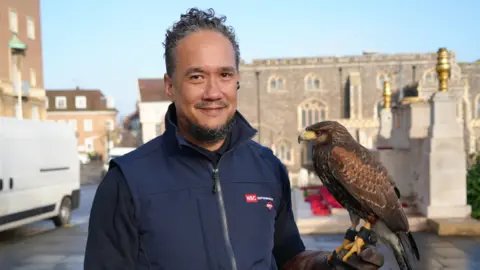
The council hoped Harris's hawks would ruffle some feathers and deter pigeons and gulls from the market.
It paid £4,000 for a falconer to patrol the market for four weeks at the end of last year, with the idea that the bird of prey's domineering presence would encourage the pigeons to clear off.
It may have worked at London railway stations and the Wimbledon Championships for years, but not so in Norwich.
The project was scrapped after bird-feeding folk ignored the council's plea not to feed the birds appeared to up the ante, providing a regular al fresco buffet which rendered the scare method pointless.
Thousands of people also backed a petition calling for the pigeons to be given a nesting site elsewhere.
Harper said "selfish" people had been giving the pigeons "industrial amounts of bird feed", and insisted the move had been "pro-market" rather than "anti-pigeon".
What do pigeon fans say?
 Owen Sennitt/LDRS
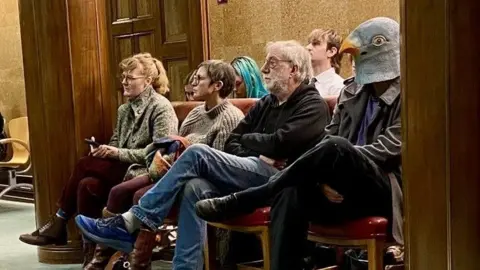
One thing this debate has revealed: pigeon-feeders are unshakeable in their determination to spread a bit of bird seed.
"I have been told not to feed them before. I said just 'fine me'," Sandi Lowe previously told the BBC.
The 69-year-old regularly feeds the pigeons and called it her "god given right".
 Paul Moseley/BBC
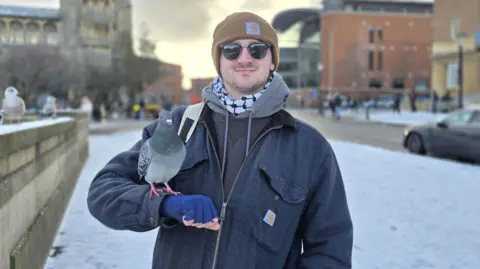
Another time, a BBC reporter saw three people separately turn up with bags of bird seed in the space of 15 minutes.
One of them, Niall Adams - who feeds the pigeons several times a week - said the pigeon supporters were being "vilified" by the council.
"I think if you're suggesting you're going to fine people for feeding pigeons, people will do it anyway – they'll [just] do it more secretively," he said.
Jenny Coupland, who cares for injured birds, said "industrial-sized bags" of seed, as claimed by Harper, was an exaggeration.
She said she fed birds small amounts in order to untangle litter from their legs and feet, and agreed that constantly providing a food source in one location encouraged them to flock.
All attempts by the council were a waste of taxpayer's money, she claimed.
"They should move the flock to Chapelfield Gardens and create a dovecote and replace eggs with dummy eggs, which has been proven to work elsewhere in bringing the population down," she said.
Are pigeons unfairly maligned?
 Paul Moseley/BBC
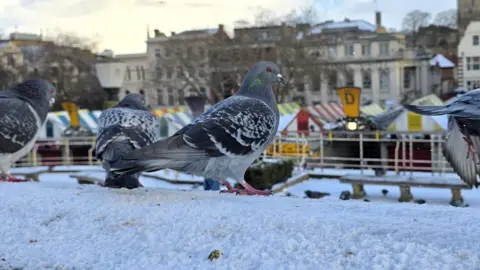
Will Smith, an evolutionary biologist who has studied the birds and how they compare to their wild relatives, rock doves, certainly thinks so.
He pointed out that feral pigeons are a human-created entity in that they descend from tamed pigeons which escaped from dovecotes, or which failed to find their way home after races.
"Feral pigeons get the quite nasty name of 'rats with wings', which is not quite fair," he said.
"Culturally, we forget that just a few generations ago we put these birds on a pedestal.
"It's only over the past century really that we see them as a dirty pest."
 Will Smith
While feral pigeons can carry disease, this was true of all wild animals, he added, and they were found to be "very resistant" to avian influenza - the main worry with getting close to wild birds.
Their crucial role during wartime is well documented and they were loved by Charles Darwin, who dedicated a whole chapter of On the Origin of Species to the diversity of domestic pigeon breeds and how they differ to rock doves.
"He once wrote to a friend that to see someone's pigeon flock is 'the greatest treat, in my opinion, which can be offered'," said Smith, who is based at the University of Nottingham.
Interestingly, pigeons are one of the only birds which can make "milk", secreted from a pouch near the stomach which the chick can then feed on from the beaks of both parents.
"This means that they can convert all the rubbish they eat on the streets into something nutritious for their young - which is probably part of their secret for how they survive in cities," he said.
There are no statistics on their numbers but they are estimated to be in the hundreds of thousands in the UK, compared with millions of wood pigeons.
"It is really amazing that a bird has managed to adapt so well to an urban ecosystem," added Smith.
"They are fully dependent on humans though, which means that debates such as this can become very controversial because people often feel such ownership of their local birds."
Would they starve if we did not feed them?
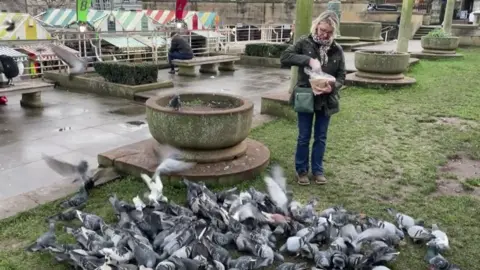
It has been claimed that it would be cruel to stop feeding pigeons, and that they may even starve.
Smith said scraps and deliberately-provided food formed their main source of food and unlike most wild birds they did not forage "in nature".
Life would certainly get "tricky" for feral pigeons if that suddenly stopped - with the gradual reduction in food being the "most humane" method, he added.
"They can become dependent on just one location," he explained.
"People can often think that they only feed a tiny bag of seed, but if it's lots of people, in the same place, this can quickly add up to a very large quantity of food.
"Pigeons can of course, and probably will, find new sources of food, but if feeding has been going on for a long enough time, then the population size could have grown to a size where it would not be sustainable without that large food supply."
What happens now?
Councillors are considering the possibility of fines for feeding pigeons at the market and memorial gardens.
It has proven a successful way of curbing the population in London's Trafalgar Square - once the country's most famous pigeon-feeding spot - and has been introduced in other areas, including in Boston, Darlington and several west Yorkshire towns.
For now, the city council is looking into the use of contraceptives, hidden within food, to provide a "humane and non-lethal" population control method to curb the growing flock.
Follow Norfolk news on BBC Sounds, Facebook, Instagram and X.
