'Hanging cloths' sports site granted listed status

 Historic England Archive
A "remarkable" concrete building inspired by hanging cloths has been granted protected status on the centenary of its Swiss architect's birth.
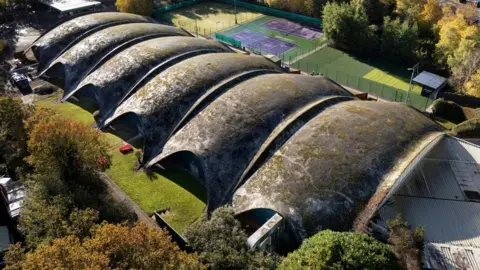
The former Norwich Sports Village, which opened in Hellesdon in 1988, has been given a Grade II listing by the Department for Culture, Media and Sport on the advice of Historic England.
The complex, now a David Lloyd health club, is the only UK example of work by the renowned engineer Heinz Isler, who was born in 1926 and died in 2009.
"The listing of Norwich Sports Village recognises a remarkable and internationally significant building in the heart of the city," said Tony Calladine, Historic England's eastern region director.
He added: "The only building in Britain by celebrated structural designer Heinz Isler, it is a striking historical landmark and an important part of the local community."
 Historic England Archive
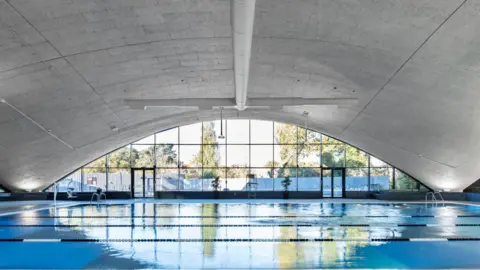
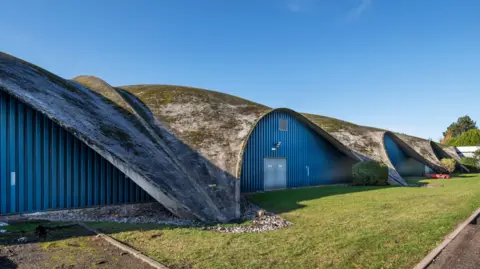
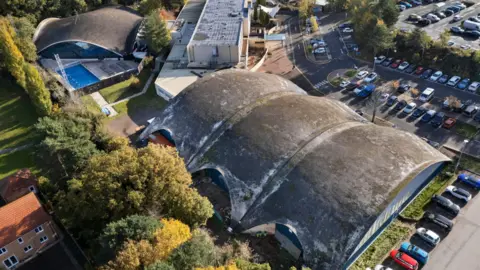
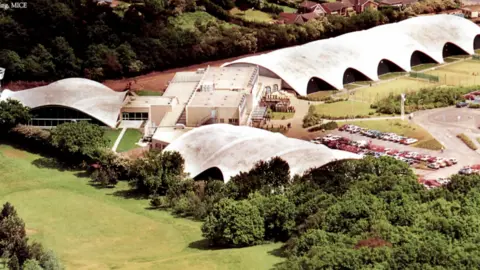
The complex has been deemed nationally important for its inverted membrane concrete shells.
They were inspired by the shape of hanging cloths and Historic England said they were the only example of free-form shell design in Britain.
The design became the specialism of Isler, who was inspired by the shape of his plumped-up pillow when working on his first project, a Swiss hotel, in the mid-1950s.
He created about 1,000 shell structures across Europe and four of his buildings in his native Switzerland have been protected.
 Historic England Archive
According to Historic England - the public body that manages the country's heritage register - concrete shell construction was introduced in Britain in the 1930s, but has remained rare.
The Norwich Sports Village building, in Drayton High Road, is one of only three such shell structures built in England since the 1970s.
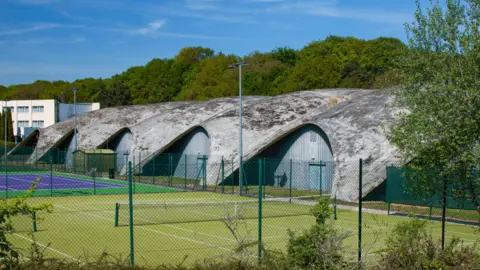
The listing covers the concrete shells of the sports hall, former skating rink and swimming pool.
Most of the building was constructed in 1987, before it opened the following year - while the swimming pool was built later and opened in 1991.
 John East/Twentieth Century Society
The Twentieth Century Society had campaigned to get the site listed due to its uniqueness.
Its director Catherine Croft said: "The graceful, tent-like canopies... are a masterpiece of engineering, making the super-fine 100mm thick concrete shell ripple and billow like it's blowing in the wind.
"These are unique structures in the UK and we're delighted to see them recognised with national listing.
"Perhaps, just as importantly, they're still well used and serving their original purpose; to provide an elegant and practical shelter for the various activities beneath - a swim, trip to the gym, or a game of tennis."
 Historic England Archive
Other well-known buildings that used the shell structure included the 1930s Doncaster Municipal Airport - now demolished - and a Grade II-listed 1940s bus depot in Manchester, the society said.
A school sports hall in Worcestershire, and a sports centre in Mildenhall, Suffolk, both built to an Italian engineer's shell design in 1977 and Grade II-listed, were thought to be the last examples of the construction nationally, until Norwich Sport Village.
 Linford Heli Photos/Twentieth Century Society
Prof John Chilton, emeritus professor of architecture at the University of Nottingham, said Isler spent years experimenting with the design.
"He would have been absolutely thrilled that the shells of Norwich Sports Village have been listed," he said.
Follow Norfolk news on BBC Sounds, Facebook, Instagram and X.
