Lost Robert Burns portrait discovered after 200 years

 PA Media
It's a missing painting story worthy of Sherlock Holmes.
In 1803, the greatest painter of the day, Sir Henry Raeburn, was commissioned to create a new image of the greatest poet of the day, Robert Burns.
Burns, who had died a few years earlier, had only ever agreed to sit for one artist, Alexander Nasmyth in 1787 and that painting became the template for every image.
The publishers – Cadell and Davies – paid 20 guineas for the new painting which they planned to use as an engraving in all future editions of Burns' books.
Although the painting was delivered a year later, it was never used as planned. In fact, it vanished altogether - setting in motion a mystery which has taken 200 years to resolve.
Burns scholar and enthusiast Dr Bill Zachs said: "Arthur Conan Doyle, the creator of Sherlock Holmes, reported about a séance that happened where a crazy Burns collector named Edward Barrington Nash tried through the medium of a spirit to invoke Robert Burns and find where this missing portrait was."
The director of Glasgow Art Galleries and Museums, TCF Brotchie, wrote in 1924 that "its discovery would be an event bordering upon the sensational".
But it would take a further 100 years for that sensational moment to happen.
Zachs, who is director of the Blackie House Library and Museum in Edinburgh, had been searching for the lost Raeburn since he first came to Edinburgh 42 years ago.
Last March, he came across a painting in a London auction house, part of a house clearance.
"There have been so many copies of the Nasmyth in auctions over the years. I have two or three myself," he said.
"So there was no reason to think that this was the missing painting - except that I had acquired a letter 20 years before from the man who had the Nasmyth portrait in his possession and who chose Raeburn as the person to produce a new painting, an image of Burns that would endure for the ages."
That man was Alexander Cunningham, a close friend of Burns who had become a custodian of the Nasmyth painting.
He agreed that it could be used as the basis for a new image of Burns – as long as the artist was Raeburn. The leading portraitist of the late 18th and early 19th century, he was renowned for his direct and powerful style.
 Nick Mailer
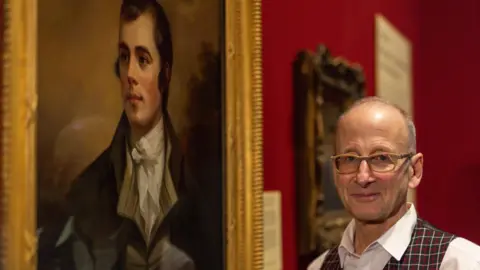
While he uses the Nasmyth work as his template, his Burns is younger, fresher faced and more vivacious than the original.
Zachs believes he may have met Burns – and was painting from memory as much as from the only available portrait.
With a starting price of £300-£500, he was willing to take a chance but others had the same idea, and the bids pushed the final price up to £68,000.
It was only then that Zachs could return to Scotland and begin the process of having the work cleaned and verified.
Lesley Stevenson, senior conservator of paintings at the National Galleries of Scotland in Edinburgh, is among several experts who have since confirmed the Raeburn attribution.
"Raeburn's expressive, seemingly effortless brushwork, the characteristic warm palette, soft atmospheric lighting and sensitive rendering of the instantly recognisable Robert Burns are a joy," she said.
"This is a significant discovery and one we can all celebrate."
On public display
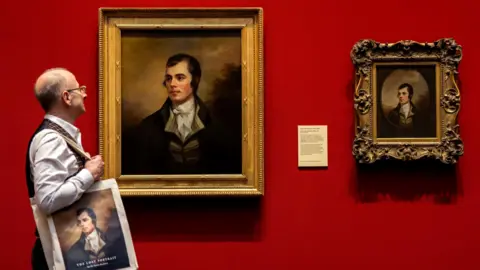
This week the painting went on public display for the first time, alongside the Nasmyth portrait which already belongs to the National Galleries of Scotland.
Director general Anne Lyden said: "We call it the patron portrait.
"It is the one that people call to mind when they think about Robert Burns because it's featured in everything from shortbread tins to tea towels and key rings.
"Everything originates from that.
"But to see it hanging side by side with the Raeburn and look at the differences in size, in palette and in light is very special.
"It just makes Burns feel like a real living figure."
Having been "lost" for two centuries, the painting is now back home in the place where it was first made, and just in time for Burns Night.
Zachs is lending the work to the National Galleries of Scotland where it will be free to see until July, when it will transfer to the Robert Burns Birthplace Museum in Ayr.
"To share this painting is fantastic and the story is just beginning," he said.
"The doors have only just opened and I hope people will come and see for themselves this work which has been hidden from the world for 200 years."
