How a rescue attempt of a whale in the Thames brought millions together

 AFP via Getty Images
Mark Stevens has spent years rescuing stranded whales, dolphins and other large marine mammals around the British Isles, but one event two decades ago remains etched in his mind.
"We'd never heard of PTSD (post-traumatic stress disorder) before, but down the line we realised that that's what it left us with," he recalls.
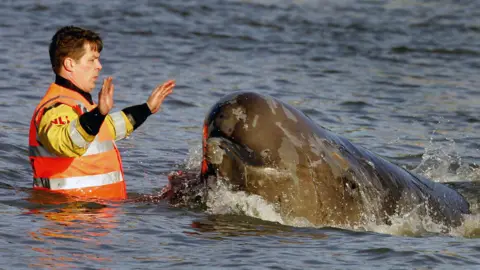
On Friday 19 January 2006, a photo appeared of a huge whale swimming in the River Thames past the Houses of Parliament.
Stevens says those at the charity British Divers Marine Life Rescue (BDMLR) had heard a whale was in the river earlier in the week but that the photo confirmed it was a northern bottlenose, a deep-diving species usually found in the North Atlantic.
A science teacher by trade, he was at work that day when he got the call to head to central London.
"I told my head teacher I was going to London to rescue a whale and that she could sack me on Monday... She didn't, I hasten to add," he says.
With more sightings throughout the day, excitement was building and the following morning Stevens was appearing on Breakfast television as the interest continued to grow.
 Getty Images
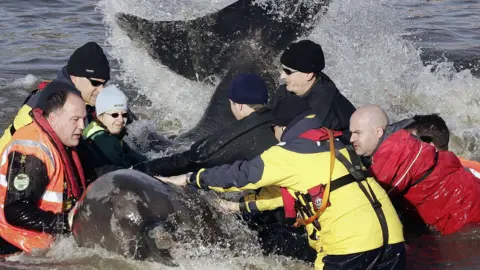
Later that morning he boarded a boat near Albert Bridge where the whale had been located, and a plan was devised.
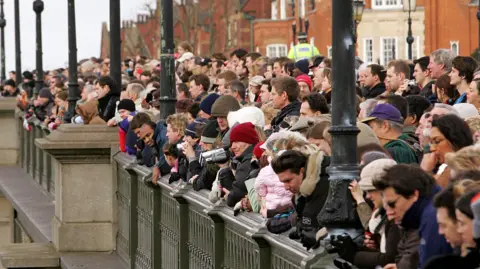
Thousands of people were now cramming on to the surrounding riverbanks and bridges trying to get a glimpse of the 19ft (5.85m) long whale, while in the water the team were being pursued by a vessel filled with press and photographers
With the promise of getting "the best photographs you're ever going to get", Stevens persuaded the journalists to use their boat to help manoeuvre the mammal on to a sandbank to secure it so that a veterinary check could be carried out.
He says that while the team considered the chances of the whale surviving to only be "50-50 at best", they still decided to attempt a rescue.
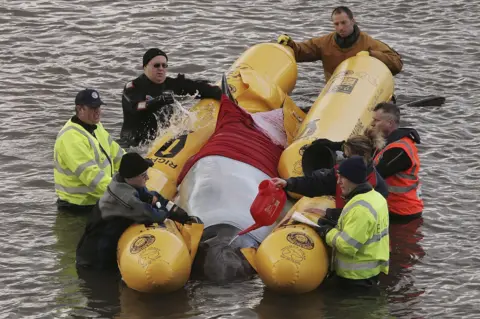
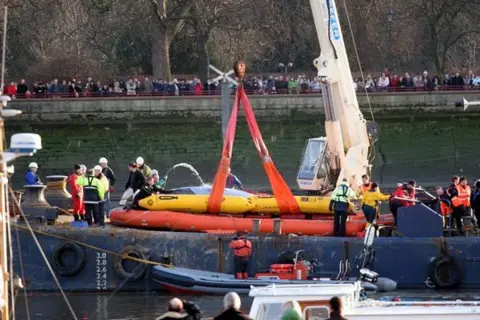
The weight of the whale meant a crane was required to winch it on to a barge so it could be taken out to sea, so inflatable pontoons were first positioned on either side of the mammal to carefully manoeuvre it in place.
However, this work then accelerated dramatically as they learned they were racing against the tide otherwise the crane would not fit under London's bridges.
"As soon as the whale touched the lifting barge and was on the boat, we started moving - the anchor wasn't even up at that time because there was such a rush but we just about made it," says Stevens.
 AFP via Getty Images
Among those onboard as part of the veterinary team was Rob Deaville, project manager for the UK Cetacean Strandings Investigation Programme, which is affiliated with the Zoological Society of London.
He had dealt with other whale strandings in the Thames but describes what happened as a "once-in-a-lifetime experience", with so many having headed to the river, no doubt buoyed on by it being a sunny day.
"The most impressive thing was the response of Londoners - it was almost like a carnival atmosphere; people were lining every bridge, all along the Thames we could hear people cheering as the barge was being driven out."
At the same time, news coverage of the rescue attempt was being beamed live around the world with helicopters hovering overhead filming everything that happened.
"We were advised later something like 20 million people were watching. We were glad we didn't know at the time because that would possibly freak us out a bit," Deaville says.
 Getty Images
The barge continued its journey east, winding along the Thames towards the English Channel, with people still lining the banks cheering loudly in the fading light.
But as the rescue group neared Gravesend in Kent the whale began to convulse and it was concluded that it would not survive.
"We did inject it with drugs to put it to sleep," says Deaville. "We weren't sure if that was what did for it but it obviously then died on the boat."
A solemn and heavy silence then spread across the vessel as the team learned their day-long efforts had failed.
"Even knowing that it was at best 50-50, you put your heart and soul into it and everybody was very upset.
"I asked the skipper of the barge to turn the deck lights off just so we could have a quiet moment to ourselves," Stevens says.
 BDMLR
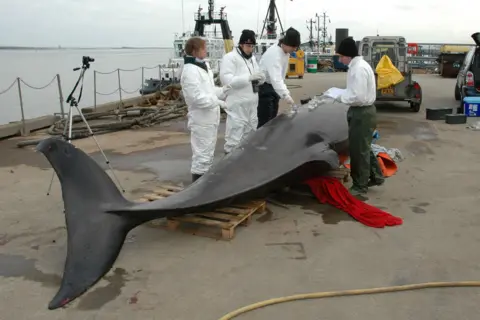
BDMLRThe whale was taken to a nearby landing spot where the following day the veterinary team carried out a post-mortem examination.
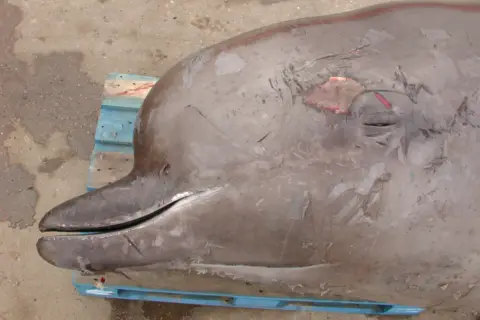
It revealed how unwell the female whale had been. A creature that lived off sea life found thousands of feet down in the depths, she had not being able to get the nutrition and liquids she needed in the coastal waters around Britain.
"It hadn't been feeding, it was also really dehydrated. It had effects from having live-stranded, probably repeatedly," says Deaville.
"There was only going to be one outcome, but that's what we learned after the facts."
 CSIP-ZSL
Deaville says the samples taken from the whale still help scientists to this day.
"Deep-diving whales are a really cryptic species. They're hard to study in the wild so when you get a stranding like that you try and collect as much as you can and it's fed into research for years now."
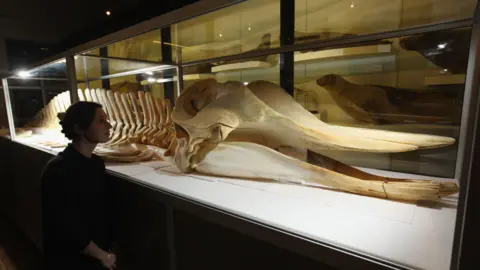
The whale's skeleton, which is held in the Natural History Museum stores, went on display in 2007 at the Guardian newspaper's headquarters in central London.
The marine mammal also fuelled artistic endeavour: the Damon Albarn-penned song Northern Whale and Oisín McKenna's 2024 novel Evenings and Weekends.
 Rod Penrose/MEM
What still stands out for Stevens 20 years on is how the life of one whale brought so many people together, with offers of help coming from everywhere - from the person who found out Stevens was diabetic and turned up with a plate of cheese-and-tomato sandwiches, to the government minister who phoned up to offer to get the Thames Barrier lowered.
The team even had the parking fines they had picked up during the day rescinded.
"I think I said afterwards if we wanted world peace - and Lord knows we could do with that at the moment - I think all you need to do is a whale rescue. It brings out the best in people."
 Getty Images
For Deaville, the events of that day demonstrated how far Britain had come from being a country he describes as once at "the epicentre of whaling".
"It shows how much we have changed from a nation of whalers to a nation of conservationists in a really short timeframe," he says.
"If that whale had come up the Thames 50 years ago, maybe it would have been killed as a shipping hazard rather than this huge rescue attempt.
"That's the really profound outcome from it."
Listen to the best of BBC Radio London on Sounds and follow BBC London on Facebook, X and Instagram. Send your story ideas to hello.bbclondon@bbc.co.uk
