The carol of peace based on a Biblical massacre

 Getty Images
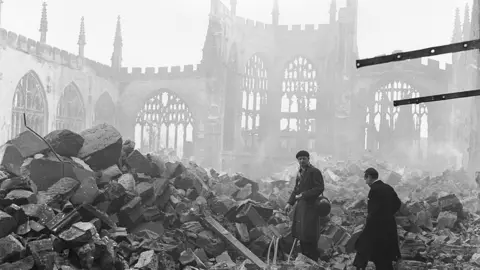
On Christmas Day 85 years ago, just weeks after the devastation of the Coventry Blitz, a small group gathered in the shattered shell of the city's cathedral for a service broadcast live to the nation.
Six weeks earlier, on 14 November 1940, German bombers had dropped hundreds of tons of explosives and incendiaries, destroying much of the city and its medieval cathedral.
Despite the devastation, Provost Richard Howard addressed the Empire from the ruins, speaking of forgiveness and hope, calling for the country to "banish hopes of revenge".
The service concluded with the choir singing the Coventry Carol, music as old as the cathedral itself, and a song which now exists alongside it as a symbol of peace and reconciliation born from tragedy.
The Coventry Carol is not "what you would call a normal carol," explained amateur city historian Malvern Carvell.
He has contributed to a new podcast, examining the origins of the piece, which was not initially associated with Christmas, he said.
 Getty Images
The music was first performed in the city's Mystery Plays - medieval religious dramas based on Bible stories.
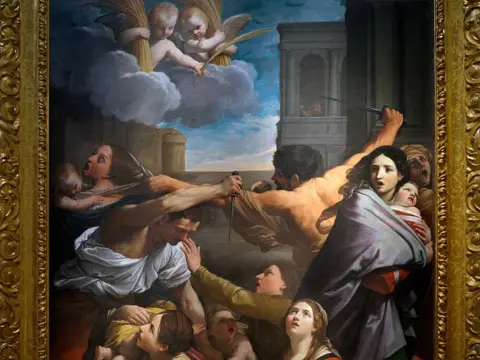
The story depicts the Massacre of the Innocents from the Gospel of Matthew, he explained.
Lully, lullay, thou little tiny child.
Bye bye, lully, lullay, the carol begins.
'Not normal Christmas cheer'
Its lyrics imagine "terrified mothers singing a haunting lullaby" to hide their babies from the swords of King Herod's soldiers who had been ordered to murder all male infants.
"They are saying quiet, quiet please, don't make a noise, Herod's men are coming to kill you," Mr Carvell said.
"It's fear, the carol is pure fear, he added.
"It's not your normal Christmas cheer."
Now a Christmas staple, covered by artists from Annie Lennox to US singer-songwriter Sufjan Stevens, the piece was first performed in Coventry's pageants, dating back to the 14th Century and involving stories surrounding Christ's life.
It was part of a play performed by the city's Guild of Shearmen and Taylors, with the first written record dating from 1534.
This copy, kept at the Library of Birmingham, was destroyed in a fire, but another record survived, he said, and by the late 1800s there was a move to revive it.
"I think possibly as a consequence of the fire the plays started to be better known again," Mr Carvell said.
"It then began to move into the public consciousness and became more well-known outside the city."
There is even speculation that Shakespeare may have witnessed the original performances in the late 16th Century.
 Getty Images
The link between Coventry and the biblical story of Herod's infanticide also found its way into modern popular culture.
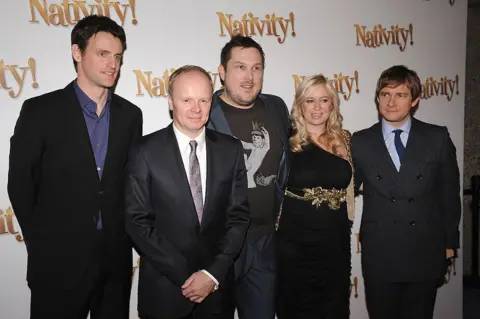
In the 2009 film Nativity!, set in the city, rival schools compete to stage the ultimate Christmas play.
One ambitious teacher, Gordon Shakespeare, played by Jason Watkins, opts for a primary school production of the Massacre of the Innocents.
The scene sees young pupils pull long red ribbons from a doll, symbolising blood, before tossing the baby dramatically into the lap of a visiting critic, played by Alan Carr.
 Getty Images
Director Debbie Isitt said the scene was one of her favourites in the film.
"It seemed so fitting for the story that Gordon with his dark, ominous, competitive streak should wish to create a play that focussed on the most disturbing of subjects - the Massacre of the Innocents," she said.
The character's inspiration was to "outdo the traditional school nativity and grab the attention of the critics and Hollywood," she added.
"The connection with the Coventry Carol and Coventry Cathedral made perfect sense and certainly inspired the moment in the film."
 Getty Images
BBC Russia Editor Steve Rosenberg has recorded a version of the carol this year with cellist and Channel 4 News presenter Ciaran Jenkins.
Their annual long-distance Christmas collaborations are broadcast on the BBC and Channel 4 as well as being shared on social media.
"The Coventry Carol was Ciaran's idea - and I happily agreed - it's a beautiful piece of music," said Steve.
"I heard Coventry Carol for the first time aged 18 and fell I love with it immediately. I was in a choir with a fantastic group of people who would go on to become friends for life," added Ciaran.
"We performed a little carol concert each year at a small rural church - it was incredibly idyllic: the scent of mulled wine, the flicker of candlelight, an audience glowing with goodwill. It was a very happy time."
'Poignant beauty'
In the podcast Hark! Rev Kate Massey, the cathedral's minister for arts and reconciliation, said the carol echoed the city's spiritual power.
"There is something incredibly intimate about it, this mother singing to her child, the way parents and carers do when things are difficult.
"They can't stop the bad things happening, but they can be there to hold them," she said.
She said Jesus was "born into a time of occupation, a time when his peers were at risk of violence".
"What breaks my heart even more about this carol is there are fathers and mothers and aunts and godparents around the world today who are soothing their children who are hungry, who are living through conflicts, who can't keep them safe from the world's dangers but still are loving them and comforting them," she added.
"I think it's an incredibly powerful carol from that point of view.
"The carol, for all of its melancholy, for all of its challenging grim material within the lyrics, it has that poignant beauty and again it sustains our soul, as all beauty does."
Nativity! is available to watch on BBC iPlayer.
Follow BBC Coventry & Warwickshire on BBC Sounds, Facebook, X and Instagram.
