'My brother's deteriorating health went unrecognised'

 BBC
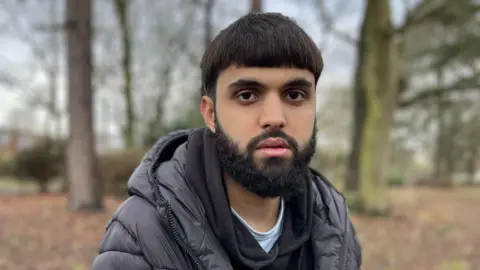
BBCWhen Adam Hussain repeatedly called 999 as his health took a turn for the worst, his brother thought help would come.
The 23-year-old was suffering from appendicitis but his worsening symptoms were dismissed as non-emergency and he developed sepsis, leading to his death on 16 May.
By the time he was taken to hospital, Adam had suffered a cardiac arrest and emergency surgery couldn't save him.
Would things have been different if help had come after numerous calls to 999 and 111?
That was Qasim Hussain's first thought when surgeons delivered the news his brother might not survive.
"I immediately asked them, 'if he was brought into hospital sooner would he have a chance of surviving?'
"They said that was a question that would be impossible to answer," he said.
But last week, a coroner concluded it was probable Adam would have survived his illness if an ambulance was sent to him earlier.
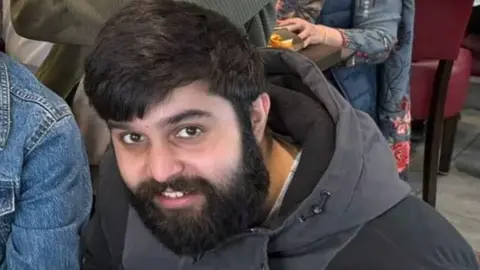 Qasim Hussain
Adam was staying with his brother in Clifton when he started to feel unwell with abdominal pain and vomiting.
His condition quickly deteriorated and his symptoms had been ongoing for eight hours when he made his first call to 999 on 12 May.
By the time of his third call to 999 the same day, Adam was shaking due to the pain he was in and breathing was becoming more difficult.
Still, the seriousness of his condition was not recognised.
"It became very distressing," Qasim said.
"When he reached out for help from the emergency services, they pushed everything away.
"They ignored a lot of things and made it seem like it wasn't urgent."
'He was clearly unwell'
On 14 May, Adam was complaining of blood in his urine, heart palpitations, feeling faint and was struggling to speak on the phone.
He was unable to get to a hospital by himself.
Qasim said: "They pushed a lot of things to the side and they tried to blame [symptoms] on other factors."
He said one clinician focused on the fact that Adam wasn't eating and drinking enough, suggesting that was making him unwell.
"A lot of the emergency services spoke to Adam and clearly when speaking to him you could really tell that he was unwell and a lot things were wrong, but they didn't seem to catch it and they didn't seem to investigate it more," he said.
An inquest at Nottingham Coroner's Court heard missed opportunities by East Midlands Ambulance Service (EMAS) and Nottingham Emergency Medical Services (NEMS) to identify and escalate Adam's condition contributed to his death.
NEMS provides an urgent care co-ordination hub to triage patients and navigate them to an appropriate next step.
Evidence highlighted issues in communication between NEMS and EMAS.
At one point Adam was told by a clinician that an ambulance would be sent, but a digital request for an ambulance was subsequently deemed not serious enough for attendance by EMAS.
When an ambulance did attend on 15 May, Adam was so unwell he collapsed.
Qasim felt unable to stay in the room.
"The ambulance called out for [more] help. Things went from zero to 100, things became very intense and overwhelming," he said.
The 22-year-old could hear medics performing CPR on his brother.
He said: "Every second that I could hear them still trying to recover his pulse, I knew that it was a chance he might not survive and that he could have passed away there and then."
Adam was taken to hospital and underwent emergency surgery.
He died the next day of multiple organ failure caused by septic shock due to appendicitis.
'Lonely and empty'
Adam was the eldest of four siblings and took on the responsibility of looking out for his family, Qasim said.
"Whenever we are together now as siblings, it feels lonely and empty," he added following the inquest.
"My brother, he was very kind. Very intelligent, very driven.
"He was ambitious and had a massive personality that people recognised."
At the inquest, Adam's family learned another young man died months earlier after a similar chain of events.
Jake Hartwright, from Sandiacre in Derbyshire, died on 17 January after collapsing at home and suffering a cardiac arrest.
He too had sought help from 999, the NHS 111 non-emergency number, and NEMS on 16 January, and had been unwell since 14 January.
Both of the men's deaths prompted the coroner to issue a prevention of future deaths report - sent when a coroner thinks action is needed to protect lives.
The coroner said there had been a third death which followed similar circumstances, with an inquest due to begin in 2026.
Qasim said there were "clear gaps" within the system that was supposed to be helping patients.
Promises to improve
EMAS and NEMS admitted there were failings in both Adam and Jake's care, accepted the coroner's findings and apologised.
Lucy Dadge, chief executive of NEMS, said the service fully accepted the coroner's findings, adding she was "deeply sorry for the mistakes [it] made in their care".
Dr Steven Dykes, clinical director at EMAS said: "We are working with our commissioners and partner services to ensure continuous improvement, shared learning, and quality care for patients."
Both services made promises to the families to ensure changes were made.
Qasim said: "It doesn't change anything. Adam has gone now.
"But I feel like some of the [inquest witnesses] were quite sincere and they have recognised their mistakes.
"I hope it's something they can learn from and can make the right improvements."
The NHS Nottingham and Nottinghamshire Integrated Care Board (ICB), which commissions NEMS to provide an urgent care hub, said it had worked with the service and EMAS to understand more about their investigations into Adam's and Jake's deaths.
Rosa Waddingham, executive director of quality at the ICB, said: "Both organisations are working closely to improve assessment, navigation, guidance and governance.
"As commissioners, we have supported them to make immediate changes to patient pathways as this work continues.
"In line with the coroner's recommendation, we will maintain close oversight of this work."
The ICB said it was also working with other care boards and NHS England to ensure the learning was adopted more broadly, in response to the coroner's concerns.
Follow BBC Nottingham on Facebook, on X, or on Instagram. Send your story ideas to eastmidsnews@bbc.co.uk or via WhatsApp on 0808 100 2210.
