Man 'might have survived if ambulance sent earlier'

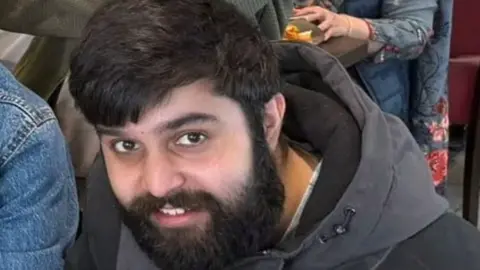 Qasim Hussain
A man who made numerous pleas for help as he suffered worsening appendicitis could have survived if he was taken to hospital sooner, an inquest has heard.
Adam Hussain called 999 and 111 - the non-emergency NHS number - several times between 12 and 15 May before he eventually died in hospital of multiple organ failure on 16 May.
An inquest heard despite becoming so unwell he was unable to walk or talk properly, the 23-year-old was not given a face-to-face assessment until he collapsed on 15 May, before suffering a cardiac arrest.
On Friday, a coroner concluded missed opportunities "on balance, made a more than minimal contribution to his death".
Following the inquest, Mr Hussain's brother, Qasim Hussain, said in a statement he was "a truly extraordinary person, a loving brother and a loyal friend".
He added: "I witnessed first-hand how quickly he became unwell and how his symptoms worsened.
"We phoned for medical attention many times but no-one came, despite Adam telling them he was too unwell to stand, never mind make his own way to the hospital. Adam deserved better.
"Whilst nothing can bring Adam back, I hope that there will be serious learning by the medical professionals involved and changes made to prevent this happening again to someone else."

The inquest at Nottingham Coroner's Court heard Mr Hussain first called 999 on the morning of 12 May, complaining of abdominal pain and vomiting, and was mistakenly told to expect a call from his GP within 24 hours.
Upon a second 999 call, Mr Hussain was told to go to a walk-in centre, which he did.
He was triaged to the urgent treatment centre the same day, but discharged by 11:29 BST.
Assistant coroner Elizabeth Didcock said during a third 999 call on 12 May, she found "the seriousness of [Mr Hussain's] condition was not recognised".
On 14 May during a call to 111, Mr Hussain was told an ambulance would attend.
Dr Didcock said at this stage it was likely Mr Hussain had developed sepsis.
A request for an ambulance was sent digitally to East Midlands Ambulance Service (EMAS) but was subsequently not deemed serious enough for attendance.
The court heard non-clinical staff making the assessment looked at limited information on its system, rather than the whole sequence of events.
This meant Mr Hussain's log of calls and what happened during them was not looked at.
The coroner said if an ambulance had been sent at that point, Mr Hussain "would have been likely identified as having sepsis".
Dr Didcock said the process for assessing the calls was unsafe, adding "the 111, EMAS and Nottingham Emergency Medical Services (NEMS) interface is not providing enough and/or timely care".
After Mr Hussain's fourth call to 999 at 20:23 on 14 May, he was referred to NEMS for another telephone clinical assessment.
During the 999 call, which was heard in court, Mr Hussain was struggling to breathe and speak and told the call handler he was unable to walk.
Dr Didcock told the court the NEMS assessment also "fell far below the standards".
An ambulance finally attended to Mr Hussain at 15:23 on 15 May but on its arrival, he suffered a cardiac arrest. He died in hospital the following day.
Care pathway concerns
On Friday, the court heard Mr Hussain's death followed the death of another young person after a similar chain of events, prompting a call to action to prevent further deaths.
Jake Hartwright, 25, died on 17 January after collapsing at home and suffering a cardiac arrest.
He died of multiple organ failure secondary to bowel ischemia - when blood flow to the intestines is reduced - and peritonitis, an infection of the inner lining of the stomach.
The court heard Mr Hartwright, from Sandiacre in Derbyshire, sought help from 999, the NHS non-emergency number and NEMS on 16 January, and had been unwell since 14 January.
Both Mr Hussain and Mr Hartwright - despite worsening symptoms over several days - were not deemed unwell enough to require an ambulance or in-person assessment.
Their deaths highlighted concerns about the way information was passed across the urgent care pathway involving EMAS, NEMS, and 111, the court heard.
Dr Didcock said while the pathway was working well for most patients, it was not working for those in serious "but not life-threatening" conditions.
The coroner issued a prevention of future deaths report, which EMAS and NEMS will have 56 days to respond to, to outline their actions planned or taken.
'The system failed you'
In court, NEMS medical director Nita Mandhar became tearful as she addressed the families.
She said: "Adam and Jake should have never been reduced to initials on a case review."
She promised to do everything in her power to ensure lessons were learned.
"I want to express that we do care as an organisation," she added. "Our intention is always to do our very best and when we fall short it is our duty to learn and to improve.
"Jake and Adam will remain at the heart of our reflections."
Lucy Dadge, chief executive of NEMS, said the service fully accepted the coroner's findings, adding she was "deeply sorry for the mistakes [it] made in their care".
Dr Steven Dykes, clinical director at EMAS, also told the families in court: "I want to say a huge apology to you. The system failed you at a time of need.
"EMAS should have done better at identifying Jake and Adam were seriously unwell and unfortunately the system at EMAS just didn't provide the right forward care for you at all.
"My promise to you is that we will get better and work together to make sure that this doesn't happen again."
Following the inquest, he added: "We accept the findings of HM Coroner and will respond before the given deadline.
"We are working with our commissioners and partner services to ensure continuous improvement, shared learning, and quality care for patients."
Follow BBC Nottingham on Facebook, on X, or on Instagram. Send your story ideas to eastmidsnews@bbc.co.uk or via WhatsApp on 0808 100 2210.
