Why is Bradford on Conde Nast's seven wonders list?

 Caroline Hudson
Heathcliffe and Cathy knew it, the fairies of Cottingley knew it, and Rombald the mythical giant who created Ilkley Moor knew it - there's something magical about the moors above Bradford.
And now, global travel magazine Conde Nast Traveller has selected Bradford Pennine Gateway National Nature Reserve as one of its Seven Wonders of the World for 2026.
Encompassing Ilkley Moor, St Ives Estate, Penistone Country Park and Shipley Glen the nature reserve was created in May by Natural England for the King's coronation.
But what makes the area so special?
'Nature sits alongside heavy industry'
The magazine curates its own list annually, distinct from the ancient or new seven wonders of the world.
Its intention is to showcase new places of awe for modern travellers beyond traditional lists and this year Bradford's National Nature Reserve has featured.
David Campbell, Interim Countryside and Rights of Way Manager at Bradford Council, was involved in its creation.
When he found out the area had been selected by Conde Nast Traveller, he was "stunned" he says.
"I know how wonderful the NNR sites are and how wonderful Bradford's countryside moorlands and river valleys and woodlands are, but to be put alongside Banff National Park in Canada and some mediaeval Italian towns and ancient Algerian Roman sites is quite stunning.
"I didn't expect we would be put alongside places like that."
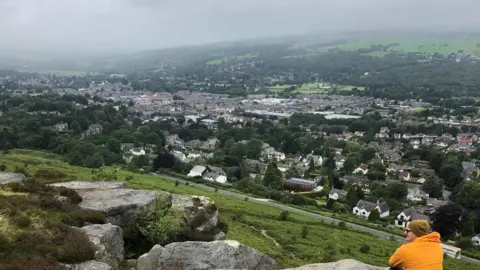
The NNR was deliberately created on the fringes of the urban and the rural to encourage the people of Bradford to get out and about in nature, he says.
"We wanted the residents of Bradford to have the opportunity to experience wonderful habitats, wonderful countryside and some exciting engagement with wildlife along the way."
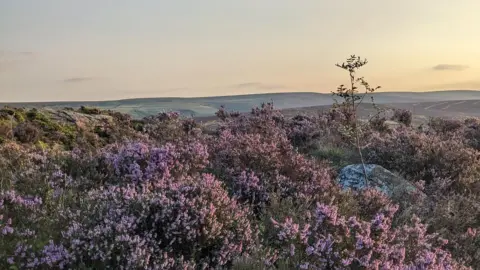
He says the beauty of the park is the variety of landscapes on offer, from ancient woodlands to lowland bogs and heather-lined moors.
"We have nature sitting alongside the industrial revolution, the heavy industry that used to exist in Bradford and the rest of the West Yorkshire.
"It's lovely to see those kind of crossovers and see how nature takes over and integrates itself among all the industry that still goes on," he says.
 Grace Wood/BBC
The NNR includes some of Bradford's most well-known landmarks.
Ilkley Moor is known for it's famous folk song, On Ilkla Moor Baht 'at, and Haworth's Penistone Hill was an inspiration for the bleak setting of many Brontë novels.
But, as illustrator and passionate hiker Bunty May Marshall explains, these areas still have lots of mystery to them.
"I've been traipsing around on those moors for years," she says.
"After a life-changing trip to Brittany I found that megalithic rocks and whatnot existed. And then I came back to the UK and was like, is there anything like that here?
"I found out that on my doorstep there was Ilkley and the moors and that had this incredible history of ancient rock art and stone circles."
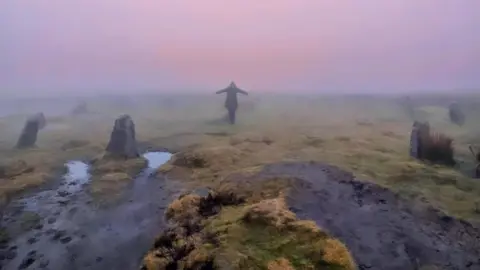
Ilkley Moor is the site of hundreds of prehistoric cup-and-ring stone carvings from the Neolithic and Bronze Ages.
"There's just something about Yorkshire that I find super mystical and it's such an enigma. There's so much pre-history dotted around on that band between Leeds and Bradford and the Aire Valley," says Bunty.
 Bunty May Marshall
Ilkley's history became the inspiration behind Hwaet, a zine Bunty created with her partner George, which guides readers on a history walk across the moors.
"Many people have speculated as to what the cup and ring marks might mean, whether that might be maps of the stars or hallucinogenic sort of patterns," she says.
"One of the explanations I think is most probable in certain circumstances, but not all circumstances, is that they could be maps of the actual land.
"The badger stone up on Ilkley Moor. I'm almost certain that's a map of springs because I've overlaid it over a map of the area and not only does it fit shape-wise, it faces directly north and a lot of the cups and subsequent rings line up with springs."
Bunty says part of what she loves about the NNR is the "liminal quality" between the rural and the urban.
"There's just so much on those moors that tell thousands of years' worth of history. Then on top of the history is the folklore and it's never ending."
 PA Media
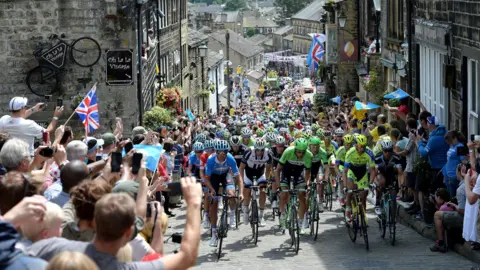
Brontë birthplace Haworth may be celebrating it's new title as a seven wonder but Machu Picchu - it's twin town - has had the accolade for decades.
The Peruvian Inca citadel is one of the New Seven Wonders of the World, chosen in an internet poll in 2007 by more than 100 million people.
Rita Verity, who runs Fairtrade shop Sonia's Smile on Main Street, was part of the team behind the twinning.
"The mention of Machu Picchu was actually not a serious suggestion but exploring the similarities and discovering that no other community had done it, it seemed a possibility, however remote," she says.
"It's a bit of a stretch to compare the two of course but it is amazing that this area is part of that chosen to be the only UK destination on the Conde Nast Travellers bucket list."
Rita says Haworth is a "beautiful village" in which to live and work and customers often say they are returning tourists.
"I hope if people come here they stay long enough to get to know us, explore the surroundings, the church, the locals and I hope they bring decent footwear too because the cobbles (setts) are unkind to high heels," she adds.
 Caroline Hudson
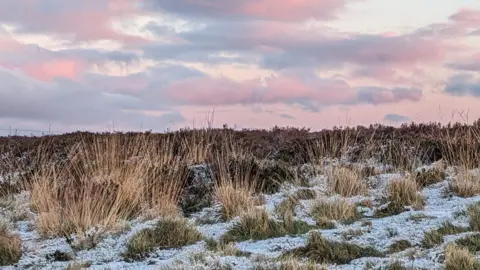
Artist Caroline Hudson lives in Haworth and takes inspiration from Penistone Hill Country Park for her work.
"That feeling of being up on the top and engulfed with the sky. I remember in early spring being mesmerised by the bit of pink in the sky and the feeling of freedom and going through the seasons and seeing the change of light," she says.
"If you look really closely into the mosses and the different sort of plants, there's so many different colours.
"The grey and the green is always there. That seems to be ubiquitous to this area but you can look deeper into the colours and the textures and the rawness."
She creates ceramics and paintings, which have sold globally - taking a little bit of Penistone across the globe.
"I used to have a studio gallery where people bought work, so I met them face-to-face and people were from Europe and America and New Zealand."
 Canal and Rivers Trust
A lesser-known area of the NNR is Bingley North Bog, formed 10,000 years ago as a result of a glacier, which is now a haven to birds, plants and wildlife, according to the RSPB.
"Bogs doesn't sound very attractive," says Campbell, "but actually when you get in there and how wonderfully peaceful and relaxing these places are, they are places to experience a chance encounter with a particular water species or different species of bird."
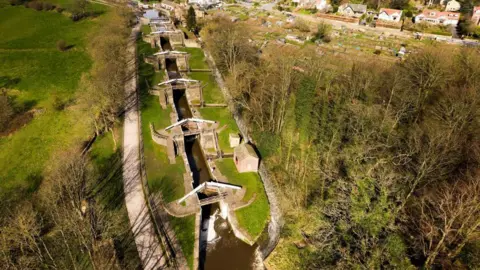
It can be accessed from the towpath of the Leeds Liverpool Canal not far from Bingley's famous Five Rise Locks - a 250-year-old heritage site visited by hundreds every year.
It is the steepest lock flight on the Leeds & Liverpool Canal, and the lock gates are some of the tallest in the country.
This canal was once an industrial artery, transporting goods from the region's mills to be traded and sold across the globe.
Now it is home to wildlife and, according to the Canal and River's Trust, is one of the seven wonders of the nation's waterways.
 Grace Wood/BBC
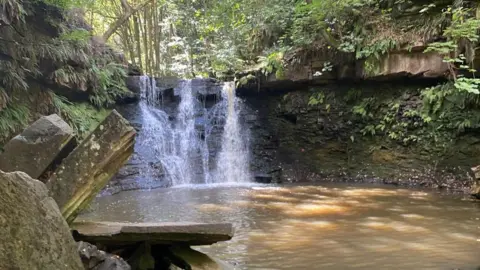
Ancient woodland St Ives Estate is also in the NNR's boundaries, home to an unusual story of a murderous tax dodger, explains the chairperson of the Friends of St Ives, Pam Lakin.
"For 400 years it was a monastic grange. It was full of monks digging for iron and breeding sheep, and they were part of Rievaulx Abbey," she says.
"We even have a documented issue about one gentleman who lived at St Ives called William Cherrycheek who decided, because the Abbott used to send out tax collectors once a year and he didn't want to pay the tax, to shoot the tax collector from Rievaulx Abbey."
More recently, St Ives experienced a different kind of tragedy - 5,000 trees were felled when the estate fell victim to a disease.
Pam is hoping the increased awareness of the NNR will help bring money and volunteers to St Ives.
"We need somebody really to win EuroMillions and absolutely love St Ives and to roll up and say: 'We'll help you, because it does need a lot.'"
Despite recent difficulties, it remains a special place, she says.
"When I walk around, I very much feel the past and see the past in a sense. There's so much history there."
Listen to highlights from West Yorkshire on BBC Sounds, catch up with the latest episode of Look North.
