Burning carcasses and smoke for miles - 25 years since 'devastating' foot and mouth outbreak

 Alamy
AlamyWhen foot-and-mouth disease was discovered at an Essex abattoir in February 2001, few could have imagined the horrors that followed.
The highly contagious virus spread rapidly to other livestock across Britain. In an attempt to control it, millions of sheep, cattle and pigs were slaughtered.
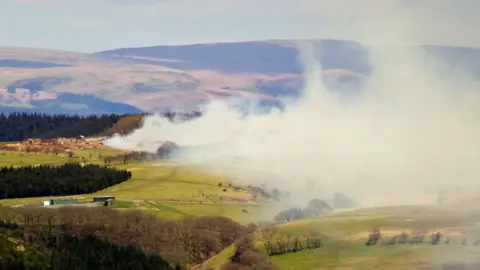
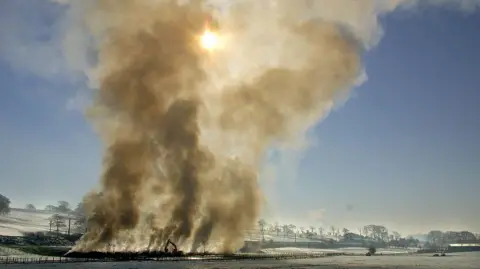
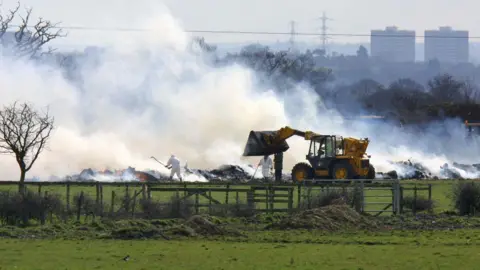
Mass pyres of burning livestock carcasses, bellowing clouds of foul smoke, became a lasting image of the countryside.
"It was devastating. I lost my father in 1988 and I'm glad he never saw it, because it just about finished me," recalled Brian Davies, who farms near Brecon.
This article contains details of animal slaughter which some readers might find distressing.
Foot-and-mouth disease affects cloven-hoofed animals including cattle, sheep, goats, pigs, camelids and deer. It does not affect humans.
The virus causes painful blisters inside the mouth and under hooves and can cause lameness and problems feeding.
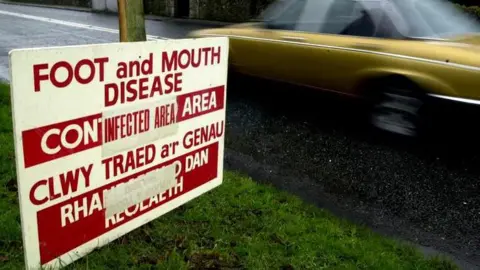
After the first case was discovered on 19 February, more quickly followed. Eight days later, foot-and-mouth was found in Wales at an abattoir on Anglesey.
To try to control its spread, more than six million animals - including one million in Wales - were slaughtered and burned, with the Army called in to help.
 Getty Images
The vast majority of the animals culled did not have the disease but were on farms that were contiguous - which means they shared a boundary - with a farm where there was a confirmed case.
This happened to Brian, who lost more than than 1,000 of his sheep in the cull.
"Fortunately, to a certain extent, we only lost the sheep because our cattle were indoors," Brian said.
"They shot everything in the pens. The little lambs were only like a month to six weeks old. They had to be shot, and then their throats had to be cut. It was devastating. Loaded onto a lorry and they were taken to Widnes in Liverpool to be incinerated."
 PA Media
The 2001 outbreak was the first major one in the UK since the late 1960s.
It cost the taxpayer £3bn, with a third of that being paid to farmers who lost livestock.
One of the focal points of the outbreak was the Epynt mountain near Sennybridge, nine miles (14km) west of Brecon.
The bodies of thousands of cattle were carried there to be burnt or buried in the hills.
Huge pyres were built, stacked high with burning carcasses which sent massive clouds of smoke across the area.
Near Trecastle, three miles (5km) further west, a massive pit was excavated on an Army range on Epynt for the burial of tens of thousands of animal carcasses which were brought in from outside the area.
It was a time of tension and protests by local people against the burials and the burning. The lorries carrying the carcasses needed to be escorted by police.
As the lorries passed, protesters would stand at the roadside and throw daffodils in front of them.
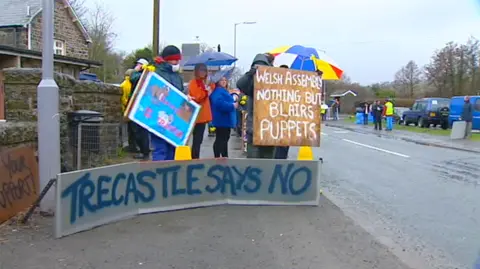
Edwin Roderick, from Sennybridge, is now retired but was a farmer in 2001. He chaired the Epynt Action Group, which campaigned against the burials and burning on the mountain.
"It was an awful thing to see. We were taken up to see where the burial part was going to be - that was a massive hole on the Epynt," he said.
Edwin said he saw a stream below the disposal site "flowing white" which he believes was caused by effluent from the pit where the carcasses were buried.
"People were scared. It was affecting their livelihoods. Don't forget, [these people were] farmers who will put feed in front of a sheep before they put bread on the table."
'The smell was obnoxious'
Edwin recalled the terrible smell of the carcasses which were carried through Trecastle on their way to the burial pit.
"The smell was obnoxious. It was unreal. You could smell it coming into the village, and you could smell it going out.
"I spent many hours by the side of that road. Some [of the vehicles] were just tractors and trailers and lorries, and they were leaking with juices coming through.
"Then going up the Epynt, it was everywhere, and then it was found that the burial pit was leaching."
Edwin believes the leaking pit and the strong community campaign put a stop to the burials on the Epynt.
He and the other campaigners went to the National Assembly - as the Senedd was known then - in Cardiff, and were told that the burials would stop in April.
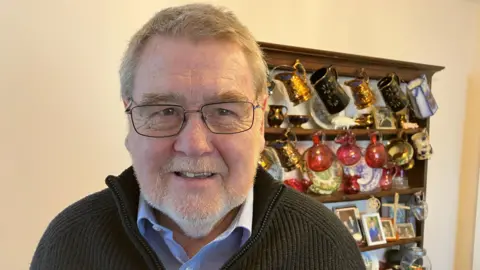
But although the burials ended, the burning on Epynt continued, which local protesters continued to oppose.
Jenny Layton Mills started work as an auctioneer in Powys in 1999, first in Knighton market and then Brecon where she still works today.
When foot-and-mouth struck, the livestock markets closed.
"We had to close the market for at least 12 months, from memory," she said.
"It was a terrible time for people. A lot of people on restrictions - they had no cash flow. It was a worry for people, a very hard time.
"Because not only were people losing stock or not being able to sell stock, they also couldn't go out within their community as they normally would have, to market."
The 2001 outbreak was devastating for agriculture, but it also had wider effects on rural communities and beyond.
Powys, Anglesey and Monmouthshire were Wales' worst affected counties, but at its peak 35% of the Welsh countryside was under restrictions.
Access to the countryside was restricted, public footpaths and many tourist attractions closed, and the number of visitors to rural areas plummeted.
The Royal Welsh Show that year was cancelled and the 2001 Six Nations rugby tournament disrupted, with Ireland's games against Wales, England and Scotland postponed until the autumn.
The outbreak was declared over in January 2002.
The Department for Environment and Rural Affairs (Defra) later said that the distressing pictures of burning carcasses beamed around the world put many people off visiting Britain, not just the countryside.
 Getty Images
A smaller outbreak of foot-and-mouth occurred again in 2007, but the virus has not been found in Britain since.
However, it continues to be a problem in other countries around the world, including in Europe.
Earlier this week, the UK's chief veterinary officer said the disease had been found in cattle and sheep in Cyprus, and urged livestock owners to remain vigilant to the signs of the infection.
Brian still feels the anguish of 2001.
"It was a devastating time for everybody," he said.
"We don't want to remember it as an anniversary. It just makes you think, what's around the corner? It's worrying."
Asked if he felt a similar outbreak could hit agriculture in the same way today, Brian replied: "I hope to god not."
