'Relentless fly-tipping happens almost every week'

 BBC
BBCFarmers in Surrey say that fly-tipping is "relentless" and happening "virtually every week", with the clear-up costing them thousands of pounds a year.
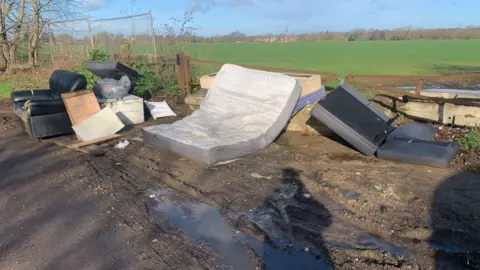
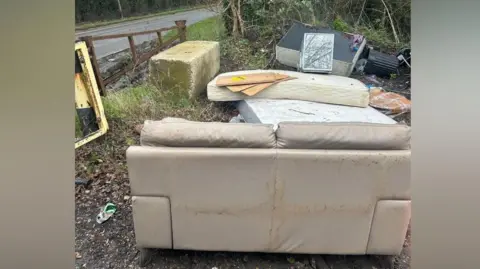
The dumped waste includes tyres, asbestos, furniture, household rubbish and dead animals and farm gates often have to be guarded, as well as concrete blocks installed in some places.
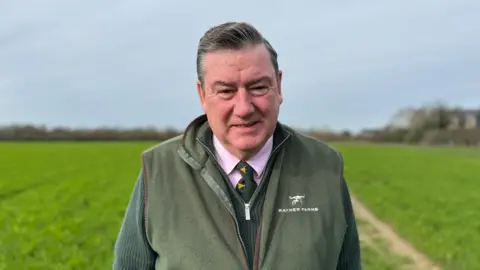
Tim Bamford, south east regional director of the Country Land and Business Association (CLA), has urged the government to create a commissioner style role to tackle the issue.
The Department for Environment, Food and Rural Affairs (Defra) said tougher checks and stronger penalties were being introduced.
 COLIN RAYNER
Colin Rayner said he farmed around 2,500 acres in Surrey and Berkshire, including wheat, barley and oilseed rape and maize.
"We have an experience of fly-tipping virtually every week," he told BBC Radio Surrey.
"You see the gates blocked with concrete blocks, topsoil, to keep the fly-tippers out."
'You name it, we've found it'
He added the waste dumping was happening on an industrial scale and that he had to bring in people to guard gates during harvesting.
"We find anything from asbestos to tyres to dead dogs...you name it, we've found it," he said.
"We then have the responsibility of taking it to a waste transfer station and getting rid of it legally.
"It costs us thousands of pounds a year."
William Conisbee, who works on farms in Fetcham and Pyrford, said: "It's just a relentless thing that you kind of come accustomed to.
"It doesn't surprise me if I find fly-tipping any more.
"It just becomes an issue of clearing it all up and reporting it...but we never seem to get too far with any of it really."
 COLIN RAYNER
Between April and December 2025, 10 of the borough and district councils in Surrey said they had received almost 8,000 reports of fly-tipping.
Defra is due to publish the latest data on fly-tipping at 09:30 GMT on Wednesday.
Bamford said CLA heard from members "almost on a daily basis that there is a blight in the south east of England" and that, as well as costing farmers economically, it was an environmental and pollution issue.
He added there needed to be tougher action from the authorities.
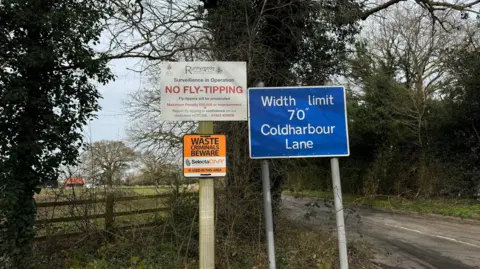
"It is just becoming something that we as a country have got to take far more seriously and we do call on the government, because fundamentally this is a government thing," he said.
"They have the powers to impose greater fines, greater prosecutions, and the law that actually allows this to be dealt with.
"If they simply put somebody in charge - a commissioner, if you like - I think we would see this being dealt with far more seriously, quickly and efficiently."
A Defra spokesperson said: "Waste criminals scar our countryside and make life miserable for the communities forced to live alongside illegal dumps.
"We are determined to stop them."
They added that the government was "giving authorities the tools they need to fight back" including increasing the Environment Agency's enforcement budget, bolstering the Joint Unit for Waste Crime, and introducing tougher checks and stronger penalties.
"Digital tracking will close the loopholes criminals exploit, drones are catching offenders in the act, and councils have the power to crush their vans - leaving waste criminals with nowhere left to hide," they added.
Follow BBC Surrey on Facebook, on X, and on Instagram. Send your story ideas to southeasttoday@bbc.co.uk or WhatsApp us on 08081 002250.
