Farmers on edge as record rainfall dampens slurry season

 BBC
BBCMore than six weeks of frequent rain is not how anyone wanted the new year to start, least of all farmers.
Dairy farmer Mervyn Gordon sums it up in one word: "Hectic."
He is managing a 400,000-gallon slurry storage tank under the shed where most of his 250-strong herd have spent the winter.
Normally at this time of year, the tank should be emptied and slurry spread on the grass to give it time to be absorbed before the first silage is cut in May - but the wet weather is delaying that.
It has also disrupted early potato-planting.
Agriculture and Environment Minister Andrew Muir said he appreciated the challenges extreme wet weather has created for farmers, with agriculture being one of the sectors most affected by climate change.
He said the draft Northern Ireland third Climate Change Adaptation Programme, as required by law, is currently with the Stormont Executive for consideration and should be published "urgently".
Why is slurry important?
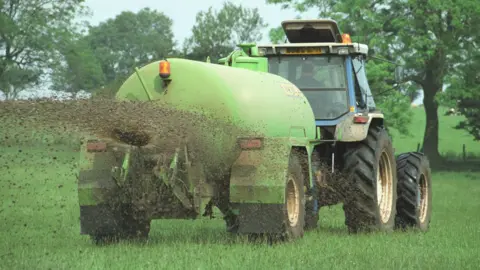
Slurry, made up of animal manure and farmyard water run-off, contains vital nutrients for growing grass, crops and plants.
A readily-available fertiliser for farmers when livestock are housed over winter, it is collected in storage pits for use in spring.
But because it can be very nutrient-dense, there are rules on how and when it can be used.
 Getty Images
Except in very restricted circumstances, slurry spreading is forbidden in Northern Ireland from 15 October to the following 31 January.
Known as the closed period, it is designed to protect water quality when plants are not growing and cannot absorb the nutrients slurry contains.
Slurry-spreading can only resume when ground and weather conditions are suitable.
Farmers are supposed to have adequate slurry storage to prevent animal welfare issues and any pollution risks due to potential overflowing.
But if that storage is at capacity, a "reasonable excuse" clause in Daera policy allows them to spread a minimal amount if they have exhausted all other options.
Bovine TB outbreak
Mervyn Gordon's farm of around 300 acres is nestled at the foot of the North Sperrins. As well as a large dairy herd, he has 100,000 chickens.
For him, this has been "one of the worst years" he can remember.
"It has just been fairly hectic, just watching the slurry tanks fill up," he said.
His farm is currently closed due to a bovine tuberculosis outbreak which means his extra stock can't be moved on and are therefore producing even more slurry.
"That has added a wee bit of extra pressure," he said.
"So we had to take other steps just to try and make sure that we didn't run out of storage."
That has included bringing in specialist equipment to separate the slurry so there is more storage.
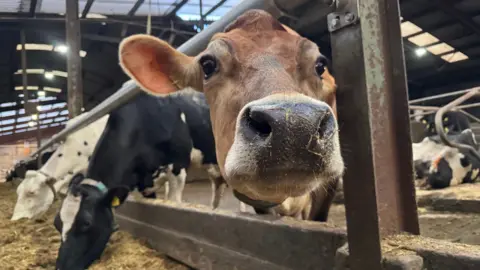
A robot slurry scraper travels up and down the cowshed at regular intervals, pushing any manure through the slatted floor into the vast storage pit below.
But with the herd producing up to 6,000 gallons of slurry a day, any breathing space can be quickly used up.
Gordon said bad weather can leave farmers "flat out" to get everything done.
"Jobs that you would be doing now, all that's piling up," he added.
"You'll just be working night and day once the weather turns turns good."
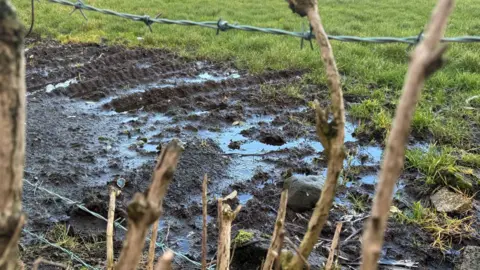
Like all dairy farmers, Gordon uses the good weather in spring and summer to grow and cut silage - grass that will be baled and used as fodder for the herd over winter.
Slurry encourages the grass to grow as the days get longer and the ground warms up.
But it needs to be spread at least two months before the silage is cut, so any delay will have a knock-on effect.
"If we haven't got good quality first-cut silage in then the cows are not going to be milking and that's going to have an impact on the profits," he added.
Early potato planting 'impossible'
With spuds a staple on our dinner tables, this is the time of year when early potatoes usually get planted.
Wilson's Country supplies retailers with potatoes throughout the year and chief executive Angus Wilson said the weather has been a challenge.
"At this stage in February we would usually have some early potatoes planted but this year that has been impossible because of the excessive rainfall," he said.
"However, nature usually has a way of re-balancing, so we are hopeful to get planting in the next month and see the crop grow even faster in the warmer mid or late spring weather."
Changing weather patterns have caused frustration for the sector in recent years, which has led to some growers warning of shortages and price rises.
But Wilson said farmers have to be optimistic.

The Ulster Farmers' Union has called on the Department of Agriculture, Environment and Rural Affairs (Daera) to recognise the strain farmers are under.
The union said "draconian planning rules" were hampering some farmers in their efforts to modernise and ease the challenges they face in managing nutrients on farms.
Deputy president John McLenaghan said increased pressure on slurry storage capacity has created difficult conditions for farms that strive to remain compliant with environmental regulations.
He added that farmers were resilient, but "resilience isn't unlimited" and called on Daera to provide "appropriate" flexibility.
"If storage capacity is becoming a welfare concern or issues are emerging, farmers should contact their UFU Technical Officer for advice and guidance," he said.
How much rain has fallen?
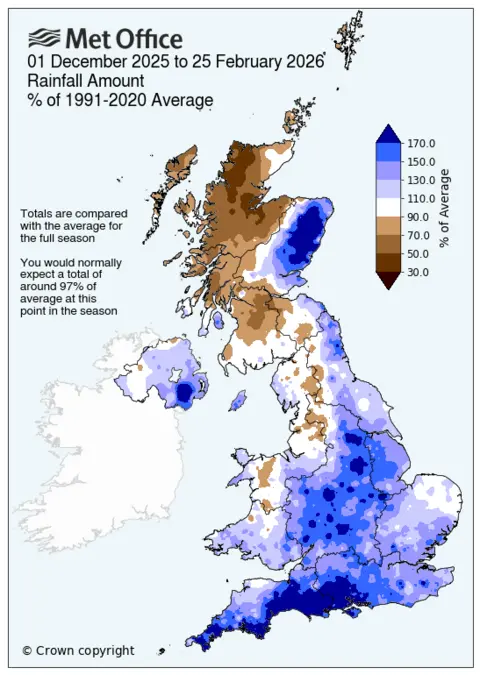
Early provisional statistics from the Met Office show that in Northern Ireland rainfall so far this winter is 25% above the winter Long Term Average.
But the provisional data (up to and including 25 February) shows that the distribution of the heaviest rain is far from even with parts of Down and Armagh seeing almost twice as much rainfall than in an average winter.
While this winter's weather has been heavily influenced by natural variability and atmospheric patterns, climate change provides important context.
A warmer atmosphere can hold more moisture, approximately 7% more for every degree celsius of warming. This means that when it does rain, downpours can be heavier and more intense.
This characteristic is already being observed in the UK and globally, with rainfall totals on the wettest days increasing over recent decades.
Climate change is also associated with a trend towards wetter winters in the UK.
Winters are expected to feature more days with significant rainfall, particularly for Northern Ireland and other western parts of the UK. Projections also indicate a greater likelihood of intense winter storms and successive storm events.
In recent weeks, Storm Bram in December has been followed by Storm Goretti, Storm Ingrid and Storm Chandra - each bringing severe winds, heavy rainfall and widespread disruption.
