Farmers worried as 'wettest winter' in memory continues

 BBC
BBCIf you have looked outside any day this year you'd be forgiven for thinking will this rain ever end?
January was the wettest month in nearly 150 years with an unusually high amount of rain.
This has continued into February, with relentless downpours affecting farms and businesses.
Where farmer Timothy Smith works, double the amount of usual February rainfall has come down in just 10 days - and that's brought serious challenges.
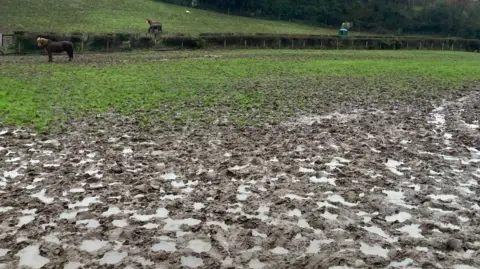
It's the "wettest winter" he can remember at his farm at Shanaghan Hill in Katesbridge, County Down.
It already recorded around 194% of the normal February rainfall (with 18 days of the month remaining) recording 128.4mm - the February average being 66.2mm.
His farm mainly produces sheep and lambs.
"The rain has been fairly constant since January and that has brought challenges with it," he said.
"Essentially it's a stock management and a stock health and welfare challenge. It's a ground management challenge as well...so you're doing things like moving your stock to higher ground.
"The other things you're going to have to do as well is possibly bringing them into the house for lambing several weeks earlier than you would. which adds coat and expense."
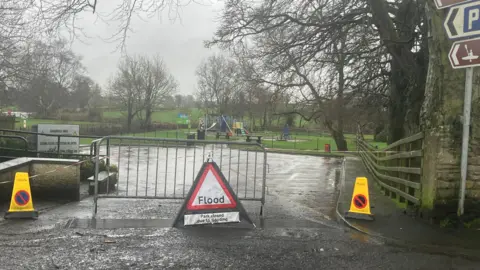
Smith says beef and dairy farmers are also struggling with the weather as they have not been able to put their livestock back out on the ground.
"I know of some nature-friendly farmers who would be wanting to do that, even at this time of year, and they just can't because the ground is saturated.
"The infrastructure is struggling as well, roads getting damaged, drains blocked and that just adds to the complication," Smith said.
"All the breeding ewes are on the highest field in the farm and so they're safe and happy and they've got plenty of forage, mercifully we haven't lost any stock."
'The tap has come on and it hasn't stopped'

Louise Skelly also farms at Shanaghan Hill and is the vice-chair of the Nature Friendly Farming Network in Northern Ireland.
"This is the worst rain in terms of persistent rain, really from the 1st of January the tap has come on and it hasn't stopped," she said.
"Farmers are very worried, this is the worst weather for animal husbandry when you have wet and windy together.
"Sheep do well outside in the winter, generally speaking, and they actually don't mind snow, but this long period of wet and windy is very difficult for them.
"Particularly those ewes that are growing lambs to keep condition on them and make sure that they're in good order.
"It can affect some farmers' mental health, the concerns that they have, because some of them have to feed extra concentrates and bring sheep into the house and all of that costs money."
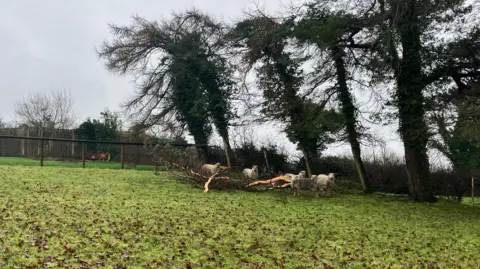
Skelly said County Down is normally the "dry county, but for some extreme reason it has been the opposite this month".
"Historically, maybe one or two fields would've flooded but right along the River Bann, from here to Banbridge, fields have flooded that have never flooded before.
"Farmers are remarkably resourceful and resilient and particularly the group of farmers that I work with....they are always looking at ways of trying to mitigate the extremes of weather and working with nature."
In a statement on Wednesday, the Ulster Farmers' Union (UFU) said the rainfall has caused "severe challenges" for farmers.
It said the prolonged wet weather had significantly reduced opportunities for farmers to manage nutrients, increasing pressure on slurry storage capacity.
This, it added, created difficult conditions for farms "that strive to remain compliant with environmental regulations".
When will it stop raining?
The rainy season continues through Wednesday and much of Thursday and another 15mm of rain could fall in some areas.
Colder air will feed in from the northeast across Northern Ireland on Thursday which will mean some sleet and wet snow over the higher ground for example the Sperrins, Antrim Hills and later the Mournes.
The colder northeasterly winds will also help clear the rain/sleet mix southwards on Thursday night.
Friday will bring some long-awaited blue sky and sunshine, and most places will be dry.
There will be a cold northerly wind and a significant drop in the temperature plus the odd snow flurry cannot be ruled out.
It will also be a chance to see the developing stretch in daylight, after so many dull days it has been difficult to notice.
Friday night will continue dry but very cold with widespread frost and ice as temperatures drop subzero.
The last time there was 24 hours with no measurable rain across NI was on 29 December last year.
Some places inlcuding Stormont Castle and Katesbridge are on 32 consecutive days of rain and Altnahinch Filters in the Antrim Glens is now on 36 days in a row of measurable rain.
At this stage most of Saturday should stay dry but it will turn wet and windy by Saturday evening.
The gap in wet weather may be brief but will be extremely welcome among farmers.
