'Why I live and breathe Jane Austen'

 Holly Kirby
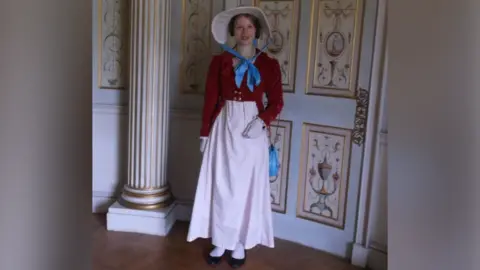
For Holly Kirby, it is not that she just likes Jane Austen - she lives and breathes the famous author and her works.
She first experienced Austen's literature when she was about 10 years old, when her uncle sent her an audiobook of Mansfield Park.
Her passion for the author deepened as she watched adaptations of her works and began reading the rest of her published books. It also led to her becoming fascinated with the Regency era, in particular the fashion worn around the time that Austen was alive.
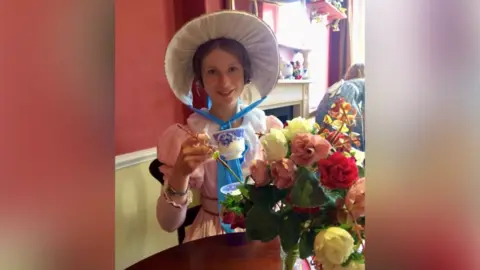
In present day, Austen's presence and legacy is weaved into the fabric of Kirby's life, quite literally, as she dresses in Regency costume regularly for work, makes her own period clothing and has written her own book about the author.
Although the historical and political definition of the Regency era is the period from 1811 to 1820, culturally, the term is applied to the years 1795 to 1837.
Austen's novels were published between 1811 and 1817, right in the heart of that time.
Kirby, from Ellesmere, Shropshire, said her love of history followed her throughout her teenage and early adult years - she studied the humanities at university and then did a masters in heritage management.
This led to a job for the 35-year-old as a collections assistant at Attingham Park, near Shrewsbury, for nine years from 2014 - the National Trust site is home to a mansion built in 1785.
"Volunteering at Attingham gave me a real appreciation for the life and times," she said.
"I then started to look into the background of [Austen]."
 Holly Kirby
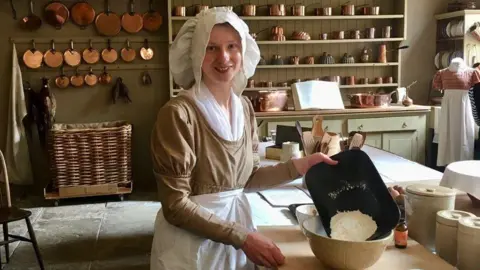
"In 2009 I saw an advert that Attingham was opening on an extra day…they wanted to have people as costumed guides, so dressing in the costumes of the era,"Kirby added.
"I love the fabrics and the styles which they had.
"They're very comfortable to wear, compared to Victorian-era costumes."
Despite leaving her role as collections manager, Kirby continues to volunteer at the site.
Dressed in Regency costume in the site's basement, she cooks recipes from the era, some of which were recorded by Jane Austen's sister-in-law.
 Holly Kirby
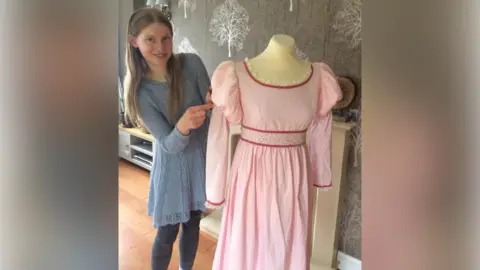
During this time, she began making her own costumes.
"I started off in an incredibly traditional way; my first outfit was a maidservant's dress and it used a beige linen fabric and metal buttons," she said.
"I didn't have a sewing machine at that stage, so I had to sew it all entirely by hand.
"It took hours, but it gave me a real appreciation for what it was like for servants - a Christmas gift for the female servants was a bolt of cloth and the employers would say: 'You can make your uniform for the new year'."
Kirby is a member of the Jane Austen Midlands Society and hosts talks about period clothing.
"For Jane Austen there's only one garment that we know belonged to her, which is a pelisse - an outer coat - and it's got a lovely brown fabric with an oak leaf pattern, and the oak leaves related to the Royal Navy at the time, as two of her brothers were in the navy," she said.
"The most fascinating thing for me was how they actually went about walking [in that era].
"At this time of year, the paths [then] were incredibly muddy and icy... they wore patterns on their shoes, so it was like a raised wooden sole that was raised up on iron."
 Holly Kirby
Her book, Jane Austen's Easter, does what it says on the tin - it explores how Austen may have celebrated and viewed Easter.
"There's lots of books out there about how Jane Austen celebrated Christmas, I thought there's obviously other religious festivals that would've been important to her as a clergyman's daughter," she said.
"I started to do a lot of research into the customs of Easter time and what springtime in general would've been like, looking through her letters and her novels and collecting it all together into a book, which contains suggestions like crafts and recipes."
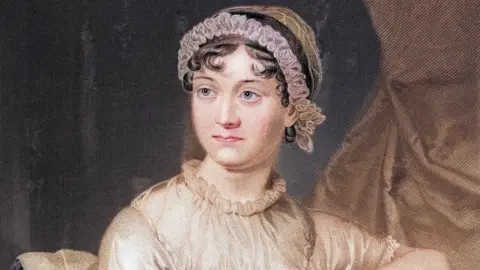
Who was Jane Austen?
 Getty Images
- She was born on 16 December 1775 in Steventon, Hampshire, one of eight children of a clergyman
- She fell in love with reading and writing from a young age, often putting on plays for the family with her older sister Cassandra
- Sense and Sensibility, her first novel, appeared in 1811, followed by five others - Pride and Prejudice, Mansfield Park, Emma, Persuasion and Northanger Abbey (the last two were published posthumously)
- In her novels she regularly poked fun at how people expected women to behave at that time, and her female characters were witty and clever
- Austen died in 1817 in Winchester, in Hampshire, at the age of 41 and is buried at the cathedral there
- To this day many people still celebrate her work, and study it in schools and universities and her face is on £10 notes in the UK
Follow BBC Shropshire on BBC Sounds, Facebook, X and Instagram.
