Is it time to overhaul child working laws?

 Little Dreamers
Child employment laws are holding children back from "chasing their dreams", the mum of two child entrepreneurs has said.
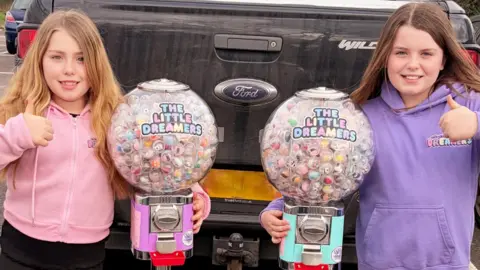
Amy's nine and seven year old daughters started a business making and selling 3D-printed fidget toys as part of their home schooling.
She is calling for changes in the law to clarify how "child-led microbusinesses" can operate.
The Department for Education has been approached for comment.
Amy said there was a "big gap" in child labour legislation, some of which dates from the 1930s, for children wanting to start their own businesses in areas such as gardening, selling merchandise or creating digital content.
After beginning to home school their daughters Lily and Poppy, Amy and her husband Derek helped set up a business, the Little Dreamers.
The girls design and make the toys and sell them through their own vending machines at local venues.
"We quickly realised they were learning real life skills - maths through their money skills, making pitches, designing the website. It's a really broad way of learning, without them feeling like they are learning," she said.
While the girls are not technically employed, Amy feels there is a "lack of clear rules" in legislation covering child labour.
 Little Dreamers
Currently, children aged 13-14 should only work a maximum of 12 hours a week, up to two hours a day on school days and Sundays, and up to five hours on Saturday.
Exceptions are made for younger children working in areas including television, theatre, sporting events or modelling.
A performance licence, issued by local councils, allows those children to take part in paid-for performances, allocates an approved chaperone and deals with issues such as missed schooling.
Amy is campaigning for this to be "duplicated and adopted" for young entrepreneurs.
"You see teenagers offering to do gardening on Facebook - the amount of praise they get for getting off their backside and working, not sitting watching screens," she said.
"If a child starts to make money, there is nothing covering them or giving them guidelines.
"It's the uncertainly - its so, so sad to see many parents stopping them from chasing their dreams and fulfilling their creativity."
With existing rules to prevent exploitation and abuse of children in workplaces, Amy insists safeguards would remain in place.
"This is not about removing safeguards. It is about replacing uncertainty with clarity," she said.
"The right safeguarding - with adult supervision."
It follows the family of a 14-year-old boy setting up a petition after a council intervened to stop him from cooking in his family food truck.
Dexter, from Four Marks in Hampshire, said cooking alongside his father after school was his "hobby" and asked the council to let him continue.
Amy has drafted proposals for a "Young Innovators Act" and has sought support from local MPs including Fareham MP, Suella Braverman.
Following a meeting with Amy, Braverman said she would be writing to the government, calling for child employment legislation to be "clear, proportionate and appropriate for the modern economy".
"It is important that regulations are properly understood and applied, so that children who wish to take their first steps in business are supported within the existing legal framework," she said.
"Any considerations in this area will, of course, prioritise safeguarding and the wellbeing of young people."
You can follow BBC Hampshire & Isle of Wight on Facebook, X (Twitter), or Instagram.
