How lichen hold the secret to a breath of fresh air

 BBC
BBC"I love lichens. I really do."
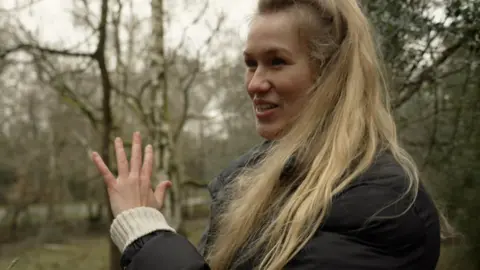
Which is fortunate, as April Windle is currently peering down a magnifying lens on a muddy bank in the middle of a slightly damp New Forest.
"I've been lucky enough to spend nearly a decade actually studying and appreciating them," she says.
Those 10 years have brought a wealth of knowledge which, as a member of the British Lichen Society, April is keen to share.
"They look like plants," explains April. "They sit within the biological kingdom fungi.
"What they do is they either partner up with an algae or a bacteria and then when you get all these different species together you get this physical formation, which we call lichen."
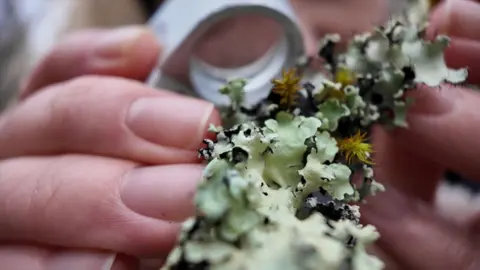
It is the variety of lichen that is part of the attraction for many.
There are around 1,800 species in the UK each tolerant to different environments and atmospheres.
That means lichen can be a good indicator of air quality as rather than living off the item they're growing on lichen absorb what is around them.
And it is that property scientists are using to help study air quality.
"You wouldn't get really shrubby lichens where it's really polluted. You'll have a collection of species that can tolerate those air environments," April says.
We have moved out of the forest and near a main road. There are different species of lichen growing.
"What we have on these twigs is completely different in terms of form and colour.
"So firstly it is a striking yellow colour this species and we call this the sunburst lichen.
"And this species in particular is very tolerant of nitrogen pollution. The fact that this species is growing on the twigs which are right by the road here is completely unsurprising to me."
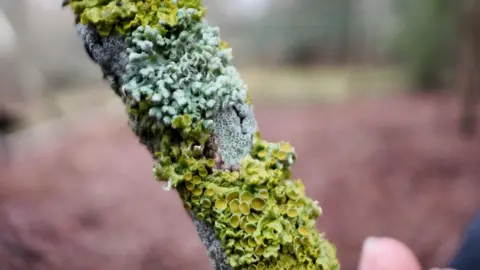
Recording the presence and absence of different species of lichen can give clues to the environment around them.
Scientists at the UK Centre for Ecology and Hydrology (UKCEH) have developed an app for researchers and keen lichen spotters to record what is growing around them. By logging lichen the local air quality should be revealed.
Although the process is straight forward there are certain rules.
"You need to find two types of trees. You need to find oak or birch," explains Dr Bill Bealey.
UKCEH has identified a suite of "indicator" lichens which can be found on these two specific trees. These lichen species are either sensitive or tolerant to nitrogen.
By recording the presence or absence of these lichens on tree trunks and branches, users of the app can quickly estimate how polluted their local environment is.

"You match what you're seeing with the guide. You just click it and record it," Dr Bealey says.
"We suggest the branches and trunks of five trees. And you keep going – you then go to the end and it calculates what's called a Nitrogen Air Quality Index (NAQI)."
The research programme with see the information gained from the LicheN app crossed checked with more traditional methods of monitoring.
"We're regularly measuring these gases at monitoring stations around the UK," explains Dr Bealey.
"So we can really start to map those sorts of data with the lichen data and see how they're comparing with each other."
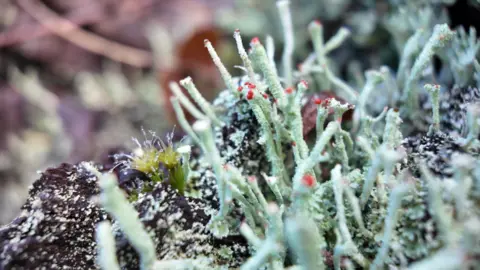
Back in the New Forest, April is examining another tiny specimen.
"Lichens tell us so much about the environment in which they're found," she says.
"They're such fantastic indicators but they're very small and they're very inconspicuous and they are so easily over looked.
"But when you start delving really deep into nature they just tell you a huge amount about the landscape which you explore on a day to day basis."
You can follow BBC Hampshire & Isle of Wight on Facebook, X (Twitter), or Instagram.
