India and US defer trade talks after Supreme Court's tariff ruling

 Getty Images
India and the US have deferred trade talks which were set to take place this week as they "study the implications" of the US Supreme Court striking down the Donald Trump administration's global tariffs, an Indian commerce ministry official told the BBC.
An Indian delegation was due to travel to Washington this week to finalise the terms of an interim trade deal which was announced earlier this month.
The agreement reduced US tariffs on Indian goods from 50% to 18%, even though several aspects of it remained unclear.
The Supreme Court ruling has led to new uncertainties as Trump said he would impose global tariffs of 15% on all goods coming into the US.
It's not clear yet what the court ruling and the new tariffs mean for existing trade deals between the US and other countries.
The new developments come after a chaotic few months for Indian exporters who have been grappling with 50% tariffs imposed by Trump, which came into effect on 27 August. The duties included a penalty for buying Russian oil, which Trump had long criticised.
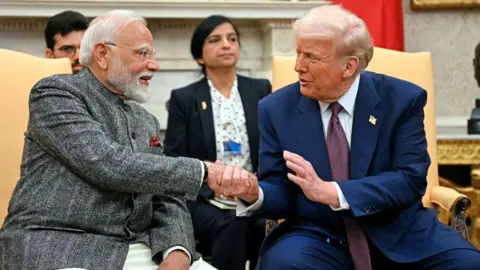
On 2 February, Trump announced the two countries had reached an interim trade agreement after a phone call with Prime Minister Narendra Modi, bringing relief to Indian markets.
Under this, India promised to reduce its standard tariffs on all US industrial goods as well as several food and agricultural products, while the US agreed to lower reciprocal tariffs that apply to about 55% of Indian exports, bringing them down from 50% to 18%.
But the announcement triggered some yet-to-be-resolved questions about whether India was giving more than what it was getting, whether or not Delhi pledged to halt its purchases of Russian oil and whether India could actually buy $500bn of US goods over five years.
It also upset India's farm unions who warned that tariff cuts on US agricultural imports could undercut domestic producers. India's Commerce Minister Piyush Goyal has said that the country has not offered concessions on dairy, genetically modified products, meat or poultry, and that safeguards for farmers are in place.
But analysts are still waiting for clarity on the terms of the deal, and what exactly Delhi has agreed to.
Last week, Goyal said that the deal could take effect in April after outstanding issues were addressed during the delegation's Washington visit.
This has now been complicated by Friday's US Supreme Court ruling that Trump overstepped his authority by using the 1977 International Emergency Economic Powers Act to impose sweeping global tariffs. It came as a major blow to the US president's second-term agenda.
Uncertainties deepened over the weekend after Trump announced that he would increase global tariffs to 15%, the maximum allowed under a never-used trade law.
"The two sides [India and the US] have decided to defer the talks until both sides are able to study the implications of recent developments," the official in India's commerce ministry told the BBC.
Reuters reported, citing an unnamed source, that no new date has been set yet for the visit of the delegation, which was set to leave on Sunday.
