Hope and uncertainty as India and US strike long-delayed trade deal

 AFP via Getty Images
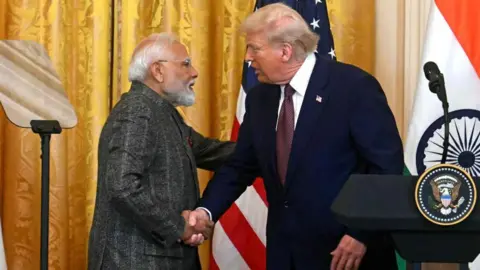
US President Donald Trump's decision to lower reciprocal tariffs on India from 50% to 18% has been met with a sense of relief in Asia's third-largest economy, even as precise details on the agreement remain sketchy.
India paid the highest tariffs in the world after Trump raised import duties on Indian goods from 25% to 50% in August last year, saying Delhi's purchase of discounted Russian oil was helping fund Moscow's war effort in Ukraine.
After his call with India's prime minister on Monday, Trump claimed Narendra Modi had "agreed to stop buying Russian oil, and buy much more from the United States, and potentially Venezuela".
India has not commented on these exact claims, but Modi thanked Trump "on behalf of the 1.4 billion people of India for this wonderful announcement", saying he hoped to take the partnership with the US to "unprecedented heights".
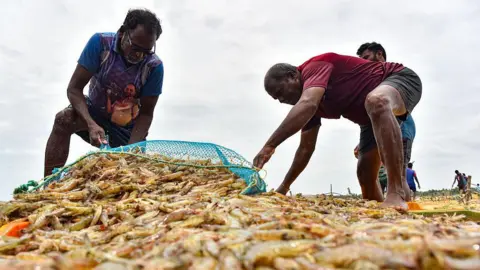
The patch-up comes after Trump's trade war soured carefully cultivated relations between Washington and Delhi, with exports from India to the US falling sharply across key job-creating sectors such as textiles, seafood and jewellery.
Trump's tariffs also forced a notoriously protectionist government in Delhi to expedite a flurry of other trade agreements and diversify its export markets.
Last week, India and the EU announced "the mother of all trade deals", eliminating tariff on 80-90% of goods. It was Delhi's ninth free trade agreement in four years, as the deal with Washington showed no signs of progress.
The long-delayed announcement by Trump was, as expected, widely welcomed by Indian industry.
"While the devil is in the details, it removes a hanging sword over the rupee, equity and rates market. Let us hope that it is a win-win deal for both the countries," said Nilesh Shah, a fund manager.
 NurPhoto via Getty Images
Tariff-related uncertainty was one of the many reasons for India's rising trade gap, falling rupee and a flight of foreign money from the country last year. The 18% tariff now brings the rate in line with India's peers in Asia such as Vietnam, Thailand and Bangladesh who pay duties between 19% and 40% on US exports.
"This greatly boosts India's appeal as an alternative to China for the reconfiguration of supply chains. Indeed, India still offers many other advantages that other manufacturing hubs can't, including low labour costs, political stability and a large domestic market for MNCs to sell to as a hedge against future tariffs," Shilan Shah of Capital Economics said in a note.
India's textile exporters also cheered the announcement, with the Confederation of Indian Textile Industry saying the deal will allow them to "compete effectively in the US market, the single-largest market for India's textile and apparel exports".
But trade experts warn that there's much that's still in the realm of speculation, and Delhi should not rush to celebrate just yet.
"The Truth Social post [by Trump] leaves major questions unanswered - what products are covered, what the timelines are, and whether India has really agreed to zero tariffs and zero non-tariff barriers, especially in sensitive areas like agriculture and regulated imports," said Ajay Srivastava of the Delhi-based Global Trade and Research Initiative (GTRI) think-tank.
According to US Secretary of Agriculture Brooke Rollins, under the deal, the US will "export more American farm products to India's massive market, lifting prices, and pumping cash into rural America", helping reduce the US's $1.3bn agricultural trade deficit with India.
But Delhi has refrained from commenting on this politically sensitive issue. Greater access to farm produce was one of the biggest sticking points in the negotiations, given 50% of India's population depends on agriculture for their livelihoods.
GTRI also cautioned against Trump's claims that Modi had committed to "Buy American" and purchase more than $500bn worth of energy, technology, agricultural and other goods, given that India's current annual imports from the US are under $50bn.
"Until there is a joint statement, negotiated text, and clarity on enforceability, this should be treated as a political signal - not a concluded trade deal. Caution, not celebration, is warranted," said Srivastava.
 Getty Images
But the breakthrough in talks after a long impasse is being seen as directionally positive.
"Both governments have made clear that this is only the beginning, with additional phases and negotiations anticipated in the months ahead," the US-India Strategic Partnership Forum said in a statement, calling it an important first step.
From a geopolitical lens too, the announcement holds significance, say analysts.
Over the past year, Beijing, Delhi and Moscow had deepened ties after Trump's sweeping tariffs came into effect.
In August, China and India had pledged to be "partners not rivals".
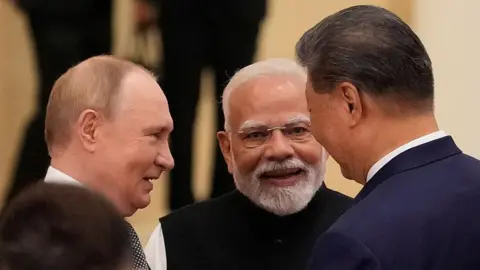
In September, the leaders of India, China and Russia displayed rare solidarity at the Shanghai Co-operation Organisation Summit in Tianjin, smiling and posing for photographs in what was seen as clear signalling of a new bonhomie to the US administration.
And in December, Modi and Putin met again, to further their "no limits partnership".
India's foreign policy has always had to juggle between these important relationships. But some reckon that the thawing of the relationship with Trump could now mean that Delhi leans back more quickly towards the US.
"Many in India would like to remain strategically unaligned, but if this rapprochement proves durable, India would likely gravitate back to the US bloc," said Shah.
