Oil, tariffs and farming: What we still don't know about US-India trade deal

 Getty Images
India's opposition parties, farmer groups and trade experts have raised concerns about the interim India-US trade agreement after additional details were released on Friday.
A joint statement confirmed that India will purchase $500bn (£367.4bn) worth of US goods over five years, but did not mention a pledge by Delhi to stop Russian oil purchases.
Earlier last week, the countries had announced a trade deal, with the US cutting tariffs on Indian goods to 18% from 50%.
Final negotiations are still under way, but the interim deal has raised four key questions.
Is India giving more than it is getting?
As per the agreement India has promised to reduce its standard tariffs on all US industrial goods as well as several food and agricultural products.
The United States on the other hand will only lower reciprocal tariffs that currently apply to about 55% of Indian exports - bringing them down from 50% to 18%.
This suggests an "uneven exchange", according to the Delhi-based Global Trade and Research Initiative (GTRI) think tank.
Opposition leaders like India's former finance minister P Chidambaram have also argued that the framework is "heavily tilted in favour of the US and the asymmetry is obvious".
But India's trade minister Piyush Goyal has defended the agreement saying the 18% tariff charged by the US is among the lowest faced by its trading partners and will boost labour-intensive Indian sectors such as textiles, leather and gems.
Most industry associations have given the agreement a thumbs up.
Will Delhi stop buying Russian oil?
Whether or not Delhi has pledged to halt the purchase of Russian oil still remains unclear.
While announcing the trade deal last week, President Donald Trump said India was committed to this - but it isn't in the joint statement. In a separate executive order, Trump also said the US would monitor whether India resumed Russian oil purchases "directly or indirectly" and that would determine whether a 25% import duty would be re-imposed on the country.
Goyal, meanwhile, told news agency ANI in an interview that oil buying decisions are taken by "individual companies" and that the trade deal "does not decide who will buy what and from where".
And Russia has said it has received no indication from Delhi that supplies will stop.
According to media reports, while Indian refiners are avoiding new Russian oil purchases, some deliveries are still scheduled.
The lack of an explicit Indian statement has fuelled opposition claims that commitments are being made without parliamentary clarity.
"By lifting the 25% Russian oil penalty only on the condition that India cease all direct and indirect imports from Russia, Washington has effectively weaponised trade to constrain Indian foreign policy," Brahma Chellaney, a strategic affairs expert said, on X.
Could the deal hurt farmers?
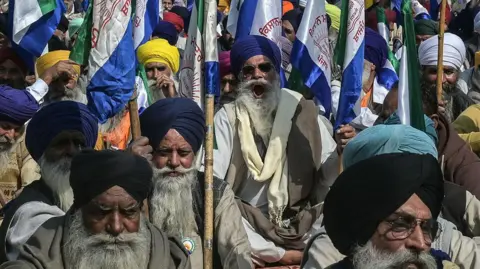
The agreement has upset India's farm unions who warn that tariff cuts on US agricultural imports could undercut domestic producers.
The Samyukt Kisan Morcha that led the protests against the controversial farm laws in India in 2020 and 2021said allowing freer imports of items such as dried distillers' grains, soybean oil, red sorghum, nuts and fruits would harm farmers' incomes.
It has demanded the resignation of the commerce minister and announced plans to intensify protests.
According to GTRI, there is also a lack of clarity on the "additional agricultural products" that have been included for tariff cuts in the agreement.
The inclusion of agricultural and food items in the tariff-reduction list could spark "domestic backlash" as farmer groups have warned of price undercutting in maize, soybean, dairy and nuts, Systematix Research, a brokerage house, said in a note.
Goyal has said India has not offered concessions on dairy, genetically modified products, meat or poultry, and that safeguards for farmers are in place.
He has argued that the agreement will ultimately help farmers by expanding export opportunities.
 Getty Images
Is India's $500bn purchase pledge realistic?
Under the framework, India has expressed an intention to buy $500bn of US goods over five years, including energy, aircraft, technology products and coking coal.
Critics question whether this is achievable.
According to GTRI, this would require India's annual imports from the US to more than double every year. The announcement also relies on private sector decisions that are beyond government control.
The commitment also "risks inflating India's import bill and eroding its trade surplus with the US", Systematix Research said, warning of longer-term pressure on external balances.
However, Goyal has described the target as "extremely conservative", citing rising demand for aircraft, energy and data centre equipment.
He says India already has tens of billions of dollars worth of aircraft orders in the pipeline and expects overall imports to grow as the economy expands.
Despite several unanswered questions, India's stock markets rose sharply on the back of the deal announcement, with lower tariffs, stronger energy ties and deeper economic cooperation with the US expected to add to the country's growth prospects.
