All one big family, says Ride to the Wall founder

 National Memorial Arobretum
The founder of an annual motorbike ride has said a strong community has built up around the event which has marked its 18th year.
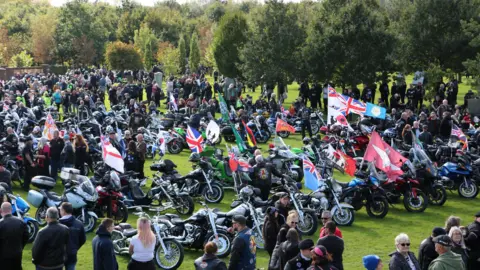
Ride to the Wall (RTTW) sees riders from across the UK and beyond head to the National Memorial Arboretum in Alrewas, Staffordshire, to remember those who have died in service since the end of World War Two.
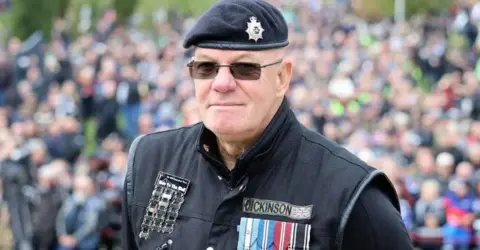
Founder Martin Dickinson, 66, said most people attending had a military connection and the event was built on these bonds. There was also "close-knit community within the motorcycling world", he said.
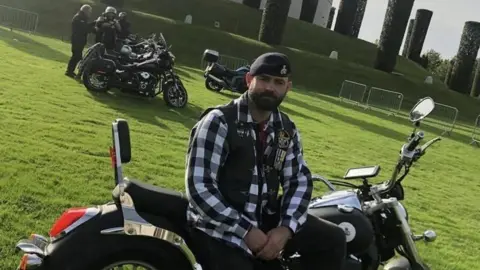
Anthony Frith, who is among thousands of "Wallers", said of organisers: "I don't think they realise the difference they've made in people's lives by doing this."
 Anthony Frith
The ride is followed by a remembrance service at the Armed Forces Memorial which displays the names of more than 16,000 lives lost since World War Two.
It happens on the first Saturday in October, near the date the memorial was dedicated by Queen Elizabeth II in 2007.
It has so far raised more than £1.83m for the NMA.
Meticulously planned, there are 12 start points for riders, including Worcester's Strensham Services, Telford Services and Donington Park.
Wallers, as riders are nicknamed, keep in touch via a Facebook page, arrange their own social events, make new friends or reconnect with old ones.
Mr Dickinson, from Northamptonshire, meets up every June with a group of Belgian Wallers.
He joined the former Royal Corps of Transport at 18 before later serving for 30 years with the prison service.
He still has "dozens and dozens" of friends from his army days and said it was difficult to explain "the bond that people that serve together in the military have".
"I get numerous emails from partners to say that either their husband, girlfriend, wife - it allows them the opportunity to really be themselves because they're in the company of like-minded people," he said.
RTTW may help those who have "struggled since they've come back" from Afghanistan, Iraq and Bosnia and other places, he said.
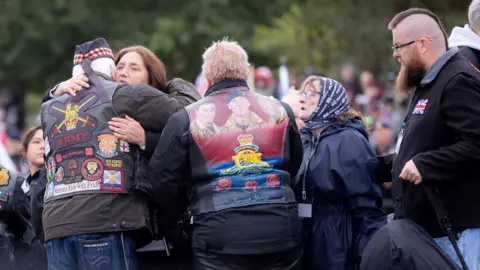
"When they are standing next to somebody during the service and they know that person served, we're all one big family really," Mr Dickinson said.
 National Memorial Arboretum
Mr Dickinson has also heard about people reunited after many years apart after meeting at the memorial service.
"They turn and look to their side and the guy that they served with 50 years ago is stood next to them and the conversation carries on as if there hasn't been that 50 year gap," he said.
 National Memorial Arboretum
Mr Frith, who served in the Staffordshire Regiment, bought a motorbike and got a licence to take part in RTTW in 2023.
"I'd always admired it from afar because I used to go down to Fazeley and watch all the bikes go past. It was always a sight to see," he said.
He believes "remembrance" is its main meaning.
"I think it's showing the families of the fallen that their sacrifice as a family isn't forgotten, and that their boys, girls, fathers, mothers, daughters, brothers will always be remembered," he said.
This has particular meaning for him, as he has led efforts for a monument for three young men who were killed by a roadside bomb when he was on patrol with them in Iraq in 2005.
That memorial is being created by sculptor Johanna Domke-Guyot who made the Victory over Blindness statue for Blind Veterans UK in Manchester.
It will be unveiled in Tamworth Castle grounds in April.
Mr Frith, of Atherstone, Warwickshire, was asked to be a standard bearer for RTTW at this year's event and said he was "absolutely honoured" to do so.
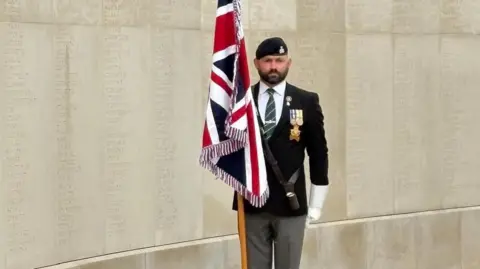 Anthony Frith
Philippa Rawlinson, director of the NMA, said she was "always blown away by the sense of camaraderie and shared purpose at the heart" of RTTW's remembrance service.
She added the "incredible generosity of the Wallers" has helped the venue to remain freely open to all.
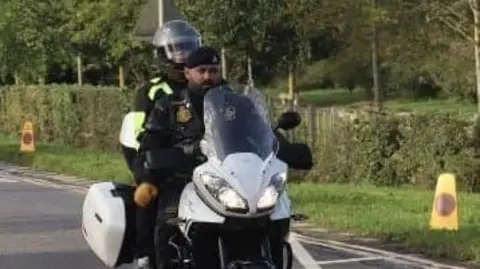 Anthony Frith
Mr Dickinson said RTTW came about after he visited the arboretum on Armistice Day when he was director of a Harley Davidson owners' group.
He said he "had this lightbulb moment" when he realised the many children at the site were there to remember maybe "parents or an uncle or an aunt" whose name was on the Armed Forces Memorial wall, rather than to commemorate World War One or Two.
"I felt there was a bit of a gap," he explained. We needed to to modernize remembrance."
He said in the first year he asked for 200 riders to attend, but about 2,000 turned up, and it grew from there.
Of its success and the community around it, he said: "I don't think I could really put it into words how proud I feel, it's actually unbelievable."
Mr Frith said RTTW had spread far, with people from Denmark, Spain and France among those attending.
"You can't really go anywhere without finding a Waller," he said.
He may see a badge on a car, or spots someone wearing a t-shirt in a coffee shop.
"It's just phenomenal because you always give each other that nod or you'll stop and say hello," he said.
He added: "It's that community, it really brings people together."
Follow BBC Stoke & Staffordshire on BBC Sounds, Facebook, X and Instagram.
