Are things going to get better for your finances?

 Getty Images
The UK's rate of inflation has risen, but the chancellor, in response, promised that Britain would this year turn a corner.
Rachel Reeves said cutting the cost of living was her "number one focus", following comments from Prime Minister Sir Keir Starmer who claimed that every minute not talking about it was "a wasted minute".
It is a clear strategy ahead of local, Scottish and Welsh elections in May, driven in part by difficulties in boosting economic growth, and also in knowing there could soon be better news to tell.
But many households are still struggling to cover essential bills, and others are unconvinced of improvement.
Here are some of the key factors affecting family finances and whether government policies can, or do, have an impact.
Energy prices set to fall
Winter directs inevitable attention to household energy bills, but it will be spring when the government's flagship policy kicks in.
In the Budget, the chancellor announced a £150-a-year cut to a typical domestic energy bill - but delivery of this simple pledge is a little more complex.
While there is a reduction, some green policy costs are actually being shifted from bills to general taxation. While the move has received a warm welcome, taxpayers will still be covering some of the cost through other taxes.
Investment in gas networks and electricity transmission will also mean costs added to bills. The latest forecast from respected energy consultancy Cornwall Insight is for the typical annual bill to fall by £138 in April.
It says the Energy Company Obligation - which is being entirely removed - will cut about £62 from a typical annual dual-fuel bill, while 75% of the renewables obligation is being removed - which will take about £67 off the bill but this will be funded through general taxation instead.
Labour's much-debated general election promise to cut household energy bills by £300 by 2030 remains under close scrutiny.
Money saving is already ingrained at home, with batch cooking, more prudent selections on the thermostat, and warming the body rather than the whole home having become the norm for many people.
Energy prices are much lower than their peak after Russia's invasion of Ukraine, when the previous government was forced into emergency measures, but campaigners say they remain relatively high. That, they say, requires a long-term strategic response.
Feeling the cost of the food shop
Food, like energy, is essential spending. People on lower incomes who spend a bigger proportion of their income on essentials feel a larger impact when prices change.
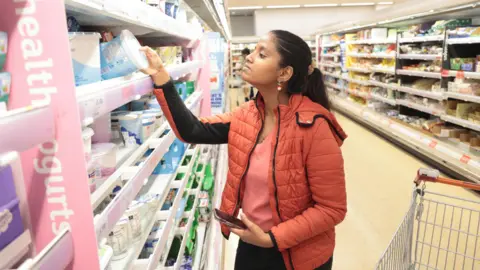
Ask people how the cost of living is affecting them, and many will point to the cost of their supermarket shop.
The impact of changes to business rates on the High Street will be closely watched.
The UK's biggest retailers have been relatively upbeat about Christmas trading, saying that shoppers were willing and able to treat themselves.
But Ken Murphy, chief executive of Tesco, the UK's biggest retailer, said consumer sentiment was mixed. Some shoppers' household budgets were in good shape while many others were counting every penny, he said.
There is intense competition between supermarkets on price, but retailers and governments have little control over the weather, harvests and the like which affect the cost of certain items.
Ministers tend to point to external factors when food prices rise sharply, so equally cannot take all the credit when they slow. The same is true of inflation in general.
The latest inflation data showed a pick-up in food price inflation after a slowdown the previous month. Either way, the food shop was not getting cheaper, it just meant it was rising more quickly or more slowly.
For the most vulnerable, the government has confirmed the Crisis and Resilience Fund will begin at the start of April, providing £1bn annually for the next three years. This gives emergency cash payments and support to those potentially in crisis.
Rail and bus fares frozen in England
Rail fares in England have been frozen for the first time in 30 years by the government.
This applies to season tickets covering most commuter routes, some off-peak return tickets on long-distance journeys and flexible tickets for travel in and around major cities until March 2027.
As well as the cost of fares, there is the potential cost of delays, leading to the government's announcement about rail improvements in northern England.
 Getty Images
The £3 cap on bus fares in England, outside London, has also been extended to the same date. However, that scheme is voluntary and not all bus companies have signed up.
For drivers, the 5p "temporary" cut in fuel duty on petrol and diesel was extended in the Budget but will see a staged increase from September.
Mortgage rates falling but rents still rising
It is the independent Bank of England that sets interest rates, not the government.
Ministers will claim that the government has brought stability to the economy, allowing for the rate of inflation and, in turn, interest rates to fall.
The reduction has brought mortgage rates down too, with some analysts expecting further movement early in the year.
The sharp rise in rents, which has had a massive impact on younger workers in recent years, has slowed too. But groups representing landlords say that further tax burdens will restrict the number of homes they can offer which risks pushing rents up.
The main elements of the Renters Rights Act will come into force in May, offering more protection to tenants in England, but also some concern from landlords.
Tax, benefits and economy
A hugely complex area involving billions of pounds clearly affects the finances of different people in different ways.
The government will point to the end of the two-child benefit cap in April as evidence of how it is putting money back into the pockets of larger, low-income families.
Opposition parties and critics will highlight the chancellor's decision to extend the freeze on tax thresholds, meaning more people will pay more tax.
After the Budget, the Institute for Fiscal Studies think tank said households were facing a "truly dismal" increase in living standards.
Average disposable income - a measure of people's earnings after tax - will rise by just 0.5% over each of the next five years, according to the Office for Budget Responsibility - the government's official forecaster.
