UK inflation rises for first time in five months - but one-off factors blamed

 Getty Images
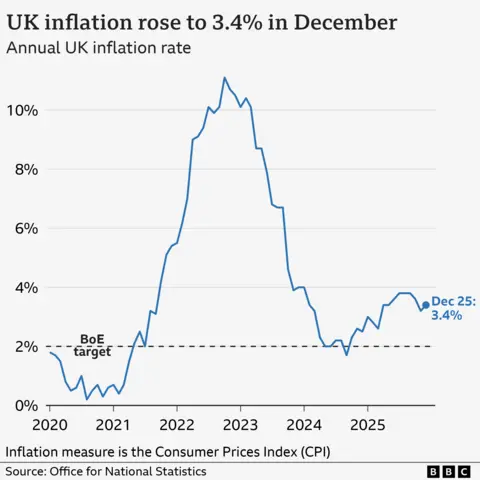
Higher tobacco prices and airfares pushed the UK rate of inflation higher for the first time in five months, official figures show.
The rise to 3.4% in the year to December was higher than expected with most economists predicting only a slight uptick.
However, analysts do not think it marks the start of a longer, upward trend because December's data includes one-off factors such as flight costs over Christmas and an increase in tobacco tax announced in the Budget.
The rise in inflation precedes the Bank of England's first meeting of year to decide on interest rates - it ended 2025 by trimming the cost of borrowing to 3.75%.
Inflation rose from 3.2% in the year to November and was higher than forecast of 3.3%.
The Bank of England's rate-setting committee will meet on 5 February.
Michael Saunders, a former rate-setter at the Bank, said the increase "is not the start of a new upward trend, it reflects a variety of fairly temporary erratic factors".
He said it was unlikely the Bank would reduce borrowing costs in February but expects it to announce "gradual" cuts this year.
"The reason they can't cut quickly is because inflation and pay growth are still too high for comfort," he said.
During December the Office for National Statistics (ONS), which published the data, said airfares was a big contributor to inflation "because of the timing of return flights over the Christmas and New Year period".
Tobacco prices grew largely due to duty rises announced in the Budget on 26 November.
The ONS's chief economist Grant Fitzner added that "rising food costs, particularly for bread and cereals, were also an upward driver" to inflation.
In response to the figures, Chancellor Rachel Reeves said her priority was cutting the cost of living, citing measures in Budget including a freeze to rail fares and prescription charges.
"There's more to do," she said. "But this is the year that Britain turns a corner."
However shadow chancellor Mel Stride blamed the rise on what he called the government's "economic mismanagement".
He said: "A record-high tax burden and irresponsible borrowing are stifling growth and fuelling inflation – leaving working people worse off."
The data revealed that some elements of inflation eased in December such as rents.
Housing and household services, which measures rents, slowed to 4.9% compared to a 5.1% rise in the 12 months to November.
Transport prices rose by 4% in the 12 months to December, the figures show, mainly because of airfares.
"This owes a lot to timing differences," said Sarah Coles, head of personal finance at Hargreaves Lansdown.
She said that when the ONS calculated the average inflation rate in December 2024 "the flight prices being measured were Christmas Eve and New Year's Eve".
But she said in the December 2025, they were recorded on 23 and 30 December.
"Prices are naturally lower on high days and holidays, and higher as people flock to get away in time for Christmas," Coles added.
A 4.5% rise in the price of food and non-alcoholic drinks was mainly due to bread, cereals and vegetables.
Balwinder Dhoot, director of growth and sustainability at the Food and Drink Federation, said rising costs meant households were "feeling the squeeze, resulting in a subdued Christmas for the sector".
"The low UK consumer confidence, coupled with the prospect of continued geopolitical volatility, is concerning for food and drink manufacturers who face rising costs and tighter budgets themselves."
Compared to European neighbours, December's inflation rate in the UK was higher.
Inflation in Germany was 2% in the year to December – it has been a year since UK inflation has been below that of Germany's. In France, the rate was 0.7%.
Sanjay Raja, chief UK economist at Deutsche Bank, predicted that UK inflation will "take a big step down in January". He forecast that by spring the Bank of England's 2% target will "be in sight".
"In fact, we think the UK will see the biggest fall in headline inflation of any G7 country this year," he said.
