Squabbling, U-turns and 'made-up' quotes - who's in the right over the hospital scandal?

 Getty Images
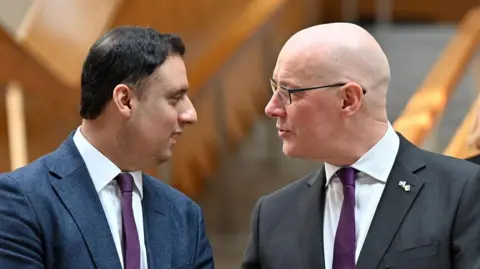
After a fortnight of twists and turns, the political row over the Scottish Hospitals Inquiry continues to evolve with leaders trading increasingly barbed accusations.
Every passing week seems to add a new layer of complexity and controversy to the story, from eleventh-hour U-turns from the Greater Glasgow and Clyde health board through to Saturday night statements.
Off the back of an afternoon of document-brandishing drama at Holyrood, Scottish Labour is now claiming that the first minister "fabricated" a quote from an inquiry KC and misled parliament.
However, the government has doubled down and says this is unequivocally not the case.
Helpfully, we can look at the transcripts side by side - so who's right?
And does the evidence stack up in terms of there having been political involvement in the scandal at the Queen Elizabeth University Hospital (QEUH) campus?
What has happened at the inquiry?
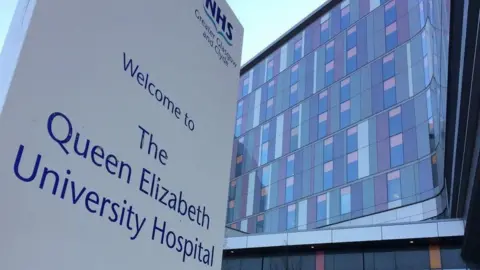
The public inquiry was set up in 2019 after a number of deaths and high levels of infection at the QEUH campus.
There was particular focus on infections among young people being treated for blood disorders and cancer - like Milly Main, who died aged 10 while in remission for leukaemia.
NHS Greater Glasgow and Clyde had long denied that there was an unusual level of infections, or that it could be concluded there was a problem with the buildings.
But in its closing submissions to the inquiry earlier this month, the board admitted that "on the balance of probabilities" there had been a "causal connection" between some infections and the hospital environment.
It also stated that: "Pressure was applied to open the hospital on time and on budget, and it is now clear that the hospital opened too early. It was not ready."
This led to questions about who applied this pressure, with John Swinney insisting that ministers had not been involved, and Nicola Sturgeon - who was first minister at the time the hospital opened in 2015 - also denying putting on any pressure or having any knowledge of safety concerns.
The health board then issued a statement on a Saturday evening backing this up, and clarifying that any pressure had been internal to NHS Greater Glasgow and Clyde.
But there was a further twist on Thursday when Sarwar produced a government paper which blew the dispute open again.
What was said in parliament?
 Getty Images
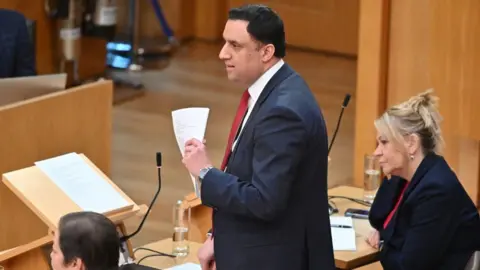
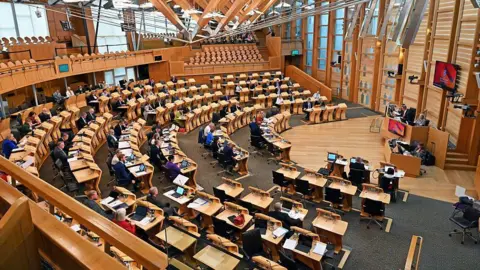
The Scottish Labour leader produced a "gotcha" moment during First Minister's Questions.
He held aloft a set of government meeting notes from 2019 and 2020, in which officials and health board colleagues looked back on the hospital's opening.
It stated that "political pressure" was being felt by the health board, and that "no consideration was given to delaying the opening of the hospital despite the issues being faced with completion and operation".
Sarwar said this was "damning" evidence, showing "in black and white" that there had been political pressure.
John Swinney offered a by-now familiar response - that people should wait for the report from inquiry chairman Lord Brodie.
And twice he cited the inquiry's lead counsel, Fred Mackintosh KC.
In response to the claims of political pressure, he said: " That was not the case, and the reference for that is what counsel to the inquiry said on 23 January.
"They said there is no evidence of external pressure on NHS Greater Glasgow and Clyde to open the hospital early or before it was ready to be opened."
He made the same defence a third time when questioned by journalists outside the Holyrood chamber.
But Labour insists that the first minister misquoted Mackintosh, with Sarwar writing an open letter to Swinney accusing him of "choosing not to tell the truth to parliament".
He said: "You did not misinterpret the evidence. You fabricated it. You have misled Parliament and you have lied to the people of Scotland."
Where does the quote come from?
 PA Media
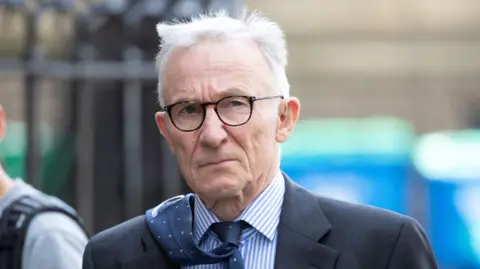
During the final day of oral submissions at the inquiry, chairman Lord Brodie was discussing the matter of pressure on the health board with Fred Mackintosh.
The judge reflected that he had not asked lawyers for the health board about their claims of pressure, and that there had not been an explanation about why it had appeared in their closing statement.
Mackintosh replied that "as far as I can recollect, beyond one particular aspect of pressure, there was no evidence from the senior GGC (Greater Glasgow and Clyde) people involved in opening the hospital about pressure, either from them or anyone else".
He later added: "There's pressure in the sense that it would be a good idea to meet the target because otherwise it will be difficult for everybody, there will be failures. But we didn't detect, in the evidence, pressure in the sense of 'open it earlier than was planned'."
The KC also said that the late admission about pressure came as "somewhat of a surprise, because although there was a pressure to open on time because of the obvious consequences, we'd not heard anything else in our investigations".
The Scottish government stated that Swinney had at no point said he was directly quoting Mackintosh, and that in any case some of the extracts repeated above are "unequivocal".
The government also said the document raised by Sarwar is "not new" and had already been considered by the inquiry.
Where could this lead?
 Getty Images
The charge of misleading parliament is a serious one, with the ministerial code stating that members who do so deliberately are expected to resign.
But with John Swinney clear that he feels no need to correct the record, it is hard to see where the specific dispute over these comments goes.
It is perhaps possible to take a different interpretation of Mackintosh's comments - that the inquiry had not previously sought or been offered particular evidence about pressure, rather than a definitive statement that no such evidence exists in the world - but it is in shades of grey rather than the black and white claimed by Sarwar.
It is yet another element in this row which is frankly a bit of a mess.
One issue is that - as seen in the extracts above - the inquiry has not really dug into the question of pressure.
It essentially wasn't on anyone's radar up until the point the health board volunteered it in its closing submission.
And so despite the first minster's refrain that we should wait for Lord Brodie's report, it seems unlikely that the judge will actually address the question of pressure in any depth, given it only surfaced at the last moment and has barely been considered.
It is also in Labour's interests politically to keep bringing this up again and again as we build towards a Holyrood election.
If the claims about misleading parliament don't stick, they can always go back to that government minute which mentioned pressure.
The trouble is that there are just a few snippets of information out there about it, passing references in documents which the inquiry will not now be going back to re-examine in an impartial way. The evidence is circumstantial, not definitive, and certainly doesn't implicate anyone specifically.
So we are left with a political row founded on something which can neither be conclusively proved nor entirely dismissed, and rhetoric building fast about a hugely emotive and contentious inquiry.
