'My career was saving lives on the roads - and then I lost my brother in a crash'

 BBC
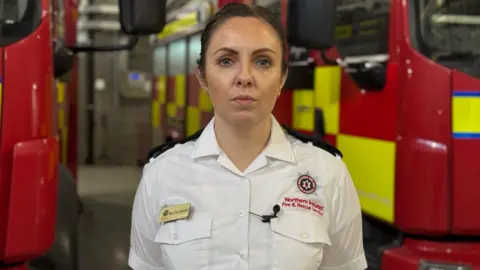
BBCLike the many, many people left grief-stricken by crashes on Northern Ireland's roads, Mary-Kate McKevitt will never forget the day her brother John Paul died.
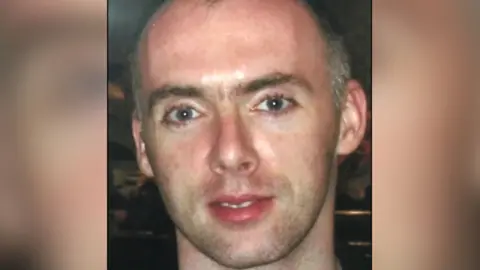
The 34-year-old's bike was struck by a car 11 years ago. She remembers watching him on life support. She remembers the doctors turning the life support off.
"It's the most horrendous thing that any family should ever have to go through," she said.
"When Paulie died, he left behind two little boys and a partner who was completely distraught, so you were trying to support them, while also grieving your own brother, so it was really hard."
 McKevitt family
What made it different for Mary-Kate, however, is her job - as a long-time firefighter, who is now a station commander, she spent her career being among the first on the scene of horrific road crashes.
After her brother's death, she returned to a job where she had to continue to answer the call.
"Anytime a road traffic accident call comes in, I definitely have that little extra heartbeat moment – because of what happened to our Paulie," she said.
"It's probably the most common type of call we get and because of what I went through with Paulie, I know how potentially life-altering it will be for everyone involved, so I'm always hoping it's nothing serious."
And there are many calls – last year the Northern Ireland Fire and Rescue Service (NIFRS) received 800 of them related to road traffic collisions (RTCs).
The ambulance service gets called out to more - about 3,500 RTCs a year.
There are roughly just shy of 9,000 emergency service personnel in Northern Ireland – mostly police officers, but also about 1,800 firefighters and about 850 paramedics.
These are the people responsible for treating, rescuing and saving those caught up in serious crashes every year.
But what happens when the trauma of responding to these crashes becomes personal because a victim is a friend, family member or colleague?
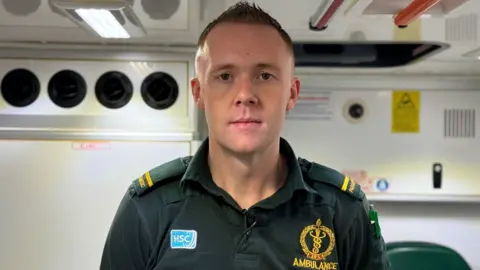
Stephen Doherty, a paramedic for 13 years, has been on the scene of more road crashes than he cares to remember - he has seen pretty much every scenario, every kind of victim.
"You'll never forget your first fatal road traffic collision. I can still remember the noise, even the smells," he said.
Stephen has also had the experience of having to treat colleagues after a serious crash.
"Obviously as ambulance staff we drive thousands of miles a year, so unfortunately there is an inherent risk that we will be involved in road traffic collisions," he said.
"It's distressing to have to treat one of your own staff members as a patient, because they are a colleague and a friend, so ethically and morally there are challenges there, but ultimately you have to maintain care for them as a patient."
There are other crashes that stay with him too, like the one fatal that will live with him forever.
"It was a hit-and-run involving a child and we actually came across the scene only 30 or 40 seconds after it had happened," he said.
"You put your professional hat on, and you do what you're trained to do, which is the preservation of life, but unfortunately sometimes the injuries are so severe that it's not possible."
That was an incredibly tough day, he added.
"One that will always, inherently, live rent-free in my head.
"Thankfully we have a lot of peer-to-peer support, and there's an ambulance service staff charity which provides a 24-hour, seven-day-a-week service, so talking to someone is really important in this line of work."
'Am I going to die?'
It is a similar story for Mary-Kate, who has likewise seen the worst of what can happen on our roads.
"Some of the worst type of road accidents are when the person is trapped in the vehicle and they have severe injuries," she said.
"I've been in situations where people are trapped in their car and have asked me if they're going to die, and you have to be somewhere in the middle between compassionate and honest."
Responding to these types of calls, seeing those scenes and bringing comfort to victims - this is what takes a toll, she adds.
"I know for me I will always remember the person's clothes, sometimes what they smell like, things like their perfume, family members they may have talked about, these intricate details stay with you."
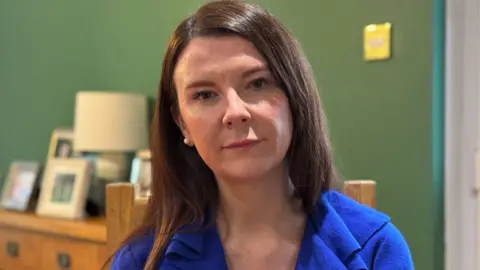
Sinead Lunny knows more than most about the important work provided by emergency services in the aftermath of a car accident.
She broke her back and had to use a wheelchair for six months after her car hit a lorry in 2008 between Banbridge and Dromore, County Down, on the same road where Mary-Kate's brother died.
Sinead was still conscious when emergency services arrived.
"They had to cut me out of my car and I remember how calm the fire and ambulance crews were, with lots of reassuring me while they did their work," she said.
Sinead says she will be forever grateful to the first responders.
"It takes a very special kind of person to work in those emergency service teams, and I have the utmost respect for them," she said.
'Silence is the hardest part'
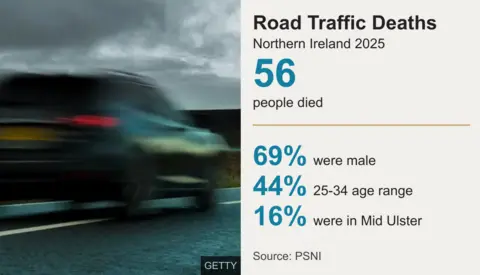
Last year, 56 people died on Northern Ireland's roads and 76% occurred on rural roads, with Mid Ulster having the highest rate.
Mary-Kate says it is important to remember that behind each statistic is a person.
"When you're driving your choices have consequences, and it only takes a second of inattention, to change yours and someone's life forever," she said.
Paramedic Stephen added: "For me it comes down to not using your mobile when driving, don't speed and don't drive under the influence, it's that simple."
When the calls come, Stephen, Mary-Kate and their first responder colleagues will answer - but what they see on shift does not leave when they clock off.
"I'm still a human being, at the end of the day I go home and take the uniform off," said Stephen.
"But after a busy shift sometimes, the white noise and the silence is the hardest part."
