Would lower speed limits improve road safety?

 BBC
BBCMore than 50 people lost their lives in road traffic crashes last year in Northern Ireland.
The figures make for grim reading and behind every statistic lies a very human tragedy.
This week, the minister for infrastructure launched a consultation on speed limits.
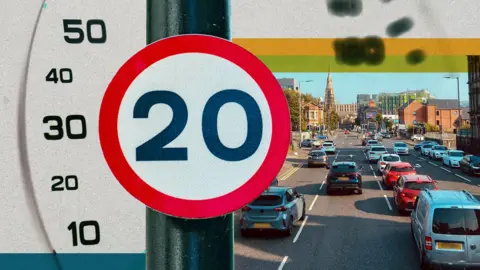
We all know the advertising slogan – Speed Kills – and one of the proposals is to introduce a 20mph speed limit in all areas that are currently 30mph.
Lowering speed limits has happened in other parts of the United Kingdom - in Wales speed limits were lowered in built up areas in 2023.
But will Northern Ireland follow suit?
We've taken a look at the other proposals and the science behind speed limits.
How many have died on Northern Ireland's roads?
Fifty-six people died on Northern Ireland's roads in 2025, according to figures released by the Police Service of Northern Ireland (PSNI).
A total of 69 people lost their lives on the roads the previous year.
Speeding is recognised as one of the Fatal Five and contributes significantly to the number of people killed or seriously injured on our roads.
The other four lethal factors are drink or drug driving; mobile phone use while driving; seatbelts and careless driving.
How does speed affect survival rates?
Broadly speaking, research shows that slower equals safer.
The Department for Infrastructure (DfI) said at 20mph a child hit by a vehicle has a high chance of survival - nine children out of every 10 hit will live (90%).
At 30mph the survival rate drops, for every two children hit only one will live (50%).
At 40mph, nine children out of every 10 will die.
What is in the consultation?
The 14-week consultation is seeking the "public's views on speed limits aimed at improving road safety".
There are three parts to it - 20mph speed limits; national speed limits on rural single and dual carriageway roads and HGV (Heavy Goods Vehicle) speed limits.
Each element has a number of options, including keeping the existing rules.
On 20mph limits, the proposals are:
- Introduce 20mph in targeted areas
- 20mph at all schools, where safe to do so
- 20mph in built-up residential areas that are 30mph
- 20mph in all areas that are 30mph, except arterial routes
- A 20mph limit in all 30mph areas
On national speed limits:
- Introduce a reduction of the national speed limit from 60mph to 50mph with a targeted approach on rural single carriageway roads
- A reduction of the national speed limit to 50mph on all rural single carriageway roads
- A reduction of the national speed limit from 70mph to 60mph with a targeted approach on dual carriageway roads
- Reduction to 60mph on all dual carriageway roads
On HGVs:
- Introduce a trial on selective routes to increase limits to 50mph on all single carriageways and 60mph on all dual carriageways to align with other regions
- No trial, just increase
What did the minister say about the consultation?
 PA Media
Infrastructure Minister Liz Kimmins said speed was "one of the most common factors in terms of road traffic collisions".
"We have seen huge numbers of people losing their lives on our roads and it is certainly my priority to do all I can to try and bring those numbers down and ensure that no more families face this devastating news," she said.
Kimmins, who is an assembly member for Newry and Armagh, said a significant part of her constituency was rural.
"We've seen in 2024 a huge amount of the collisions and fatalities that occurred were on rural roads - that tells me that we need to do something," she added.
What happened in Wales with speed limits?
In September 2023, Wales became the first country in the UK to reduce speed limits in built-up areas from 30mph to 20mph.
To say it caused quite a stir is an understatement. It was one of the most controversial law changes made by the Welsh government, sparking the largest petition in its parliamentary history.
Police figures, collected by the campaign group, 20's Plenty For Us, found there had been 882 fewer people hurt in crashes since the law was introduced. The group also said the reduction had prevented 14 deaths in Wales.
Although data showed there were more than 100,000 instances of people breaking the speed limit in the first 18 months it was in place.
The backlash did result in the re-introduction of 30mph limits on certain roads, but 20mph is now the norm in many areas.
What are the speed limits elsewhere in the UK?
More than half of London's roads now have a 20mph speed limit, according to Transport for London.
In Leeds, dozens of roads are set to become 20mph as part of the council's Vision Zero 2040 strategy which aims for zero road deaths or serious injuries by 2040.
The first 20mph limit in England was introduced back in 1991, but their popularity has accelerated in the last decade.
In December, the Scottish government dropped plans to reduce the national speed limit on single carriageway roads after a consultation.
What are the speed limits in the Republic of Ireland?
There are three types of roads in the Republic of Ireland - local, regional and national roads.
Speed limits on some of them have changed, or are due to change.
From February 2025, limit on many rural local roads dropped from 80km/h (50mph) to 60 km/h (38mph).
There are also plans to lower the speed limit on national secondary roads, such as single carriageways, from 100km/h (62mph) to 80km/h (50mph) and on urban roads from 50km/h (31mph) to 30km/h (18mph).
Dublin City Council has in recent years progressively rolled out a 30km/h speed limit to many areas of the city and the latest proposal will see the city extensively covered by a 30km/h limit.
Across Europe there is a strong desire to make 20mph (30km/h) the default speed limit on all urban and residential roads.
When does the speed limits consultation close?
Members of the public have been asked to share their thoughts by 22 April.
"I sincerely encourage you to read this review and join us in shaping a safer future for all," added the infrastructure minister.
