'I hope movie raises awareness about Tourette's'

 BBC
BBCOne of big winners at the Baftas last week was the film I Swear, which tells the story of a young boy growing up with Tourette's syndrome in Scotland in the 1980s.
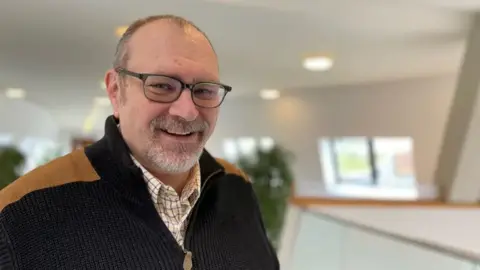
Robert Aramayo scooped the Best Actor award for his portrayal of John Davidson, but the movie's moving success was also celebrated by Prof Stephen Jackson.
Based at the University of Nottingham, his work researching Tourette's was featured in the film, including the development of a wristband used for controlling the symptoms.
He said it was "very interesting" to see his work featured and he hopes greater awareness of life with the condition is raised as a result.
'Emotional and moving'
"I thought it would to be more like a documentary when I was first told about it, but it's actually a fantastic film," he said.
"It's got fantastic actors in it, and it tells a really emotional and moving story, but it's also quite funny."
Jackson played a key role in developing the Neupulse device, which delivers electrical pulses to reduce the amount and severity of tics.
He said the wristband came from discussions with people who have Tourette's on what would make a positive impact on their lives.
"We were very aware of the lack of effective treatments available to children and young people with Tourette's, so when we talked to them about what they wanted they said they wanted a safe and effective non-drug treatment that they could use ideally on-demand [and] outside of the clinic," he said.
"We developed a way of stimulating the median nerve, which is the nerve that runs from the hand into the brain, and we used that as a way of changing those brain rhythms that are associated with movement, and the result of that was that we were able to quite substantially reduce tics and the urge to tic."
 EPA
EPAThere was controversy following the Baftas ceremony when a racial slur made by Davidson was broadcast, for which the BBC has apologised.
Jackson said the fallout from the incident highlighted the need for greater understanding of the condition.
He said: "I see this a lot with the people I see, they will say these things, but it's quite clear they're as distressed as the person hearing it that these things are being said - it's involuntary."
With critical acclaim coming the way of I Swear, Jackson hopes the film can help improve "very patchy" services for people with the condition in the UK.
"The problem is for many years Tourette's wasn't taken seriously," he said.
"That completely missed the point about how distressing and debilitating this condition is, particularly in young children - it can affect their schooling, their development, their ability to make social relationships, [and] it can have a dramatic effect that can last a lifetime.
"I hope [people] really enjoy the film, which they will do I'm sure, but I also hope that they'll have a new recognition and a new understanding of how distressing and difficult life can be with a condition like tics, so as a consequence, maybe they'll be more understanding and kind."
Follow BBC Nottingham on Facebook, on X, or on Instagram. Send your story ideas to eastmidsnews@bbc.co.uk or via WhatsApp on 0808 100 2210.
