How the Spitfire became British symbol of freedom
"Don't change a thing" - this is what Captain Joseph "Mutt" Summers declared after taking the Supermarine Spitfire prototype, K5054, from Eastleigh Aerodrome to the skies for the first time on 5 March 1936.
Summers had spent only eight minutes to test the limits of that new technology and wanted to report his observations.
The aircraft, initially only manufactured at the Supermarine works beside the River Itchen in Southampton, became the most successful British single-seat fighter aircraft of World War Two.
As events are taking place in its hometown to mark the 90th anniversary of its maiden flight, the BBC explores the fascinating history behind the fighter's enduring legacy.
The designer

 Getty Images
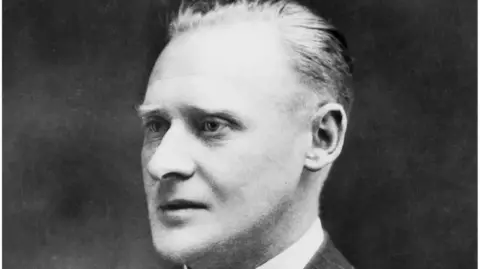
The Supermarine Spitfire was designed by Staffordshire man Reginald Joseph (RJ) Mitchell, who worked for the Southampton aviation company Supermarine from 1916 until 1936.
The fighter plane, which was commissioned to combat the Luftwaffe at the beginning of the Battle of Britain, was Mitchell's exact design, with a Rolls Royce Merlin engine "under the bonnet".
The German air force had no answer to the advanced fighter.
The Royal Air Force says more Spitfires had been built "than any other British combat aircraft before or since World War Two - 20,341 in total".
It was also used by many other Allied countries into the 1950s.
Mitchell continued to refine the design until his death from cancer in 1937, not being able to witness the triumph of its invention.
What is it made of?
According to the RAF Museum, the plane had been made "entirely from metal".
"A new thin wing that is broad at the root, but tiny at the tips, (an elliptical shape) will make the plane fast and maneuverable," the description reads.
"The wheels will fold down and go back up into the wing at the flick of a switch."
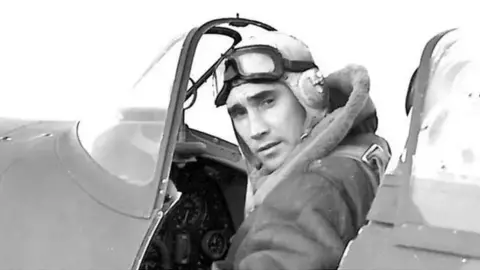
In an interview for the BBC, test pilot Jeffrey Quill, who was one of the first men to fly the prototype after Summers, recalled having "a tremendous feeling of elation".
"When I think of some of the things that I did, it really makes me wake up in the middle of the night, sweating."
 Battle of Britain Society
RAF Museum researcher Kris Hendrix writes that after the maiden flight "only few changes were made".
"One of which was a new propeller which dramatically increased the maximum speed to 348 mph (557 km/h), making it the faster than the newest Hawker Hurricane fighter which, around that time, was entering production.
"The armament was doubled from four to eight Browning machine guns."
He adds that the first Spitfire Mk. I had entered service with the RAF on 4 August 1938.
"The pilots immediately fell in love with the aircraft, which flew as wonderful as it looked.
"They recognised it as a thoroughbred combining a perfection of design with superb handling characteristics."
He says more changes "were gradually introduced such as a three-bladed metal propeller and a new cockpit hood, finally giving the Spitfire its now-recognisable look".
"By the outbreak of the Second World War, there were 306 Spitfires in service with the RAF, 71 in reserve and 2,000 on order."
Community contribution
 Getty Images
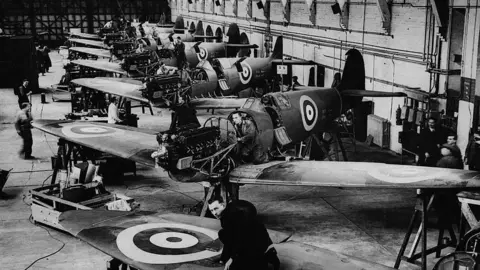
But the factory was bombed twice by the Luftwaffe in September 1940.
It left 140 people dead and production of the Spitfire was swiftly moved to dozens of smaller workshops all over Hampshire and surrounding counties.
From bus stations to laundries, all kinds of buildings were commandeered to each host a stage in the manufacturing process.
Luckily, the most important precision machines in the factory were virtually undamaged and were quickly moved to these new factories.
Workers moved to 28 sites around Southampton as well as Reading, Hungerford, Newbury, Salisbury and Winchester.
It was thanks to that collective effort and dedication that the Spitfires kept flying.
An account of National Museum Scotland reads that a total of 529 enemy aircraft had been shot down by Spitfires during the Battle of Britain.
You can follow BBC Hampshire & Isle of Wight on Facebook, X (Twitter), or Instagram.
