| 13 November 2014 |

| |
| BBC Homepage | | |
| |||
| Contact Us | | |
Local HeroesYou are in: Stoke & Staffordshire > History > Local Heroes > Reginald (RJ) Mitchell 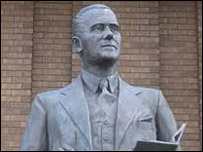 Reginald Mitchell's statue in Hanley Reginald (RJ) MitchellIt's said that World War Two was won in the skies - thanks to a little plane called the Spitfire. RJ Mitchell, its inventor and a Potteries lad, died before he could see its final success. Relatively little is known about RJ Mitchell, a shy man who, with no formal training in aerodynamics, created revolutionary aircraft throughout the Twenties, breaking several world speed records and winning the coveted Schneider Trophy a record three times in a row. Despite such success, Mitchell preferred to remain in the background, always giving credit to others. As he began work on what was set to become his greatest creation, he was diagnosed with rectal cancer. He was just 38 years old. Working on in spite of his illness, Mitchell struggled to produce an aircraft which played a crucial role in the Battle of Britain and helped to assure the nation’s freedom. ObscurityMitchell died in 1937 - just over 12 months after Spitfire took to the skies - as he worked on a revolutionary bomber to go alongside his graceful fighter. More than 23,000 Spitfires were produced in the ensuing years, but their creator’s name faded into relative obscurity. His son, Gordon Mitchell, is currently campaigning for his father’s work to be rewarded posthumously. Gordon says: “As well as being an aeronautical genius, he was also a man of great courage in the face of very grave physical adversity.” Many other people also believe there should be more fitting recognition for the father of the Spitfire. In 2003, RJ Mitchell was the surprise pick as “Greatest Midlander” in the BBC’s Online, TV and radio vote. Perhaps it is time the great innovator from Stoke-on-Trent was given the credit he deserves. Potteries historian Ray Johnson talks to BBC Radio Stoke's Janine Machin about the importance of the Spitfire and Reginald Mitchell. Help playing audio/video ******************************************* Fred Hughes, the Potteries historian, writes this personal reminiscence about Mitchell...Some years ago when I was a member of a local rambling club, our Sunday morning walk took us around the Kidsgrove district. While passing along Congleton Road, Butt Lane, one of my companions pointed out a low terraced house with a modest front bay and a couple of flat casement windows above ground level. There was nothing about the house that commanded a second glance - stuccoed walls, an ordinary worker's cottage, bland industrial architecture made worse by the very pale pink exterior paint. My friend then indicated a small plaque set in the wall between the upstairs window on which an inscription declared that Reginald J Mitchell had been born there on May 20th 1895. 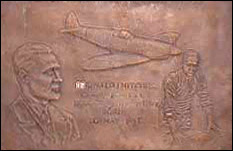 The plaque on RJ Mitchell's statue The Battle of BritainOf course I knew that Mitchell had designed the Spitfire - as a boy during the war I was very well aware of the importance of that famous plane, a symbol that played such a crucial role in the Battle of Britain. But in my maturing years I was never able to connect the true effect of Mitchell and how his aircraft saved Britain from invasion by the Nazis. I remember as a boy being in a gang of boys each playing the role of a war plane. Arms outstretched we'd run around the streets and back entries, or the school playground 'buzzing' each other and 'blowing' each other out of the 'sky', imitating the roar of the engines and the crackle of the guns. Some of us would be Lancaster bombers, or Lysanders, even American Dakotas which seemed to fill the air of the Potteries day-in day-out with transports of personal and equipment to and from the danger zones. But the more 'grown-up' of us in the gang would select to take the part of the fighter planes. One or two would be Hurricanes, but only one, yes, only the privileged one would be a Spitfire - the strongest boy would be the 'Spit' - and he would always win the schoolyard battles. We really do owe our lives to RJ Mitchell, a modest man, born in a modest home in a modest location. YouthReginald had four other brothers and sisters and the house in Butt Lane had become overcrowded so they moved to Longton where his father took a teaching job. Reginald was a pupil first at Queensbury junior school but gained a scholarship to Hanley High School where he revealed his skills in applied science. He was fascinated by flight! - just think, he was an impressionable seven years old when the Wright brothers made the first manned flight at Kittyhawk travelling between 7 and 11 mph! At 16 he became apprenticed to an engineering firm in Fenton. Learning his trade on the shop floor he graduated however to the drawing office where he very soon made a name for himself as an innovative designer. In 1916, at the age of 21 he was offered a position at the Southampton air-plane company of the Supermarine Aviation Works where he very quickly rose to become chief engineer. He was noticed for his special designs of seaplanes and he turned his attention to making them go faster. Aircraft designHigh speed flight was a great feature in post war international engineering and standards were set that lasted to the rocket science in the 1960's. His beautiful aerodynamic designs earned the company the award of the Schneider Trophy annually for air speed between 1922 and 1931 culminating with an air speed record of 407 mph in a seaplane, the S6b, which became the model for the Spitfire. Sadly RJ Mitchell died in 1937 of cancer aged only 42. The SpitfireThe Supermarine company was commissioned to produce a fighter plane to combat the Luftwaffe at the commencement of the Battle of Britain - they came up with the Spitfire - Mitchell's plane - Mitchell's exact design - with a Rolls Royce Merlin engine 'under the bonnet.' It was a plane that came to symbolise British spirit and freedom from aggression. A bird of paradise, and it is still recognised in every country throughout the world. Over 22,500 Spitfires in a variety of forms were produced and their task was to turn away the mighty German air force. And they did so famously thanks to Mitchell's famous airplane for which the German's had no answer. If it could be said that a single person did more than anyone else to win WWII - you'd have to say that person was Reginald J Mitchell - a great Staffordshire lad. Fred Hughes******************************************* Ian Shaw of the Potteries Museum also compiled a biography of Mitchell for us - with a note about the museum's Spitfire....Reginald Mitchell was born on the 20th May 1895 at 115 Congleton Road, Butt Lane near Kidsgrove. He quickly moved with his family 87 Chaplin Road, Longton, and later in nearby Victoria Cottage where he grew up. His father, Herbert, was a headmaster, but resigned the job in order to set up a printing firm and become a master printer! ListenIan Shaw from the Stoke on Trent City Museum talks about Mitchell's life and Spitfires to BBC Radio Stoke's Stuart George Help playing audio/video His upbringing was strict, and any household chores had to pass strict inspection by the father before they [the Mitchell children] were "released from duty". The grounds of Victoria Cottage were fairly large and Reg used to make things, always being good with his hands. Even at an early age he was pre-occupied with flying machines. At the age of eight, Reg went to Queensbury Road Higher Elementary School in Normacott. It was noted that he had a quick brain and was good at maths. He moved on to Hanley High School and on leaving there he worked for the locomotive engineers Kerr-Stewart in Fenton. Sense of humourHe had a good sense of humour; even making his austere and caustic foreman a mug of tea made from his own [Mitchell’s] urine! He didn’t like working at Kerr-Stewart, but it did give him first hand experience at engineering. He was a good apprentice and pupil and quickly moved on to Supermarine in Southampton. The year was 1917 and the war in Europe was three years old. Aeroplanes were a new, but much needed new weapon. He began working on racing ‘planes and flying boats in the 1920’s. He designed airframes for small monoplanes that won the Schneider Trophy in 1922 in a ‘plane called Sea Lion II. Mitchell went on to design other important aircraft, such as the S.5 seaplane (racing), the Walrus rescue plane that did much to rescue downed RAF pilots during the second world war, and the Southampton - a long range bomber/flying boat. Messerschmitt 109During the 1930’s it was obvious that Nazi Germany was re-arming, and that Britain needed a fast, powerful gun platform. The Germans had the immensely successful Messerschmitt 109. This was tested in battle during the Spanish Civil War in which Germany supported Franco. Britain had the Hawker Hurricane, a fast machine that carried eight Browning .303 calibre machine guns. It was not really a match for the 109. So the Air Ministry ordered a fast plane to go alongside the Hurricane. Mitchell was given this task, and he designed the Spitfire. Like the Hurricane it had eight .303 machine guns. But it was made entirely of metal, unlike the Hurricane, and it was faster and more manoeuvrable. It matched the Messerschmitt in the air! There is no doubt that, together with the Hawker Hurricane, the Spitfire won the Battle of Britain in the summer of 1940. However, Mitchell was not a well man, and after surgery for cancer he died in 1937. He never saw his Spitfire fly in action. 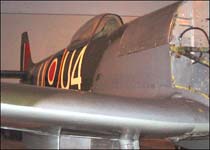 A late model SpitfireThe Spitfire in The Potteries Museum & Art Gallery is a Mk XVI. A late model Spitfire (commissioned in 1945) it has a copy of a Rolls Royce Merlin engine built by Ford [Packard] under licence. It flew in the European theatre, but never saw action. Number 4 squadron is reconnaissance. It had two flying accidents in 1945. It was converted to a Mk IX for a show, then back to a Mk XVI. It was a Gate Guardian at Bicester near Oxford before being handed over to the city in 1969. It was originally housed in a glass house opposite Hanley Library, but moved in 1986 when it was found to be suffering from metal fatigue. It is now housed in The Potteries Museum, Hanley, and is under going restoration from Supermarine Engineering in Burslem. The Spitfire, along with other artefacts, can be viewed on the museum website. Ian Shaw (City Museum)******** What do you think about RJ Mitchell?If you've got something to say about any local heroes, add to the message board by clicking on the link below. Thanks for your comments on this subject. Here are just a few of them A Great Man Grave Memorial R J Mitchell It is indeed tragic that 'R J', who died on 11th June 1937 from bowel cancer, a very unpleasant illness even today, has NEVER been properly honoured by his country, and it is poignant that Leo Blair, P M Tony's youngest son, was, like myself, born on the same day as 'R J', May 20th! I commend Dr Gordon Mitchell's book 'From Schooldays to Spitfire' to anyone who reads this; I reviewed the book on 'Amazon' some time ago under the nom-de-plume MikeMarkNine (appropriate?), and I was privileged to meet Dr Gordon at the unveiling of the 3/4 scale Spitfire at Eastleigh (Southampton) airport two years ago today. Mitchell's home in Southampton Supermarine Spitfire The first of the Few - - Mitchell The First of the Few - - Mitchell The film was shown today! They don't make them like that nowadays though... They did not dwell on his illness. Simply that he died from overwork. R J Mitchell R.J.Mitchell & Spitfire SEE EVEN MORE POSTS BY CLICKING ON THE LINK IN THE TOP RIGHT HAND CORNER OF THIS PAGE last updated: 09/12/2008 at 19:21 SEE ALSOYou are in: Stoke & Staffordshire > History > Local Heroes > Reginald (RJ) Mitchell |
| | About the BBC | Help | Terms of Use | Privacy & Cookies Policy |