US partially evacuates Beirut embassy amid rising Iran tensions

 EPA
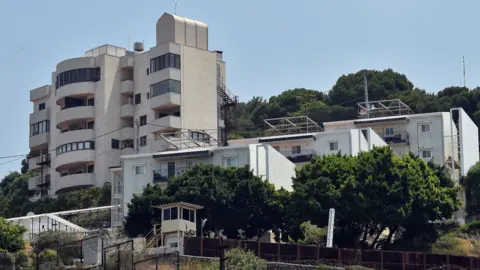
EPAThe US government has ordered all non-essential staff to leave its embassy in the Lebanese capital of Beirut after a security review, a senior State Department official has told the BBC.
The decision comes as there are heightened tensions in the region, with US President Donald Trump threatening military action against Iran if it does not reach a deal over its nuclear programme.
Iran has previously vowed to retaliate if attacked by the US, with American bases and facilities in the Middle East thought to be possible targets.
Meanwhile, Secretary of State Marco Rubio has delayed a planned trip to Israel without announcing a reason.
A senior State Department official said: "We continuously assess the security environment, and based on our latest review, we determined it prudent to reduce our footprint to essential personnel.
"The embassy remains operational with core staff in place. This is a temporary measure intended to ensure the safety of our personnel while maintaining our ability to operate and assist US citizens."
About 50 members of US embassy staff have been ordered to leave, with 32 staff members and their families flying out of Beirut airport on Monday, an airport official told Reuters news agency.
A precise reason has not been given for the partial evacuation, but it comes after Trump said "bad things" would happen if Iran did not reach an agreement over its nuclear programme.
The rhetoric has sparked fears of possible retaliation from Tehran, with Iran's Supreme Leader, Ayatollah Ali Khamenei, posting messages to social media threatening US forces.
Washington holds the Lebanon-based group Hezbollah, which is backed by Iran, responsible for the deadly bombings of a US Marine barracks and the embassy in Beirut in 1983.
On Thursday, Trump said the world would find out "over the next, probably, 10 days" whether a deal would be reached or whether the US would attack Iran.
The US and its European allies suspect that Iran is moving towards the development of a nuclear weapon, something Iran has always denied.
US and Iranian officials said progress had been made after talks between the two sides in Switzerland last week.
Despite this, the US has continued to bolster its huge military deployment near Iran, which includes an array of destroyers, combat ships and fighter jets.
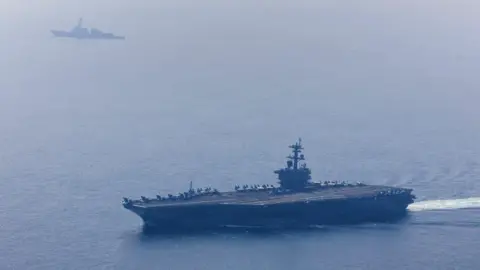
The world's largest warship, the USS Gerald R Ford, also appears to be heading towards the region.
BBC Verify has previously identified the nuclear-powered aircraft carrier USS Abraham Lincoln in satellite images taken off the coast of Oman, about 700km (430 miles) from Iran.
 Reuters
US special envoy Steve Witkoff told Fox News on Sunday that Trump was "curious" about why Iran had not yet "capitulated" in the face of the military buildup.
The president has previously said he was considering a limited strike on Iran in order to pressure its leaders to agree to a deal.
His apparent 10-day deadline would expire at the end of this week, but it is unclear exactly what would happen after that - or if he could choose to launch an attack sooner.
One day before the US and Israel's military strikes on Iran last year, the White House said Trump would decide whether to attack "within the next two weeks".
Tehran responded to those strikes by launching missiles at a US military base in Qatar last June.
Iran's Foreign Minister Abbas Araghchi said on Sunday that he believed there was still a chance the dispute could be resolved diplomatically "based on a win-win game". He told CBS News that negotiators were working on the elements of a deal.
Within Iran, anti-government protests were staged at several universities over the weekend - the first rallies on such a scale since January's deadly crackdown by the authorities, which saw thousands killed.
Trump has previously expressed support for protesters, and earlier in February he said regime change in Iran would be "the best thing that could happen".
Meanwhile, Secretary of State Marco Rubio's planned trip to Israel appears to have been delayed, with the schedule "subject to change", according to a State Department official.
Last week, officials said he would fly to Israel on Saturday to meet with Prime Minister Benjamin Netanyahu. Israeli media now reports the trip has been postponed until next Monday, but the State Department has not confirmed this.
The official said Rubio was "still planning to travel to Israel" but did not say when.
On Monday, Netanyahu said that Israel was facing "complex and challenging days" amid the US-Iran standoff. "We are keeping our eyes open and are prepared for any scenario," he told the Israeli parliament.
He added that if Iran decided to attack Israel, it would respond "with a force they cannot even imagine".
