Trump curious why Iran has not 'capitulated', US envoy Witkoff says

 Reuters
US President Donald Trump is questioning why Iran has not yet "capitulated" in the face of Washington's military build-up in the Middle East, the US president's special envoy has said.
Steve Witkoff told Fox News on Saturday that Trump was "curious" about Iran's position after he had warned of a limited military strike if a deal could not be reached on Tehran's nuclear programme.
The US and its European allies suspect Iran of moving towards making a nuclear weapon, which it denies.
Within Iran, anti-government protests were staged at several universities over the weekend - the first rallies on such a scale since January's deadly crackdown by the authorities, which saw thousands killed.
In his Fox interview, Witkoff said: "I don't want to use the word 'frustrated'... because he [Trump] understands he's got plenty of alternatives, but he's curious as to why they haven't... I don't want to use the word 'capitulated', but why they haven't capitulated.
"Why, under this sort of pressure, with the amount of sea power and naval power that we have over there, why haven't they come to us and said, 'We profess that we don't want a weapon, so here's what we're prepared to do?'"
The envoy added: "And yet it's hard to sort of get them to that place."
 Getty Images
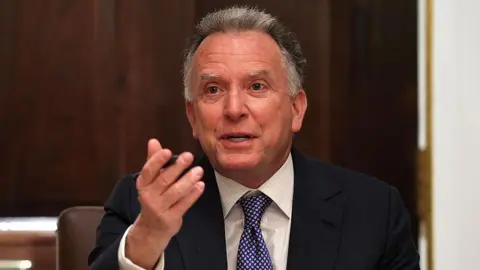
Iran's Foreign Minister Abbas Araghchi said on Sunday that he believed there was still a chance the dispute could be solved diplomatically "based on a win-win game". He told CBS News negotiators were working on the elements of a deal.
In separate comments two days ago, Araghchi said Tehran was preparing "a draft of a possible agreement" and would hand it over to Witkoff in the next few days.
US and Iranian officials discussed Iran's nuclear programme at indirect talks in Geneva in Switzerland on 17 February. They said afterwards that progress had been made.
Oman - which mediated the talks - announced on Sunday that the next round of negotiations was now "set for Geneva this Thursday".
Omani Foreign Minister Badr Albusaidi also expressed hopes that there would be "a positive push to go the extra mile towards finalising the deal" in a post on X.
The US and Iran have not commented.
Despite the reported progress in Geneva, Trump said on Thursday that the world would find out "over the next, probably, 10 days" whether a deal with Iran would be reached or the US would take military action.
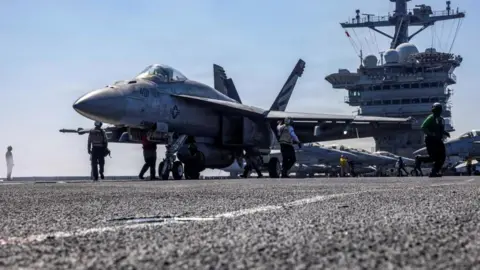
In recent weeks, the US has been building up its military presence near Iran and in the wider Middle East region.
The deployment includes the world's largest warship, USS Gerald R Ford, appearing to be heading towards the region.
USS Abraham Lincoln aircraft carrier has also been deployed, along with destroyers, combat ships and fighter jets.
In Iran, the BBC has verified footage of demonstrators marching on the campus of the Sharif University of Technology in the capital Tehran on Saturday. They were later seen scuffling with government supporters.
Protests were also reported at other universities in Tehran and elsewhere.
Iranian media reported demonstrations also took place on Sunday at the Iran University of Science and Technology and the Khajeh Nasir Toosi University in Tehran, and at Ferdowsi University of Mashhad in north-eastern Iran.
In one video the BBC has verified, anti-government protesters raise the Lion and Sun flag - a symbol of Iran before the 1979 Islamic revolution - at the Sharif University. People in the crowd can be heard chanting "Javid Shah" ("long live the king").
Another verified video shows a pro-government crowd holding a counter-protest at the Sharif University in which US and Israeli flags are being burned.
Clashes between pro- and anti-government crowds are also seen in verified footage filmed at Amirkabir University of Technology.
Students from different universities have been gathering to honour thousands of those killed by authorities last month.
The US-based Human Rights Activists News Agency (Hrana) said it had confirmed the killing of at least 7,015 people during that wave, including 6,508 protesters, 226 children and 214 people affiliated with the government. The latest figures were updated on 15 February.
Hrana also said it was investigating 11,744 more reported deaths.
Iranian authorities said late last month that more than 3,100 people had been killed - but that the majority were security personnel or bystanders attacked by "rioters".
Trump has supported protesters in the past - at one stage appearing to encourage them with a promise that "help is on its way".
Additional reporting by BBC Verify's Emma Pengelly, Shayan Sardarizadeh and Richard Irvine-Brown

Follow the twists and turns of Trump's second term with North America correspondent Anthony Zurcher's weekly US Politics Unspun newsletter. Readers in the UK can sign up here. Those outside the UK can sign up here.
