Carney heading on overseas trade mission as Canada seeks to reduce its reliance on US

 Getty Images
Prime Minister Mark Carney is travelling to India, Australia and Japan this week in his latest effort to cultivate trade ties as he seeks to wean Canada off its economic dependency on the US.
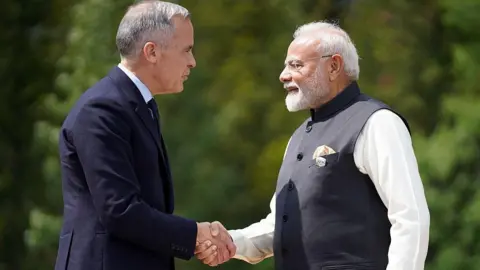
Carney will begin the trip in India on Thursday, his office said, meeting Prime Minister Narendra Modi.
He will then travel to Australia to meet Prime Minister Anthony Albanese and address Australia's parliament - the first such speech by a Canadian PM in nearly 20 years. The trip will end in Tokyo, where Carney will meet Japanese Prime Minister Sanae Takaichi.
It is the latest in a string of global trips by Carney in recent months amid trade tensions between Canada and the US.
It also marks a significant shift in Canada-India ties, which deteriorated after former Prime Minister Justin Trudeau accused New Delhi of killing a Sikh separatist on Canadian soil in 2023.
Carney has since sought to mend the relationship by inviting Modi to last year's G7 summit in Kananaskis, Alberta, where the two met on the sidelines.
Canada's foreign minister, Anita Anand, also took a trip to India late last year, where she met Modi and her counterpart S Jaishankar. After that meeting, the two countries agreed to kickstart talks on trade.
Carney's office said the forthcoming trip would also focus on energy, AI, defence, critical minerals, maritime security and food security.
Carney has repeatedly stated his objective of doubling Canada's non-US exports by the next decade, in response to ongoing US tariffs imposed by President Donald Trumpon key Canadian sectors like metals and cars.
The US is by far Canada's largest customer, making up about 75% of Canadian exports.
"In a more uncertain world, Canada is focused on what we can control," Carney said in a statement on Monday. "We are diversifying our trade and attracting massive new investment to create new opportunities for our workers and businesses."
Earlier this year, Carney broke from US trade policy by removing tariffs on Chinese electric vehicles, in exchange for China lowering retaliatory tariffs on Canadian agricultural products.
He also made global headlines for his speech in Davos, Switzerland, at the World Economic Forum, calling on countries to reject economic "coercion" by "great powers" - widely interpreted as a dig at Trump.
Canada's trade posture with the US remains uncertain after the US Supreme Court struck down Trump's sweeping tariffs on Friday.
Canadian officials noted the decision did not affect sector-specific tariffs on steel, aluminium and cars, which remain in place.
Separately, the two countries, along with Mexico, are renegotiating a North American free trade agreement, the USMCA.
This summer, all three partners must decide whether to extend the deal, which was struck during Trump's first term.
Both Canada and Mexico have said they want to keep the pact.
The Trump administration, however, has been less enthusiastic, and officials have suggested Washington would prefer separate bilateral deals.
