US build-up of warships and fighter jets tracked near Iran

 David Parody
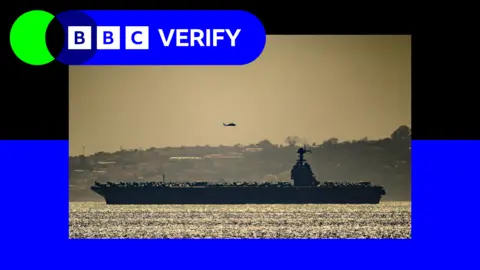
The world's largest warship appears to be heading towards the Middle East as Washington continues to pressure Iran over its military program and recent deadly crackdown on protesters.
BBC Verify confirmed the USS Gerald R Ford passed through the Strait of Gibraltar towards the Mediterranean on Friday. Verified photographs taken from land in Gibraltar show the aircraft carrier in the Strait with a Moroccan mountain range in the distance.
Ship-tracking data also confirmed the USS Mahan, one of the destroyers in the warship's strike group, passed through the Strait. The Gerald R Ford had briefly broadcast its location off Morocco's Atlantic coast on Wednesday and is believed to be travelling to the Middle East where another US aircraft carrier, the USS Abraham Lincoln, was tracked earlier this week.
US and Iranian officials met for a second round of talks in Switzerland earlier this week, where progress was reported to have been made. President Donald Trump said on Thursday the world will likely find out within the next 10 days whether the US will reach a deal with Iran or take military action.
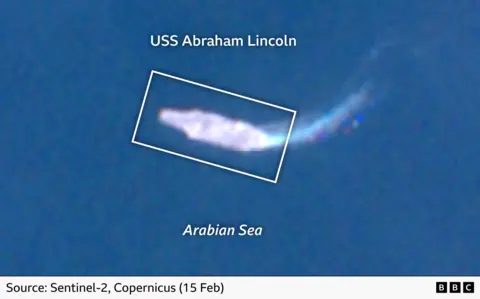
On Monday, BBC Verify identified the Abraham Lincoln in satellite images taken on Saturday off the coast of Oman, about 700km (430 miles) from Iran.
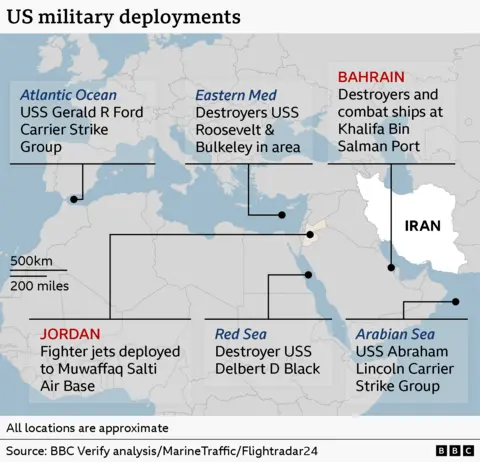
The arrival of two of the 11 aircraft carriers operated by the US Navy adds to what we know about the military build-up in the Middle East over the past few weeks, where BBC Verify has tracked an increase of destroyers, combat ships and fighter jets.
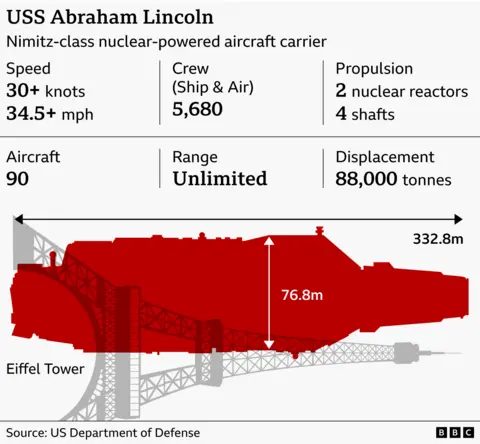
Both Gerald R Ford and Abraham Lincoln lead strike groups with several guided missile destroyer warships. They are operated by more than 5,600 crew and carry dozens of aircraft.
What military assets has the US moved into the Middle East?
USS Gerald R Ford switched on ship-tracking automatic identification system (AIS) for the first time this year at 12:30 GMT on Wednesday. The carrier transmitted its location, visible on ship-tracking website MarineTraffic, until 13:18 and was sailing in the direction of the Mediterranean.
However, a transport aircraft attached to the carrier that landed in Spain that day was tracked at about 13:00 on Thursday heading towards the area where the aircraft carrier was spotted.
It came after the Abraham Lincoln was identified in the Arabian Sea, around 240km (150 miles) off the coast of Oman, in publicly available images captured on Saturday by the European Sentinel-2 satellites.
The warship had not been seen since it reportedly entered the region in January, though it had been crossing the open sea where satellite coverage is limited. Military assets on land are more visible and frequently captured on satellite.
BBC Verify has now tracked 12 US ships in the Middle East. The Abraham Lincoln, a nuclear-powered Nimitz-class carrier, together with three Arleigh Burke-class destroyers forms a carrier strike group, plus two destroyers capable of carrying out long-range missile strikes and three specialist ships for combat near to the shore that are currently positioned at Bahrain naval station in the Gulf.
Two other destroyers have been seen in the eastern Mediterranean near the Souda Bay US base, and one more in the Red Sea.
We have also been following the movements of large numbers of US aircraft to both European and Middle Eastern airbases, including:
- F-35 and F-22 fighter jets
- KC-135 and KC-46 refuelling tankers used to support the long-range movement of other aircraft
- E-3 Sentry command and surveillance aircraft designed to coordinate large-scale operations
- C-17A heavy-lift military transport aircraft used for delivering troops and cargo
- Navy P-8A patrol and reconnaissance jets used for long-range anti-submarine warfare
- C-5M strategic transport aircraft, the largest in the US Air Force, used for personnel and cargo
How has Iran responded?
In response to recent US military movements, Iran has carried out its own show of force.
On Monday the Islamic Revolutionary Guard Corps (IRGC) launched a maritime drill in the Strait of Hormuz, located in the Gulf between Oman and Iran. The exercise saw IRGC Commander‑in‑Chief Maj Gen Mohammad Pakpour inspecting naval vessels at a harbour before missiles are seen launching from a ship, the IRGC-linked Tasnim News Agency reported.
The Strait is considered one of the world's most important shipping routes and a vital oil transit choke point. Around a fifth of the world's oil and gas flows through the Strait, including from Kharg Island, Iran's main oil export terminal. Pakpour was seen flying over the island in a helicopter in the report showing Iran's latest military manoeuvres.
Footage broadcast by Iranian state TV on Thursday also showed planned naval drills in the Gulf of Oman with Russia, which involved a simulated ship rescue operation.
Fars news agency, which is affiliated with the IRGC, claimed that operational units from "both Iran's regular army's navy and the IRGC navy" took part.
How does it compare with Venezuela and Operation Midnight Hammer?
Military intelligence expert Justin Crump told BBC Verify that the current US military preparations in the Middle East show "more depth and sustainability" than its manoeuvres ahead of the seizure of former Venezuelan president Nicolás Maduro in January, or the operation carrying out air strikes on Iran's nuclear facilities last June.
They all feature a carrier strike group and several destroyers operating independently. However, the US deployed its assets in Venezuela and Iran last year under quite different circumstances.
The US deployed the Gerald R Ford to the Caribbean ahead of its strikes on Venezuela, one of eight warships we tracked in the region at the time, though it used fewer aircraft as it could easily send jets from surrounding US bases on America's mainland or from its base in Puerto Rico instead.
The US also deployed amphibious assault ships within the Caribbean, which can be used as launch platforms for helicopter operations as was seen with the capture of Maduro. But Venezuela's military is generally seen as less capable of defending itself or retaliating against the US.
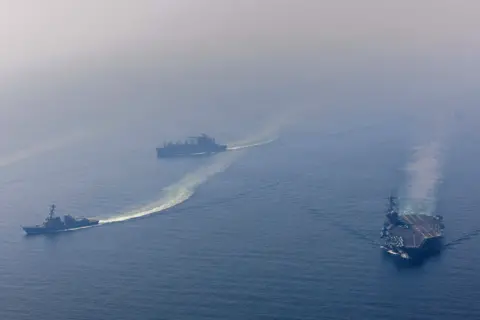 Reuters
When the US struck Iran last year in Operation Midnight Hammer, which targeted Iran's nuclear facilities, it was attacking a country with a much more powerful military than Venezuela. Iran's military is capable of hitting US bases across the Middle East.
The recent build-up in the region more closely resembles that seen during Operation Midnight Hammer. The US had two aircraft carrier strike groups in the region, five destroyers placed in the Mediterranean and Red Seas, and three combat ships in the Gulf.
It had also moved squadrons of fighter jets and refuelling aircraft from the US to Europe. But the B2 stealth bomber flights that were used to hit the Fordo, Isfahan and Natanz nuclear sites actually took off from US bases in Missouri.
Crump, chief executive of risk and intelligence company Sibylline, said the build-up of US warships and aircraft, as well as eight existing airbases in the region would allow it to conduct a "fairly intensive and sustained strike rate" of about 800 sorties a day, with the aim of rendering any Iranian responses "ineffective".
"What we are seeing isn't just strike preparation, but rather a broader deterrent deployment capable of being scaled up or down," he said. "This means it has more depth and sustainability than the force packages arranged for either Venezuela or Midnight Hammer last year. It's designed to sustain an engagement and counter all potential responses against US assets in the region and, of course, Israel."
Additional reporting by Barbara Metzler, Ghoncheh Habibiazad, Thomas Copeland, Yi Ma
