Your NHS: A day with a specialist paramedic

 BBC
BBCMy day in the company of one of South Central Ambulance Service's (SCAS) specialist paramedics has got off to a flying start.
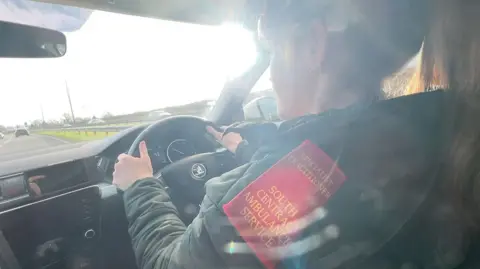
I'm conscious that I keep asking Chrissy Ames to repeat herself - not because she is being unclear, but because I am utterly distracted by my first blue light journey through rush-hour traffic.
While driving through red lights, Chrissy is calmly explaining to me why she has been called to this "category 3" incident in her liveried estate car, rather than a regular ambulance.
The patient is a woman in her 70s who called 111 in the early hours of the morning when the pain in her back became unbearable.
Normally physically well, she was unable to get out of bed at her home in Bicester.
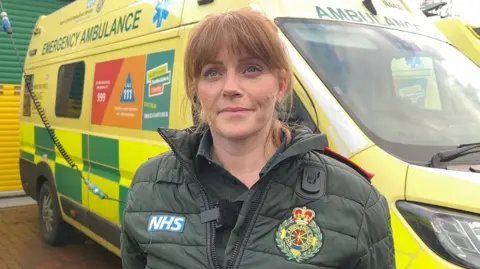
Chrissy has enhanced clinical skills, meaning she can prescribe drugs, stitch wounds and refer patients on to specialist services.
It is roles like this that mean SCAS can proudly claim more than 50% of people who get an ambulance response are not then taken to A&E or another healthcare setting.
Chrissy knelt beside the patient's bed and tried to understand all she could about her complicated health situation.
They discussed historical falls, family history, current and past medication, and all the other conditions and illnesses that could possibly be a factor in the pain.
"I was able to go in, assess, make sure there weren't any red flag symptoms... get her pain under control," Chrissy said.
"Then I was able to have a really good discussion with her GP and get her an appointment to see a specialist physio later in the morning."
By the time we left, a couple of hours later, the woman was a very satisfied customer, smiling and joking.
"She's absolutely amazing," she said of Chrissy. "She knows her stuff. She's really good at everything."
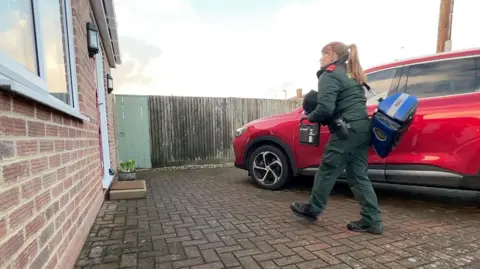
The day's second patient, who was almost 90 and lived at a nursing home in Kidlington, had fallen that morning and cut his eyebrow very badly.
An ambulance crew had attended earlier and concluded the situation was not life-threatening and a specialist paramedic could deal with the injury.
But Chrissy was faced with an additional challenge - the man had severe dementia, was quickly confused, and could not tolerate someone touching him for more than a few seconds.
He was never violent, but would verbally make his displeasure known and try to push her away.
The patient ideally needed stitches, but Chrissy concluded that wielding a needle near his eye was a bad idea for both of them.
But she was able to patiently clean the wound and pin the skin back into place using stickers and glue.
"It's really disorientating for dementia patients to take them out of their home environment," Chrissy said.
"So if we can help them in their own home, they've got a better chance of healing and not having any additional issues."
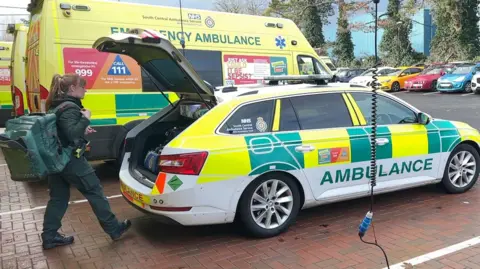
The third and final patient of the day was the most straightforward - a man in Didcot with Parkinson's disease had fallen at home and cut his head.
I was stuck by Chrissy's concern for each patient's next step. This was never about just fixing a problem and moving-on.
GP's were updated with the help of photographic evidence and charts from a cardiogram. Next of kin were appraised and armed with helpful advice.
Chrissy told me she's always "dotting I's, crossing T's and making sure that the patient is not only looked after in that immediate moment, but also making sure that they have onward care in place".
"It's imperative that patients are really aware that [emergency care] is not just about accident and emergency," she said.
"Even in crises and urgent care or accidents and illnesses - even if an ambulance is called, we have so many options available to us, particularly here in the Oxfordshire area.
"I think after 18 years in this career... I love it. I still am really passionate about what I do.
"I love the people that I get to meet every day and there is a really strong sense of satisfaction when I've had a really good day."
You can follow BBC Oxfordshire on Facebook, X (Twitter), or Instagram.
