What were Scotland's top archaeological finds in 2025?

 Crown Copyright
Evidence of feasting in the Hebrides 5,000 years ago and the discovery of a lost medieval settlement in the Borders have been listed among Scotland's biggest finds of 2025.
The Dig It! project also includes a Dumfriesshire hillfort possibly besieged by the Romans, and the remains of a Bronze Age site in Shetland used for heating up water.
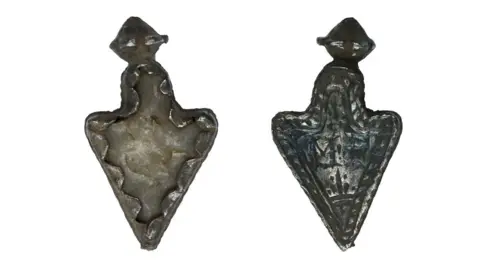
The strangest artefact on the list is a silver charm unearthed on the Black Isle and once used to protect a person and their animals against elfshot - tiny arrows fired by elves.
Science later revealed elfshot to be prehistoric flint arrowheads.
The project was co-ordinated by the 240-year-old Society of Antiquaries of Scotland.
Society director Dr Simon Gilmour said: "This year's top discoveries collated by our Dig It! project bring to light human stories from Scotland's past across five millennia; from cuisine and conflict to past beliefs and world views."
Neolithic feasts in the Hebrides
 Richard Law
 AOC Archaeology Group
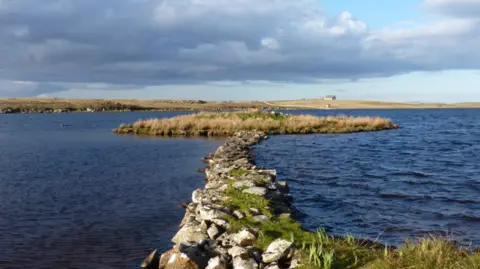
Several clues of Neolithic people gathering for feasts were uncovered by Daniel Brown, a PhD researcher at the University of Bristol, in the Western Isles.
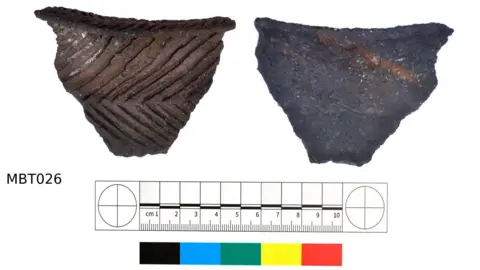
He examined pots recovered from sites of crannogs - homes built on artificial islands on lochs.
The style and decoration of some of the pots did not changed for about 800 years, which Mr Brown suggested meant there was "something symbolic" about the designs.
Analysis also revealed traces of meat, rather than more commonly found dairy products, and high amounts of fish - a rare food in Neolithic times.
 Daniel Brown
Mysterious 'burnt mounds' in Shetland
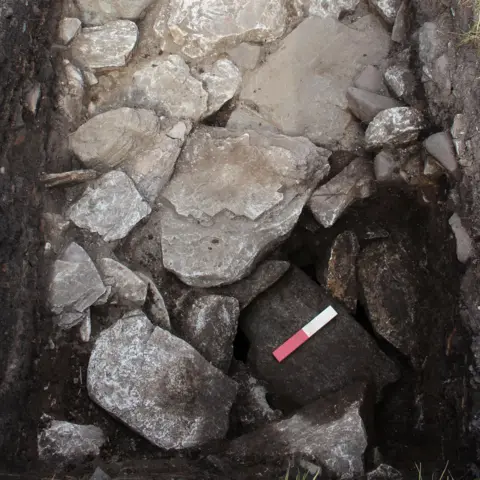
In Shetland, volunteers led by Archaeology Scotland and Scape Trust excavated a Bronze Age site at Gletness near Nesting.
They found a complex burnt mound and what might be the remains of a well.
Burnt mounds are thought to be the by-product of a method of heating water by dropping hot stones into a water-filled trough.
The archaeological evidence of these mounds include piles of ash, charcoal and fire-damaged stones.
Complex burnt mounds are stone structures that have small rooms inside them.
Dig It! said the reason why people were heating water in this way remained a mystery, but theories include beer-making or saunas.
 Scape Trust
Roman invasion in Dumfriesshire
Meanwhile, archaeologists suggest a fort on Burnswark Hill in Dumfriesshire was besieged by an invading Roman force about 1,900 years ago.
Survey work by a team from the University of Glasgow, Trimontium Trust and University of Manchester found the site was more densely occupied during the time of the Roman invasion than previously thought.
They believe this made the fort a prime target for a Roman army.
Subsequent excavations also revealed traces of a major phase of rampart construction or re-modelling.
This has been interpreted as the hillfort's inhabitants having survived or returned after a siege and beginning to rebuild.
The University of Glasgow's Dr James O'Driscoll said: "These findings offer a rare glimpse into how Iron Age communities in Scotland built, defended, and re-imagined their world in response to Roman power.
"It's a story of resilience, identity, and survival that challenges long-held assumptions about Scotland's past."
Lost medieval village in the Borders
 AOC Archaeology Group
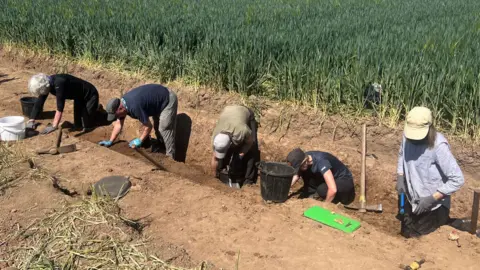
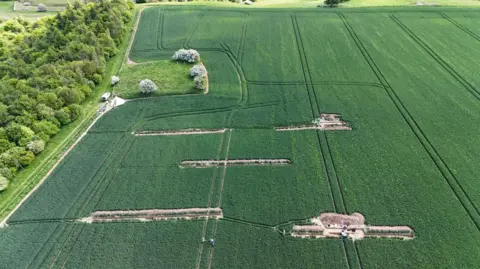
A lost medieval village was excavated at Horndean as part of the Uncovering the Tweed project.
The area had long been suspected to be the location of a settlement.
AOC Archaeology worked with volunteers to unearth animals bones and pottery produced roughly around the 12th Century.
The settlement's location adjacent to a ruined medieval church has led experts to believe that the community was associated with or working for the church, perhaps by providing food.
Archaeologists said it was rare to find lowland rural settlements from this period as the sites were often heavily damaged by later ploughing.
Uncovering the Tweed's archaeologist Cathy MacIver said: "It is really exciting for our team of volunteers to have identified new evidence for a buried medieval site at Horndean.
"The unusually well-preserved animal bone in particular is going to shed new light on the diet and daily life of this medieval community living on the Tweed."
Protection from elves?
The Treasure Trove Unit (TTU) confirmed the discovery of an elfshot amulet in April.
Uncovered near Fortrose by metal detectorist Lawrence Deans, the artefact contains a Bronze Age flint arrowhead which had been found by someone in the 17th or 18th Century and mounted in a silver pendant as a charm.
In the past, people believed small, prehistoric arrowheads they found in fields were the weapons of elves and fairies and fired at cattle, horses and even humans to cause them harm.
TTU said some people believed that turning elfshot into a charm could heal injuries and protect against being attacked again.
The amulet is to go on display at Groam House Museum in Rosemarkie next year.
Dr George Prew-Stell, treasure trove officer at National Museums Scotland, said: "This is a wonderful example of people in the past finding and reusing objects made by communities who lived on the same land millennia earlier.
"This artefact provides a rare, tangible example of two of the most wonderful things about studying historic communities: folklore, and people interacting with their own past."
