Soldier died on training exercise after rifle fired

 BBC
BBCA "well-respected" soldier died of a "catastrophic" head injury when a round was fired as he was waiting on a "cold dark" evening to go on a sniper firing range in the Scottish Highlands, an inquest has heard.
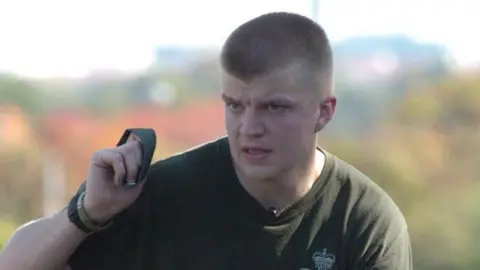
L/Cpl Joe Spencer, 24, from Hampshire, was killed on 1 November 2016 when his gun fired unexpectedly during sniper training in the Scottish Highlands.
Coroner Jason Pegg said that the inquest in Winchester had been "substantially delayed" because it followed investigations by Police Scotland and the Sheriffdom of Grampian, Highland and Islands at Tain.
He confirmed that L/Cpl Spencer died of a gunshot wound to the head.
Pegg said: "The gunshot was sustained on a range where soldiers fire their weapons in Scotland, a place called Tain Air Weapons Range."
He added: "Joe was with some colleagues waiting to be called on to the firing point on the range - the firing point is where they were going to stand or lie to fire their weapons on to the target.
"Before going on to the range, they were standing in an Iso container, a metal container used as a shipping container.
"It was a November evening in Scotland, it was dark, it was cold and you will hear while Joe was in the Iso container a round was discharged from a rifle and that round struck Joe in the head causing a catastrophic head injury."
He said the jury would need to consider whose rifle was fired, where it was, why the round was discharged and "why was a round in the chamber when Joe was waiting to go on the firing range?"
Pegg also said the jury would need to consider what position the safety catch was in, and "how did the firing pin come to strike the cartridge, causing that bullet to be discharged? Was the trigger pulled, was the rifle knocked, or was it something else?"
The coroner told the jury that they would be shown an example of a L115A3 sniper rifle which fired the fatal round.
He said: "You are going to see a very important exhibit, a sniper rifle, because it's a very important part of this case, we are going to see how it's operated and how it's made safe."
Pegg said that a post-mortem examination found that L/Cpl Spencer suffered an entry wound to the "midline of the chin" which caused a "catastrophic injury" and the cause of death was a gunshot wound to the head.
'Very capable soldier'
The youngest of three brothers and originally from Hampshire, L/Cpl Spencer joined the British Army in 2011, and became a member of 3rd Battalion The Rifles.
He was deployed abroad on a number of occasions, including on operations in Afghanistan where he was seriously wounded in a grenade attack.
Pegg said: "He joined the Army in 2011. He was just 18 when he joined the Army, something he had wanted to do since he was a young boy.
"Having joined the Army he excelled in his training phase, he was awarded the best recruit, he was a very capable young man and a very capable soldier."
Mr Pegg said that after 18 months of care following the Afghanistan incident, L/Cpl Spencer returned to operational duties and was promoted to the rank of Lance Corporal in May 2015 and the following month he bought a home with his partner.
He said: "He was a young man doing well in the Army, he was doing well in his personal life."
Sheriff Gary Aitken said in the determination of a fatal accident inquiry released in December 2024, that the training course was being delivered in three phases at ranges at Barry Buddon near Dundee, Tain in the Highlands, and Otterburn in Northumberland.
The sheriff found that L/Cpl Spencer was standing waiting for his turn to take part in an exercise, with the butt of his rifle resting on his foot and his chin resting on the barrel, when it went off.
He ruled the incident was partly due to L/Cpl Spencer's "utterly inexplicable failure" to properly unload his rifle following a live fire exercise earlier in the day.
The sheriff added that his death could have been avoided if he had not been "holding his rifle vertically in close proximity to his body during the undemanded discharge".
Sheriff Aitken also pointed to failures in the way the training course had been delivered, saying that if the "correct words of command to carry out the unload drill" had been given, the incident could have been avoided.
The inquest is expected to last two weeks.
You can follow BBC Hampshire & Isle of Wight on Facebook, X, or Instagram.
