Is whisky tourism on the rocks?

 Loch Lomond Group
It's not just whisky that's exported from Scotland. It's also the experience, sold to tourists at numerous distillery visitor centres around the country.
While the industry has poured more than £300m of investment into whisky tourism in only a decade, some of that investment is already on the rocks.
This is not a small part of the industry. Whisky tourism is thought to have more than 1,100 jobs across the country - a tenth of those directly employed in the sector.
In recent years, there have been more than two million visits annually, with the spend reaching more than £84m.
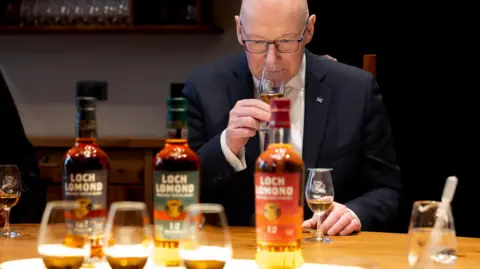
Expectations of it remain high. On Monday, First Minister John Swinney opened a new distillery and visitor centre at Luss on Loch Lomond-side, which aims to attract more than a million visitors a year in a village that's already a visitor honeypot.
However, Diageo, the biggest distiller of Scotch and biggest global distiller of spirits, has announced it is closing one of the four visitor centres expanded in recent years as "brand pillars" or the 'four corners of Scotland' for Johnnie Walker.
 Getty Images
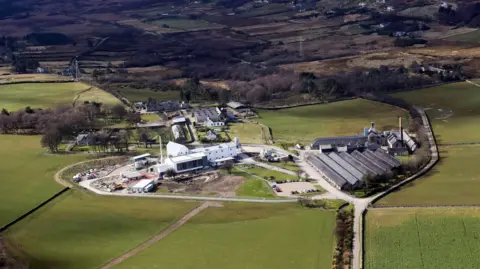
The building beside Clynelish distillery near Brora, Sutherland, has had disappointing visitor numbers, and has also struggled to find the staff required - a problem across the most rural parts of Scotland where many distilleries operate.
The centre is reported to have cost nearly £5m and opened less than five years ago.
Two other visitor centres which are part of the Johnnie Walker brand promotion are having their opening hours cut from seven to five days a week; Caol Ila on Islay and Glenkinchie near Pencaitland in East Lothian.
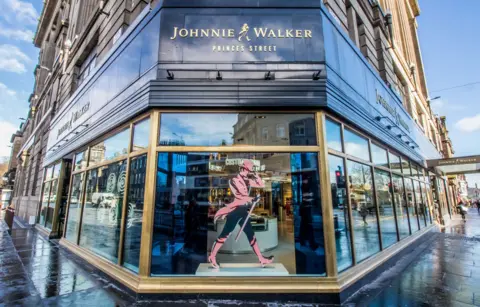
The fourth one, Cardhu on Speyside, is not affected by the changes, and nor is the Johnnie Walker Experience, in a converted department store on Edinburgh's Princes Street. That was the largest element in Diageo's £185m investment in visitor centres linked to its leading brand.
 Getty Images
The cutbacks are not directly affecting production at these distilleries, but come at the same time as the industry has sharply reduced operations.
There is a global downturn in demand, the US market is being slowed up by tariffs with the continuing threat of higher US tariffs on the more valuable single malt end of the market, and there is a shortage of storage space for maturing casks.
Diageo has stopped work at its Roseisle maltings and paused production at the Teaninich distillery in Easter Ross.
Glenmorangie, at Tain in Easter Ross and owned by French luxury goods firm LVMH, has halted production while keeping its visitor centre open.
A recent report in the Financial Times claimed the five biggest spirits distillers are sitting on $22 billion-worth of stocks (£16bn), with some of the worst problems of over-production affecting France's cognac-makers including Remy Cointreau.
Of that, Diageo had $8.6bn (£6.1bn) of inventory by last June, including Scotch and American spirits.
Meanwhile, another distillery in Easter Ross, Glen Wyvis, which claims to be the only community-owned distillery, has secured £500,000 funding from a specialist lender to social enterprises.
That follows what it acknowledges have been "significant challenges" in recent years including a well-publicised row with its founder and landlord.
Founded in 2016, it needs new funding to sustain it until it can release casks for sale that have been maturing for at least ten years.
The industry has been helped by the reduction in Chinese tariffs, announced last week while Prime Minister Sir Keir Starmer was visiting the country.
The tax on imported Scotch is being cut, as of Monday, from 10% to 5%. That is expected to boost sales by £250m over five years.
In the most recent figures, China was the tenth biggest importer of Scotch.
 Edradour Distillery
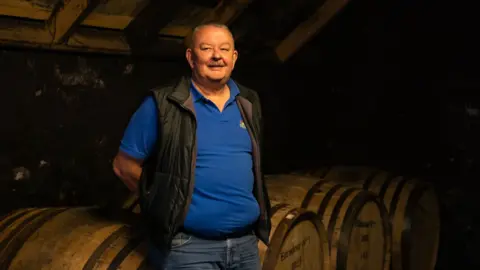
Andrew Symington, owner of Edradour Distillery in Pitlochry told Radio Scotland Breakfast that the cut in Chinese tariffs is "welcome and good", but giving a boost of £50m a year "is not really a lot of money" in the context of international markets.
He said the problem in China's market is at the super-premium end of the market, where there has been a crackdown on corruption through a tight cap on the value of items in corporate gifting.
Symington added: "What's most annoying and irritating is that our government is pleading with foreign leaders to cut taxes and not to sanction Scotch whisky, and on the other hand in their home market, they're adding excise duty, which is killing the industry in their own country."
 Getty Images
Distillers have complained that they continue to face high alcohol duty on their UK sales, rising on Monday by nearly 3.7%, or 39 pence on a typical bottle of Scotch, to £9.51.
They complain that means their prices will have to go up, while costs are also increasing.
That increase may have less effect in Scotland, where the profit margin can be higher, due to the minimum unit price on a typical bottle of Scotch taking its retail cost to at least £18.20.
The duty on a bottle of red wine has gone up by 14 pence. Beer sold in pubs and restaurants is seeing an increase in duty for the first time since 2017.
A spokesman for the Treasury said: "Alcohol duty plays an important role in ensuring public finances remain fair and strong and funds the public services people rely on every day."
